 Rich Martin
AI Medical Chronology: How It Works and What to Check
AI Medical Chronology: How It Works and What to Check
How AI medical chronology software turns PI medical records into a source-linked timeline, where it goes wrong, and eight checks before your firm buys one.

The records came in last week. Six providers, a few hundred pages, no index. Someone at your firm now has to turn that stack into a timeline the adjuster can't pick apart.
An AI medical chronology does most of that assembly for you. This guide shows how the software works, where it goes wrong, and what to check before you trust it with a case.

What Is an AI Medical Chronology?
An AI medical chronology is a date-ordered list of every medical visit in a case, built by software instead of typed by hand. Each row shows the date, the provider, the complaint, the findings, the diagnosis, the treatment and the charge. In a good tool, each row also links to the page it came from.
What changes is how it gets made. A paralegal used to read every page and type the rows. Now the software reads the pages and pulls out the same fields. Your reviewer gets a draft to check, so the job moves from typing to checking.
How Does Medical Chronology Software Work?
Most medical chronology software runs six steps: take in the PDFs, read and sort each page, pull each visit out as data, and link each entry to its page. Then a person reviews the entries. Only after that review should the tool build the chronology and the reports.
Each step is a place where an error can slip in. A good tool shows you its work at every one.
- 1Ingest. Records and bills are uploaded as PDFs, including scanned and faxed pages.
- 2Read. Text is recognized and each page is sorted: ER note, imaging report, therapy note, bill.
- 3Extract. Each visit becomes a structured event: date, provider, findings, diagnosis codes, procedure codes, charges.
- 4Link. Every event keeps a pointer to the file and page it came from.
- 5Review. A paralegal or attorney checks the events and fixes what's wrong.
- 6Generate. The checked events become the chronology, a treatment calendar, a narrative summary and an export for the case file.
Extraction, not summarization
This is the difference that matters most. A tool that summarizes reads a page and writes a paragraph about it. In that rewrite, a date or a dollar figure can drift.
A tool that extracts pulls the date, the code and the amount out as data. The figure in the chronology is the figure on the page. Here's why AI demand letters get numbers wrong when they skip this step.
Source links
Every entry should carry its source: at least the file name and the page. In a negotiation, "where is that in the record?" decides whether a point holds. Without source links, you're checking the whole file again.
Manual, Outsourced or Software: How Chronologies Get Built
Firms build chronologies three ways. Many use more than one, depending on the case.
| In-house paralegal | Outside review service | Medical chronology software | |
|---|---|---|---|
| Who reads the records | Your staff | The vendor's reviewers, sometimes nurses | Software, then your staff check |
| Turnaround | Depends on staff workload | Depends on the vendor's queue | Draft is ready once the records are processed; review time is yours |
| Source references | Only if the paralegal records them | Varies by vendor | Should be on every entry; check before you buy |
| Consistency across cases | Varies by person | Varies by reviewer | Same fields every time |
| Control over the facts | Full | You review a finished product | Full, if you can review and correct every entry |
| Typical pricing | Staff time | Per page, per hour or per report | Per case or subscription |

What a Good Medical Chronology Includes
Whoever builds it, the chronology should capture the same fields from every visit. Hold a vendor's sample output up against this list.
Date of service, provider, facility, visit type
Symptoms, pain scores, history given
Exam findings and imaging impressions, quoted
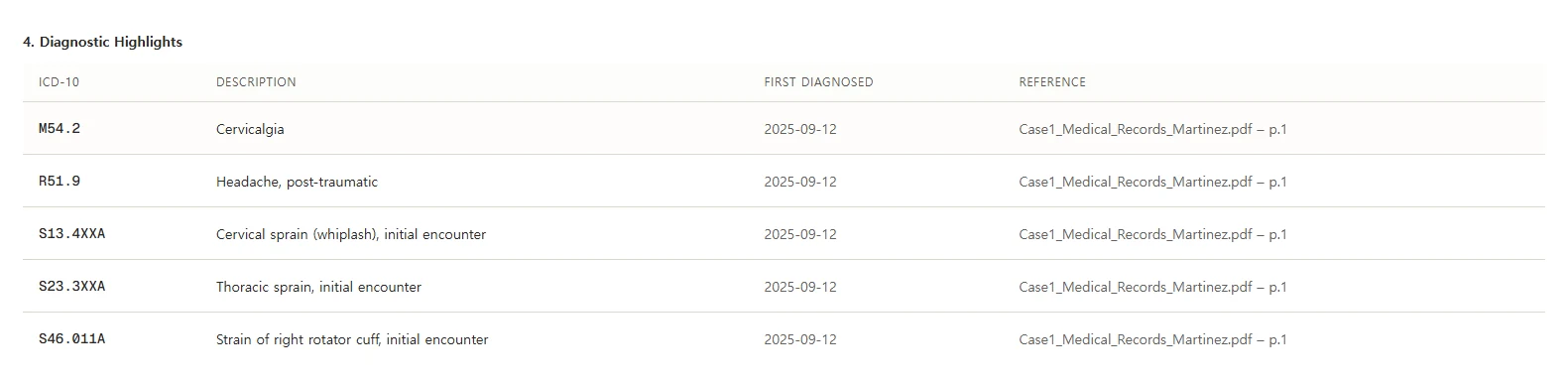
With ICD-10 codes and the date first documented
Procedures with CPT codes, referrals, prescriptions
Billed amount per date of service
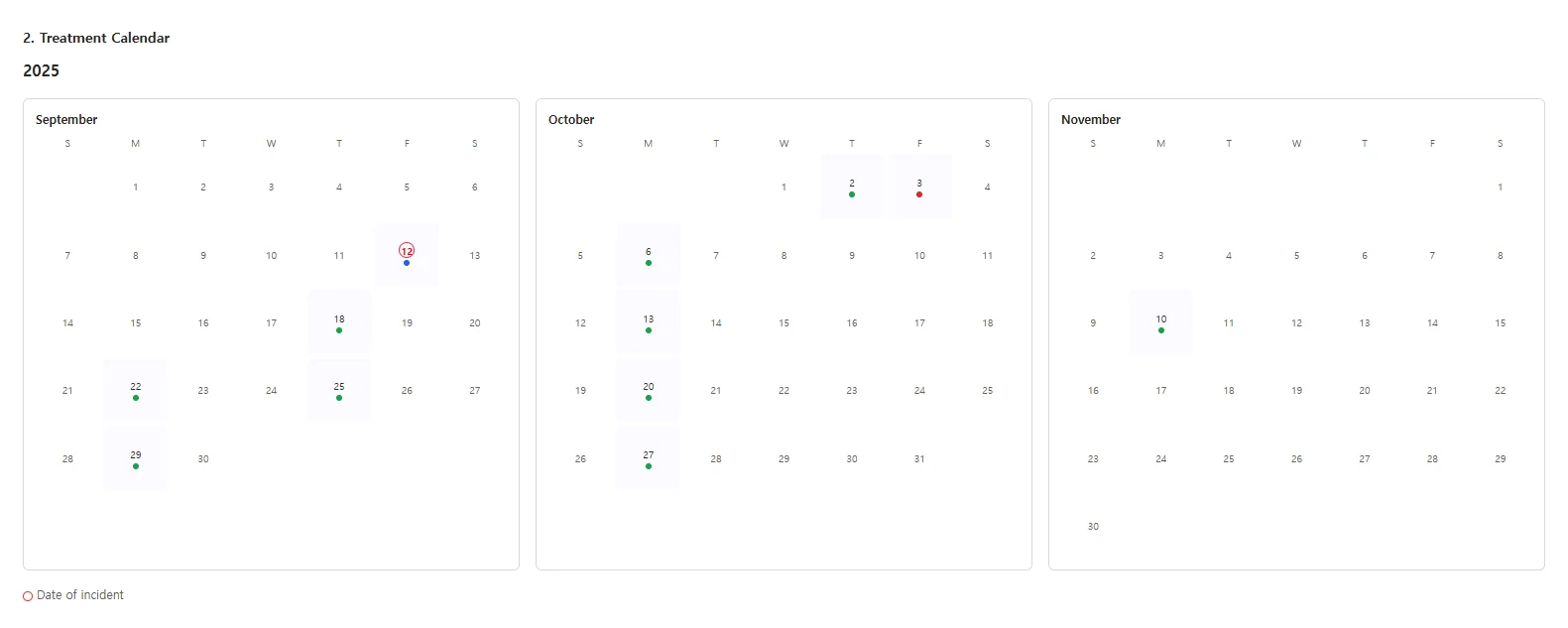
Breaks in treatment, measured and flagged
File and page for every entry

Where Do AI Medical Chronologies Go Wrong?
AI medical chronologies fail in different places than people do. The usual problems are misread dates, duplicate visits, pages from another patient, unrelated treatment, and gaps with no reason. Test for each one on your own records, because a tired paralegal skips pages while software misreads them.
Misread dates
Dates go wrong on handwritten notes and faxed pages. They also go wrong when one page shows several dates: service, signed, printed. Spot-check the first and last visit for each provider.
Duplicate encounters
The same note often arrives twice, once from the clinic and once from the hospital system. Count it twice and you overstate treatment. The adjuster will notice.
Records from the wrong patient
Misfiled pages turn up in every records production. The tool should flag a page when the name or date of birth doesn't match. It shouldn't fold that page quietly into the timeline.
Treatment that isn't related to the incident
A routine physical or an unrelated refill doesn't belong in the injury chronology. Deciding what's related is a judgment call. The tool should show that call and let you reverse it.
Gaps that are measured but not explained
Software can measure a gap in treatment. It can't know your client was waiting on insurance approval. The chronology should show the gap, so you find the reason before the adjuster asks.
The question isn't whether the software makes mistakes. It's whether your team can find them by checking the source instead of rereading the file.
What Should You Check Before Buying Medical Chronology Software?
Check eight things before you buy medical chronology software: source pages on every entry, a review step, codes and charges as data, flagged gaps, and honest handling of bad pages. Add usable outputs, privacy terms in writing, and pricing you can predict. Test all eight on a closed case you know well.
- 1Source on every entry. Click ten random rows. Does each one open the right page?
- 2A review step. Can your team check, correct and remove events before anything is generated from them?
- 3Codes and charges as data. Are ICD-10 codes, CPT codes and billed amounts extracted, or paraphrased?
- 4Gaps flagged. Does it measure breaks in treatment and show them, or leave them for you to find?
- 5Bad pages handled honestly. When a page is unreadable or belongs to someone else, does it say so?
- 6Outputs you can use. A chronology, a calendar, a narrative summary, and an export to Word for the file and the demand package.
- 7Privacy terms in writing. Where records are stored, who can access them, whether they're used to train models, and whether the vendor will sign the agreements your firm requires.
- 8Pricing you can predict. Per page, per case or subscription: run it against your real page counts. Lexyno lists its plans on the pricing page.

Is It Ethical to Use AI for Medical Records?
It can be, with supervision. Software doesn't change who's responsible for the work. ABA Formal Opinion 512 (2024) applies the existing ethics rules to generative AI: understand the tool, protect client confidences, supervise its use, and review the output before you rely on it.
Comment 8 to ABA Model Rule 1.1 also asks lawyers to keep up with the benefits and risks of relevant technology. Check your state bar's guidance too.
Medical records are also protected health information. A law firm often isn't a HIPAA covered entity, but the providers who send the records are. Some firms handle records under business associate arrangements.
Ask any vendor how it stores and protects records and what agreements it will sign. Get the answers in writing. Our post on HIPAA and AI demand letters goes further.
From Chronology to Demand Letter
The chronology isn't the end product. It feeds the medical sections of your demand, the specials table, and the pain and suffering argument. Here's where each field usually lands.
| Chronology field | Where it goes in the demand | What happens if the two disagree |
|---|---|---|
| Dates and providers | Treatment history | One wrong date and the adjuster rechecks every date after it |
| Diagnoses and codes | Injuries section | A diagnosis the records don't show weakens causation |
| Charges | Specials table and total | A total that doesn't match the bills invites a line-by-line audit |
| Gaps and their reasons | Treatment narrative | An unexplained gap becomes the reason for a lower offer |
| Source pages | Exhibits and citations | A point with no page reference is easier to dismiss |
Draft the demand from a different set of facts, and the two documents can disagree on a date or a total. The adjuster will use that. Our guide to writing a personal injury demand letter shows what each section needs.
That's the case for building both from the same events. Our medical records to settlement workflow walks through the hand-off. The free personal injury demand letter template shows where each fact lands in the letter.

How Lexyno Builds a Medical Chronology
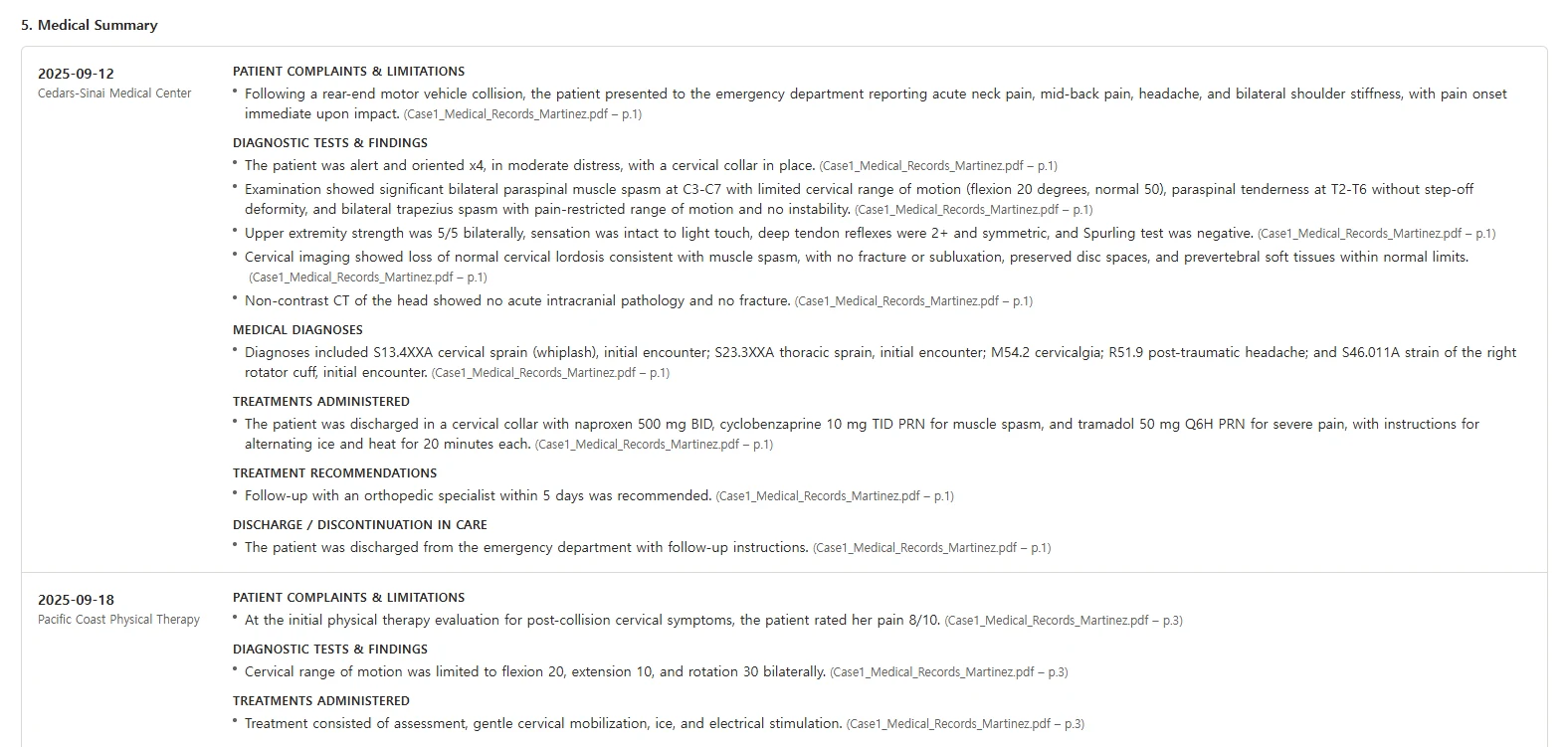
Lexyno's AI medical chronology software follows the steps above. It extracts dates, providers, diagnoses, procedures and charges into medical events, each tied to its source page. Your team can review, correct or remove any event before the report is generated.
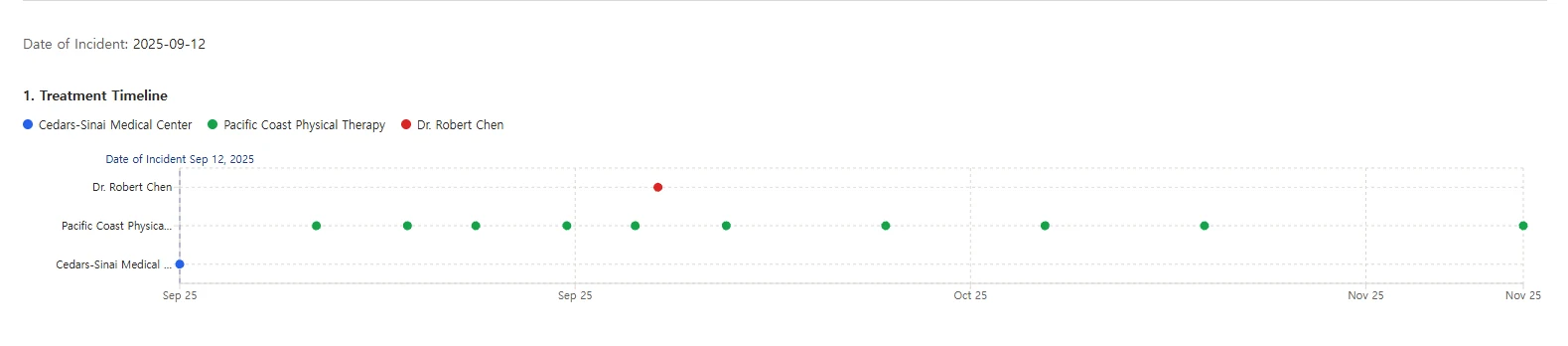
From those events, Lexyno builds a treatment timeline, a calendar that flags gaps over 30 days, a table of past visits, diagnostic highlights and a narrative summary. Everything exports to Word.
The same events feed the AI demand letter, so the chronology and the demand agree. If the facts change, the report is marked out of date so you can regenerate it. AI for assembly, humans for verification and strategy.
The Bottom Line
An AI medical chronology doesn't remove the need for judgment. It moves your paralegal's time from typing rows to checking them, and it makes every entry checkable.
Pick a tool that shows its sources, puts a review step before anything is generated, and produces the outputs your demand actually uses. Then test it on a case you already know.
The software does the typing. Your firm still does the judging.
Frequently asked questions
A date-ordered list of every medical encounter in a case, built by software that reads the records and extracts the date, provider, findings, diagnoses, treatment and charges for each visit. In a well-built tool each entry links back to the page it came from, and a paralegal or attorney verifies the entries before the chronology is used.
No. Software can do the reading, sorting and first-pass extraction, which is most of the clerical time. Someone at the firm still has to verify the entries, decide which treatment relates to the incident, and judge what the gaps and prior conditions mean for the case. The attorney stays responsible for what the demand letter says about the records.
Accuracy depends on the quality of the records and on the tool, and no vendor should promise a perfect chronology. The practical test is traceability: can a reviewer click any entry and see the source page? If every entry can be checked quickly, errors get caught before the chronology reaches the adjuster.
A medical chronology lists each encounter in date order with the provider, findings and source page. A medical summary is a narrative that explains the injuries, the course of treatment and the prognosis in plain language. Most demand letters use both, and the best tools build them from the same verified events.
ABA Formal Opinion 512 says lawyers may use generative AI tools if they understand the tools well enough to use them competently, protect client confidentiality, supervise the work, and review the output. Check your state bar's guidance as well, and treat the AI output the way you would treat work from a nonlawyer assistant.
Pricing models vary: per page, per case, per report or by monthly subscription. Compare quotes against the page counts your cases actually have and the outputs you need, such as a chronology only or a chronology plus summary and demand letter. Lexyno publishes its plans on its pricing page.
Related posts

Why Your AI Demand Letter Keeps Getting the Numbers Wrong
AI demand letter tools get figures wrong because language models predict numbers rather than look them up. Here is why, and the process that catches it.

Solo PI Attorney vs. Big Firm: How AI Levels the Playing Field
No firm dominates the $61.7B personal injury market, yet large firms use AI at nearly three times the rate of solos. That gap, not talent, is what AI can close.
What Is Fact-Lock™? How Lexyno Reduces AI Errors in Demand Letters
AI hallucination is a real, measured problem in legal documents — even in tools that promise "hallucination-free" output. Here is how Fact-Lock™ is engineered to reduce it, and why we will never claim zero.
What's next?
Ready to see the difference in your next case?
Put these strategies to work. Try a mock demand generated by Lexyno today.
Request Evaluation Access