 Rich Martin
Demand Letter to Insurance Company: A PI Firm's Guide
Demand Letter to Insurance Company: A PI Firm's Guide
How a PI firm sends a demand letter to an insurance company: what to finish first, what the adjuster reads, deadlines, state rules and what comes back.

Treatment has ended and the last bill is in. Your client wants to know what happens next. The answer is the demand.
A demand letter to insurance company adjusters has one reader: the bodily injury adjuster who has to justify a payment to a supervisor. This guide covers what to finish first, who receives the letter, and how the adjuster reads it. It also covers deadlines, state claim-handling rules, and what comes back.
For the section-by-section drafting, see our guide to writing a personal injury demand letter.

What Does a Demand Letter to an Insurance Company Do?
A demand letter to an insurance company turns a personal injury file into a formal claim with a number on it. It tells the carrier you represent the injured person, lays out liability, injuries, treatment and damages with the documents attached, and names a figure and a response date.
The adjuster can't pay what the adjuster can't document. So the letter is as much an evidence package as an argument. Most firms call the letter plus its exhibits the demand package.
A settlement demand letter that arrives without the records behind it gets valued on what the adjuster can see. It doesn't get valued on what your firm knows.
Who Receives the Demand Letter at the Insurance Company?
The demand goes to the at-fault party's liability carrier. Address it to the adjuster assigned to the bodily injury claim, and put the claim number on the first page. Three things shape where it goes: the letter of representation, the claim number, and the split between injury and property claims.
The letter of representation
Early in the case, your firm sends the carrier a letter of representation. It identifies the client and the firm, routes all contact through the firm, and asks the carrier to acknowledge the claim. The acknowledgment gives you the claim number and, usually, the adjuster's name.
The claim number and the file
The carrier matches every document to a claim file by that number. A demand without it can sit in a mailroom queue.
Put the claim number, the insured's name, the date of loss and the client's name in the letter's heading. Put them on every exhibit cover sheet too.
Bodily injury versus property damage
Carriers often give the vehicle damage and the injury claim to different adjusters. The bodily injury demand letter goes to the injury adjuster. Property damage usually settles earlier and separately, and the demand can mention that without reopening it.
Before You Send: Five Things to Finish First
The demand is valued once. Anything that arrives later is treated as an add-on to a figure that's already set. Finish these five things before the letter leaves your office.
- 1Liability evidence in hand. Police report, photographs, witness statements, and any citation or admission. The adjuster reads liability first.
- 2Records and bills complete. Every provider, every date of service, every billed amount, with the medical chronology built from them and the treatment gaps explained.
- 3Treatment finished or future care described. Either the client is done treating, or a treating provider has put the expected future care and its cost in writing.
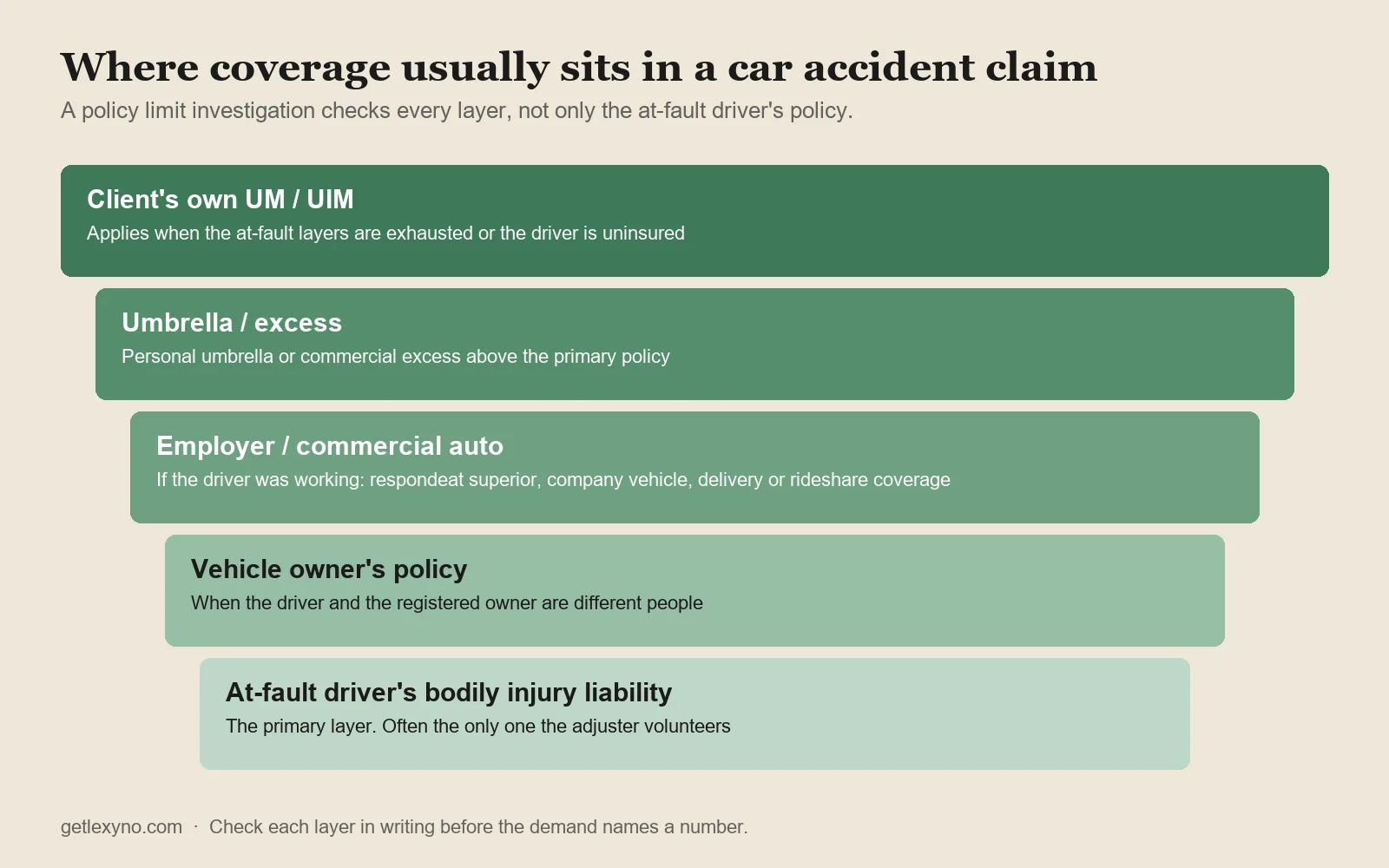
- 4Coverage known. The policy limits, any excess or umbrella layer, and the client's own UIM coverage. Our policy limit investigation guide covers how to get the numbers.
- 5Client sign-off on the figure. The demand amount, the liens that will come out of any settlement, and the net to the client, discussed and approved before the number goes to the carrier.

What a Bodily Injury Demand Letter to an Insurer Includes
Most bodily injury demands follow the same order: who's involved, what happened, and why the insured is at fault. Then come the injuries and treatment, what it cost, what it did to your client's life, and what you're asking for.
Our how-to guide breaks that into 14 core sections and 2 optional ones. Grouped, they look like this.
| Group | What the adjuster gets from it | Exhibits that support it |
|---|---|---|
| Claim posture: representation, accident, liability, property damage | Who is responsible and how clear it is | Police report, photographs, witness statements, repair estimate |
| Causation: medical bridge, pre-existing conditions | Why these injuries came from this crash | First-visit records, prior records if any, provider opinions |
| Treatment record: injuries, treatment, radiology, testing, functional limits | What was diagnosed and done, in order | Complete records by provider, imaging reports, the chronology |
| Economic damages: medical charges, wage loss | The specials, itemized and totaled | Bills, ledger summaries, employer wage verification |
| Human impact: pain, suffering, limits on daily life | What the injury did beyond the bills | Client statement, family statements, photographs |
| Offer to settle | The figure, the deadline, the terms | Coverage confirmation, lien summary if disclosed |
The car accident version of each section, with a completed sample letter, is in our sample demand letter for a personal injury car accident. The free personal injury demand letter template gives you the same structure as a Word download.
How Do Adjusters Read a Demand Letter?
Adjusters read a demand in a fixed order: liability, then causation, then specials, then general damages. On a large claim, the adjuster usually isn't the one who decides. They need authority from a supervisor who'll never read the whole package, so your letter should make that internal case easy to carry.
Is fault clear, shared or disputed? Anything the insured said at the scene?
Does the crash described explain the injuries claimed?
Billed amounts by provider, with codes, and whether the treatment matches the diagnosis
Breaks in treatment and earlier complaints to the same body part
Imaging, positive tests, measured limits, versus subjective complaints alone
What a jury in this venue might do, against the policy limits
The claim file, reserves and authority
When the claim opens, the carrier sets a reserve: an internal estimate of what the claim may cost. Your demand is the first document that can move that estimate.
The adjuster's settlement authority is usually capped. Anything above the cap goes to a supervisor or committee with a written evaluation.
Organize the demand the way that evaluation is organized, and it gets summarized accurately. Bury the specials in narrative, and someone in a hurry summarizes it for you.
Evaluation software
Many carriers run bodily injury claims through evaluation software. It scores the file from coded diagnoses, treatment types, duration and billed amounts.
The software rewards documentation it can read: ICD-10 and CPT codes on the bills, dates of service in order, objective findings quoted from the records. It doesn't read adjectives.
A table of specials by provider, with the codes, does more for the number than a paragraph about suffering. Keep the paragraph anyway. A person reads the letter too.

Setting the Figure and the Response Deadline
The demand figure
The figure is the attorney's call. It draws on the specials, the venue, comparable results and the policy limits.
Show the specials as an itemized total. State the demand as one number, with the basis for it. A round number with no stated basis invites a round counteroffer with no stated basis.

The response deadline
Most demands give the carrier a date to respond, commonly 30 days from receipt. In an ordinary demand, the deadline isn't required by law.
It's a tool. You calendar the follow-up, and if the carrier stalls, you have it on record. State a date, not a number of days, so nobody argues about when the clock started.
Time-limited policy limits demands
A different kind of demand offers to settle for the policy limits within a fixed period. In many states, a carrier that unreasonably refuses one can face liability above the limits.
What that demand has to contain is set by case law, and in some states by statute. It's a separate drafting job with its own rules. Don't turn an ordinary demand into one just by adding a deadline.
Sending the Demand: Delivery and the Settlement Label
Send the demand letter to insurance company adjusters in a way that records receipt. Use certified mail with return receipt, the carrier's claims portal, or email to the adjuster with a read receipt. Many firms use more than one.
Keep the transmittal in the file. The deadline runs from receipt, so proof of receipt is what gives the deadline teeth.
Many firms mark the letter "for settlement purposes only." Under Federal Rule of Evidence 408, offers to compromise, and conduct or statements made during compromise negotiations, aren't admissible to prove or disprove the validity or amount of a disputed claim. Most states have a rule modeled on it.
The protection comes from the rule, not the label, and the rule has exceptions. Treat the label as a signal of intent. Keep every fact in the letter accurate enough to stand on its own.

How Long Does the Insurer Have to Respond?
It depends on the state's claim-handling rules. Washington, for example, requires a reply to a claimant's pertinent communications within ten working days, and completion of the investigation within 30 days unless it can't reasonably be done. Your demand's own deadline, often 30 days, sits on top of those rules.
Every state regulates how insurers handle claims. Many do it through a version of the NAIC Unfair Claims Settlement Practices Model Act.
Among other things, the model act treats these as unfair practices: failing to acknowledge pertinent communications with reasonable promptness, and not attempting in good faith to settle promptly, fairly and equitably once liability is reasonably clear. Failing to affirm or deny coverage within a reasonable time after the investigation is complete is on the list too.
Washington's regulations show how specific the state versions get.
| Washington rule | What it requires now | Amendments effective October 18, 2026 |
|---|---|---|
| WAC 284-30-360 | An appropriate reply within ten working days to pertinent communications from a claimant that reasonably suggest a response is expected (fifteen for group policies) | Reply period restated as 10 business days |
| WAC 284-30-370 | Complete the investigation within 30 days unless it can't reasonably be completed in that time | Adds a duty to tell the claimant in writing why an investigation is taking longer than 30 days, with a further written update every 30 days |
| WAC 284-30-330 | Lists unfair practices, including the good-faith settlement duty where liability is reasonably clear | — |
What a third-party claimant can do when a carrier breaks these rules varies by state. In many states, the remedies run to the insured, not the claimant.
So use the rules narrowly in a demand. Cite the regulation in the letter, calendar its deadlines, and document every missed one. That record matters later, whether the case settles or gets filed.
The adjuster can't pay what the adjuster can't document. The demand's job is to make the documentation impossible to miss.
What Happens After the Insurance Company Receives the Demand?
One of four things comes back: a request for more, an offer, a denial, or silence past the deadline. Decide what your firm will do with each before the letter goes out. That way your response is quick and consistent.
- 1Acknowledgment and a request for more. Missing records, a recorded statement, a medical authorization, prior records. Decide what to provide and what to decline before the letter goes out, so the answer is quick.
- 2An offer. Usually below the demand, often with the adjuster's reasons: a liability discount, disputed treatment, a gap. Each reason is a negotiation point the letter should already have addressed.
- 3A denial. On liability, coverage or causation. Ask for the basis in writing. A denial on coverage may redirect the claim to the client's own UIM carrier.
- 4Silence past the deadline. Follow up in writing, cite the state claim-handling rule, and set the filing decision on the calendar. The statute of limitations doesn't pause for a slow adjuster.
Our post on how long a demand letter takes covers the time on your side of this exchange. The medical records to settlement workflow covers the steps from demand to release.
Common Mistakes in a Demand Letter to Insurance Company Adjusters
Adjusters see a lot of demands. These mistakes are the ones that cost firms money.
- Sending before the records are complete. The claim is valued on what arrived. Later bills become an add-on to a number that's already set.
- Totals that don't match the bills. One wrong specials total and every other figure in the letter gets checked by hand. Our post on why AI demand letters get numbers wrong explains how this happens in drafting tools too.
- Leaving the gap for the adjuster to find. An unexplained break in treatment is the most common reason for a discount. Explain it in the letter or expect it in the offer.
- Arguing liability the police report already settled. If fault is clear, say so in a paragraph and move on. Pages on clear liability suggest the firm is worried about something else.
- Adjectives in place of findings. "Severe" isn't a finding. A positive straight-leg raise, a disc protrusion on MRI and a measured range of motion are.
- No deadline, or a deadline nobody tracks. A date that nobody follows up on tells the carrier the firm isn't watching the file.
- Demanding more than the known coverage without saying why. If the demand exceeds the limits, the letter should address the excess: the insured's assets, other coverage, or the client's UIM claim.
How Lexyno Drafts the Demand to the Insurance Company
Lexyno's AI demand letter software follows the order the adjuster uses. Your firm uploads the police report, records and bills, and Lexyno builds the treatment chronology first. Your team can review and correct the extracted dates, providers, diagnoses and charges before anything is drafted.
Counsel chooses the strategy. Lexyno then drafts a 14- to 16-section demand around those facts, with source references so a reviewer can check figures against the record. You export it to Word for final edits.
On plans that include them, POV Reports show the same file from the insurer's side. The Medical Summary flags treatment gaps over 30 days before the adjuster finds them. Plan details are on the pricing page. AI for assembly, humans for verification and strategy.
The Bottom Line
A demand letter to insurance company claims staff is read by someone who has to justify a payment to someone else. Write it for that person.
Finish the records, know the coverage, and agree the figure with your client. Then write the letter in the adjuster's order: liability, causation, specials, human impact, offer.
Send it with proof of receipt, and calendar the deadline and the state rules. Decide in advance what you'll do with each of the four answers. Start from the free demand letter template and build the package around it.
The adjuster pays from what's in the file. Your job is to make sure it's all there.
Frequently asked questions
The bodily injury adjuster assigned to the claim at the at-fault party's liability carrier, with the claim number on the first page. If no adjuster has been assigned, send it to the claims department named in the carrier's acknowledgment of your letter of representation and ask for the adjuster's name. Do not send it to the insured directly once the carrier has acknowledged the claim.
After the medical records and bills are complete and the client has either finished treatment or reached a point where a treating provider can describe future care. A demand sent before the records are in is valued on what the adjuster can see, and anything that arrives later is treated as a supplement to a figure that has already been set.
Most states have claim-handling regulations with deadlines for acknowledging communications and completing an investigation; Washington, for example, requires a reply to pertinent claimant communications within ten working days and completion of the investigation within 30 days unless it cannot reasonably be done. The demand itself usually sets its own response date, commonly 30 days. Check the rules of the state where the claim is being handled.
A settlement demand letter states the claim and asks for a figure. A time-limited demand adds a deadline and usually offers to settle for the policy limits, which in many states creates consequences for the carrier if it unreasonably refuses. The content a time-limited demand has to include varies by state and some states have statutes on it, so it is drafted differently from an ordinary demand.
The adjuster logs it to the claim file, reviews liability and the medical specials, may request more records or a recorded statement, and then either makes an offer, denies the claim or asks for time. Offers are usually below the demand and open a negotiation. A denial or silence past the deadline is the point at which the firm decides whether to file suit.
Many firms include the label. Under Federal Rule of Evidence 408 and the state rules modeled on it, offers to compromise and statements made during compromise negotiations are generally not admissible to prove or disprove the validity or amount of a disputed claim. The rule, not the label, controls, and there are exceptions, so the label is a signal rather than a shield. Keep the facts in the letter accurate regardless.
Related posts

Medical Record Chronology: Template and Example for PI
How to build a medical record chronology for a PI case: a free template, a filled-in example from a demo case, the right format, and mistakes to avoid.

Medical Record Review for Attorneys: A PI Guide
A working guide to medical record review for PI attorneys: which records to collect, what to extract, how to catch gaps, and who should do the review.
Policy Limit Investigations: A Guide for PI Firms
How to run policy limit investigations before the demand: where hidden coverage sits, what to request in writing, and how the findings change the number.
What's next?
Ready to see the difference in your next case?
Put these strategies to work. Try a mock demand generated by Lexyno today.
Request Evaluation Access