 Rich Martin
Medical Record Review for Attorneys: A PI Guide
Medical Record Review for Attorneys: A PI Guide
A working guide to medical record review for PI attorneys: which records to collect, what to extract, how to catch gaps, and who should do the review.

Every number in a personal injury demand comes from the medical records. So does every argument about causation.
Medical record review for attorneys turns a few hundred pages from a dozen sources into something you can rely on: what happened, in what order, what was found, what it cost, and what's still missing. This guide covers which records to collect, what to pull from each, where reviews go wrong, and who should do the work.
What Is Medical Record Review for Attorneys?
Medical record review for attorneys is a structured read of a client's complete medical file, done for a legal purpose. It answers when symptoms started, what each provider found, whether treatment was continuous, what it cost, whether anything existed before the incident, and what the treating physician says about cause and prognosis.
A clinician reads records to treat a patient. A legal reviewer reads the same records to answer different questions.

The review produces a set of facts with a source for each one. Everything downstream is built on that set: the chronology, the medical summary, the specials table and the demand letter itself.
Why the Review Decides What the Case Is Worth
The adjuster evaluates the claim from the same records. If your review misses a diagnosis, the demand undervalues the injury.
If it misses a gap in treatment or a prior complaint, the adjuster finds it first and uses it. If a billed amount is transposed, every figure in the letter becomes negotiable.
The review is where your firm decides whether its numbers will survive that scrutiny.
The adjuster reads the same records you do. The only question is who reads them more carefully.
Medical Chronology vs. Medical Summary vs. Record Review: What Is the Difference?
Record review is the reading and extraction work; a medical chronology lists every encounter in date order with the provider, findings and source page. A medical summary is a narrative of the injuries, treatment and prognosis. Most demands need both outputs, built from the same review.
| Record review | Medical chronology | Medical summary | |
|---|---|---|---|
| What it is | The reading and extraction work itself | Every encounter in date order with provider, findings and source page | A narrative of the injuries, treatment and prognosis |
| Question it answers | What do the records say? | What happened, and when? | What does it mean for this client? |
| Used for | Feeding the chronology, summary and specials | Accuracy, gaps, cross-checking bills | Medical therapies and pain and suffering sections of the demand |
| Typical length | Working notes | Table, often many pages | A few pages |
Lexyno's Medical Summary produces the chronology and the narrative together from the same review, with source references on material facts.
Which Records Do You Need Before the Review Starts?
You need five sets: complete treating provider charts, signed imaging reports, itemized bills with CPT codes, pharmacy records, and pre-incident records for the same body region. A review done on an incomplete file has to be redone, so request everything first and track what has arrived.
Treating provider records
Get records from the emergency department, urgent care, primary care, and every specialist and therapy provider. Ask for the complete chart, not a visit summary: intake forms, history, exam findings, assessments, plans and discharge notes.
Imaging reports
Get the radiologist's report for every study, including negative ones. The demand quotes the impression section, so get the signed report, not a referring physician's paraphrase.
Itemized billing
Get itemized statements and ledgers from every provider, with CPT codes. A balance-due letter isn't enough to build a specials table.
Pharmacy records
The pharmacy printout ties prescriptions to diagnoses and dates. It often shows continuity of care when visit records are thin.
Pre-incident records
Get records from the same body region before the date of loss, usually going back several years. They're the only way to establish a baseline and argue aggravation honestly.
Clients can get their own records under the HIPAA right of access. Firms typically request them with a signed HIPAA-compliant authorization.
How Do You Review Medical Records Step by Step?
Index the file, remove duplicates, and read every provider's records together in date order. Extract the same fields from each encounter, flag gaps and contradictions as you go, and reconcile every visit against the bills. Then hand the attorney the chronology and a short list of issues that need a decision.
- 1Index the file. List every provider, the date range received and the page count. Note what is missing.
- 2Remove duplicates. The same note often arrives from the provider and again from the hospital system.
- 3Read in date order across providers. Not provider by provider. Causation and gaps only show up on a single timeline.
- 4Extract the same fields from every encounter. Date, provider, complaints, findings, diagnosis, treatment, restrictions, plan, and the page number.
- 5Flag issues as you go. Gaps, prior complaints, inconsistent histories, missing reports, unexplained bills.
- 6Reconcile against the bills. Every billed date of service should match an encounter, and every encounter should have a bill or an explanation.
- 7Hand the attorney a short issues list. The chronology is the evidence; the issues list is what needs a decision.

What to Extract From Each Record
Consistency matters more than volume. Pull the same fields from every encounter, so the chronology can be sorted, filtered and checked.
Date, provider, facility, visit type, source page
Complaints, pain scores, history given, mechanism described
Exam findings, range of motion, spasm, imaging results
Diagnoses with ICD-10 codes, date first documented
Treatment, referrals, prescriptions, CPT codes
Work restrictions, activity limits, sleep, driving
Causation statements, MMI, prognosis, future care
Billed amount per date of service, payer, adjustments
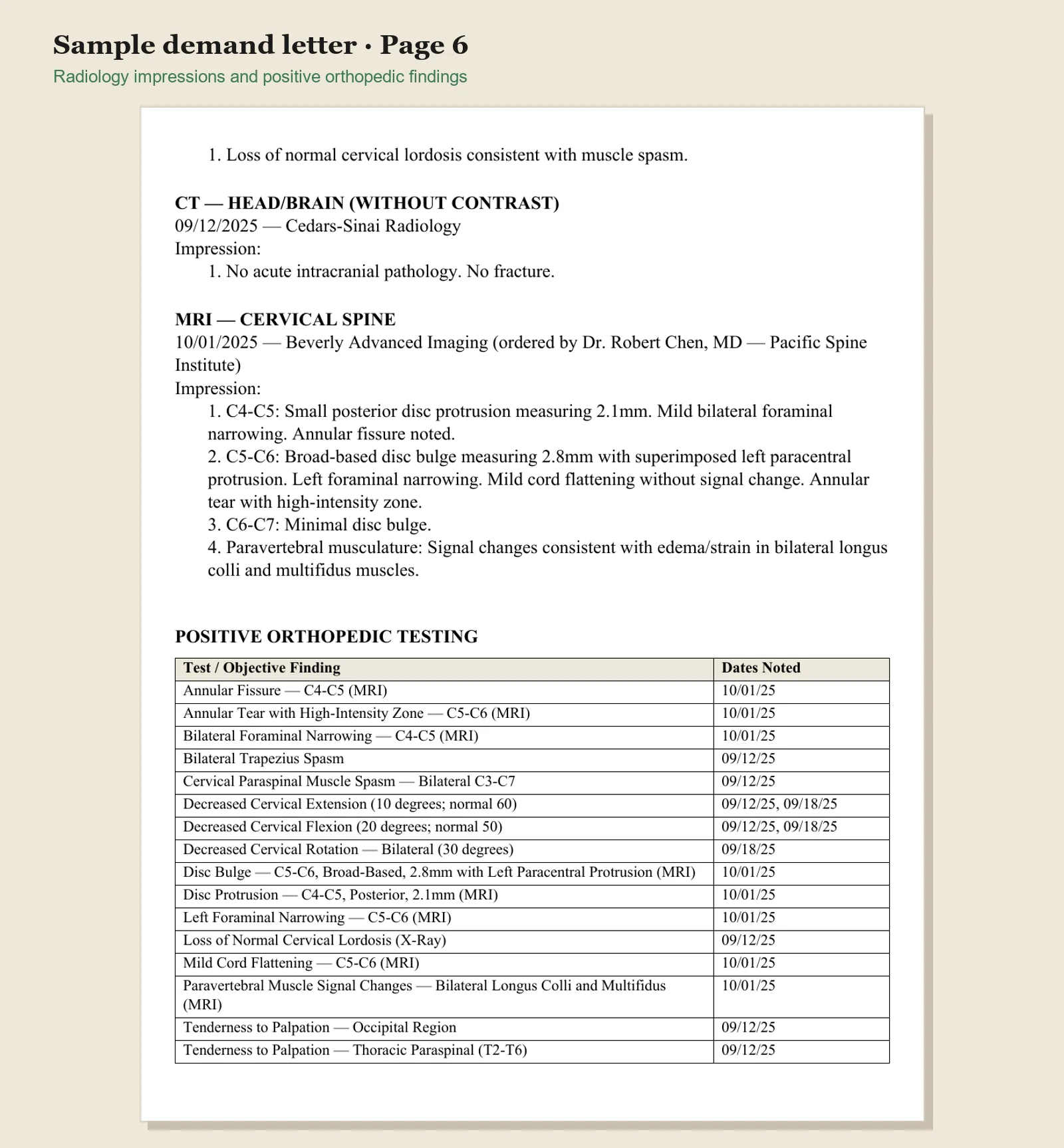
Objective findings deserve special care. Spasm on palpation, measured range-of-motion loss and imaging impressions separate a documented injury from a complaint. Quote them, don't paraphrase them.
Gaps, Prior Conditions and Contradictions
These are the three issues an adjuster looks for first. A good review finds them first, so the attorney can decide how to address them.
Gaps in treatment
A long break between visits invites the argument that your client recovered, or that something else caused the later care.
Measure every gap, then look for the reason: a scheduling backlog, insurance authorization, a family emergency, or a home exercise program the provider prescribed.
Pre-existing conditions
Prior complaints in the same body region aren't fatal to a claim. Hidden ones often are.
Document the baseline from the pre-incident records, note what changed after the date of loss, and give the attorney what's needed to argue aggravation.
Most jurisdictions allow recovery for aggravation of a pre-existing condition. The review should make that argument possible, not leave it to be discovered.
Contradictions between records
The ER note says the client hit her head; the specialist's history says she didn't. One provider records a pain score of 8, another a 3 on the same day.
Flag every contradiction with both page references. Some resolve on a closer read. The rest need the attorney's judgment before the demand goes out.
ICD-10 and CPT Codes in the Review
Diagnosis and procedure codes are how insurers' evaluation processes read a claim. Capture the ICD-10-CM code for every diagnosis from the clinical note, and the CPT code for every billed service from the itemized bill.
Check codes against the clinical note rather than copying them from a superbill. Superbills sometimes carry codes for conditions the physician never documented.
Medical records are generally admissible as business records. Statements made for medical diagnosis or treatment are a recognized hearsay exception under Federal Rule of Evidence 803.
That's one more reason to quote the record exactly. The words in the chart are evidence, and the paraphrase isn't.
How Long Does It Take to Review Medical Records?
It depends on four things: page count, the number of providers, legibility, and whether the records are complete when you start. Handwritten notes and faxes slow extraction, duplicates inflate page counts, and missing records stop the review entirely until they arrive.
A chronology with a hole in it has to be reopened when the missing records come in.
In our breakdown of how long a demand letter takes, record review and extraction is the largest single block of the work. That's why requesting complete records early, and indexing them on arrival, saves more time than reading faster.
When a record is still missing at the deadline, say so rather than work around it. Note the provider, the dates of service and the date the request went out, and keep the chronology open at that point.
A demand that acknowledges an outstanding record and reserves the right to supplement is stronger than one that quietly skips a provider. The adjuster will see the bill without the visit and ask why.
Who Should Review the Records?
For most cases, a trained paralegal does the first pass and the attorney reviews the result. Bring in a nurse or physician reviewer when causation, a prior condition or future care is disputed. Software can do the mechanical part, but a person still verifies the output.
In-house paralegal
This is the default for most small firms. A trained paralegal knows what the demand needs and works directly with the attorney.
The risk is capacity. Review competes with everything else on the desk, and a backlog delays demands.
Outsourced nurse or medical reviewer
Review services staffed by nurses or physicians add clinical judgment. That matters when causation, a prior condition or future care is contested.
The trade-offs are cost, turnaround and a hand-off. The reviewer doesn't know your case theory unless you explain it.
Software-assisted review
Tools that build the chronology and extract codes and figures shorten the mechanical work. The output still needs a person to verify it and make the judgment calls, which is why Lexyno links each material fact to its source page.
Before sending client records to any tool, confirm that its contracts and safeguards cover medical records. Our post on HIPAA and AI demand letters covers what to ask.
| In-house paralegal | Nurse or medical reviewer | Software-assisted | |
|---|---|---|---|
| Best for | Routine cases, tight attorney collaboration | Disputed causation, complex medicine, future care | Volume, long files, consistent extraction |
| Strength | Knows the case and the demand format | Clinical judgment | Speed on mechanical work, source links |
| Watch for | Capacity and backlog | Cost, turnaround, hand-off of case theory | Verification still required; data-handling terms |
How Much Does Medical Record Review Cost?
Outside services usually price per page, per hour or per report, and physician review costs more than a nurse summary or a paralegal chronology. In-house review costs staff time, even when it doesn't show up on an invoice. Software-assisted review is usually priced per case or by subscription.

Rush turnaround adds to all of them. Our analysis of the real cost of manual demand letters works through the in-house math for a small firm. Lexyno publishes its plans on the pricing page.
When you compare quotes, ask three questions. What's the page count assumption? What exactly is delivered: a chronology, a summary, an issues list, or all three? And is every entry linked to a source page?
Common Mistakes in Medical Record Review
| Mistake | What it costs | Fix |
|---|---|---|
| Starting before the file is complete | The chronology has to be reopened | Index first; review when the records are in |
| Reading provider by provider | Gaps and causation problems stay hidden | Read across providers in date order |
| Paraphrasing objective findings | The demand loses its strongest evidence | Quote impressions and exam findings verbatim |
| Copying codes from superbills | Codes for conditions never diagnosed | Check every code against the clinical note |
| Ignoring pre-incident records | The adjuster finds the prior condition first | Request them and document the baseline |
| No page references | Nothing can be verified quickly | Record the source page for every entry |
| Bills not reconciled to encounters | Specials that do not add up | Match every date of service to a visit |
From Review to Demand Letter
A finished review feeds several sections of the demand directly: the damages summary, the summary of injuries with ICD-10 codes, the summary of treatment, the radiology section, the positive findings table and the specials.
Our guide to the sections of a PI demand letter lays out the structure. The medical records to settlement workflow covers the full sequence.
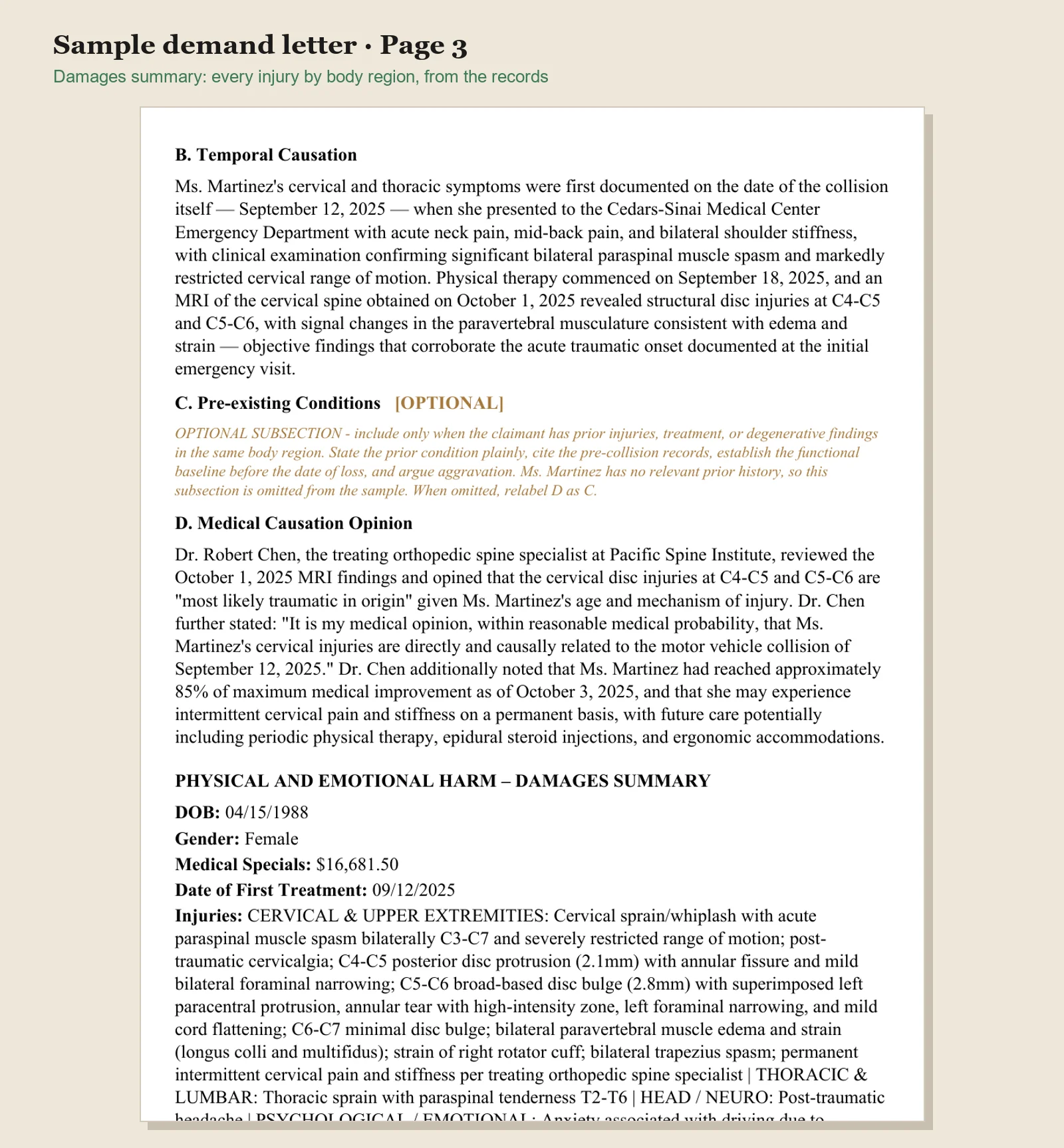
You can see the finished result in our free personal injury demand letter template, and how it applies to a motor vehicle claim in the car accident sample demand letter.
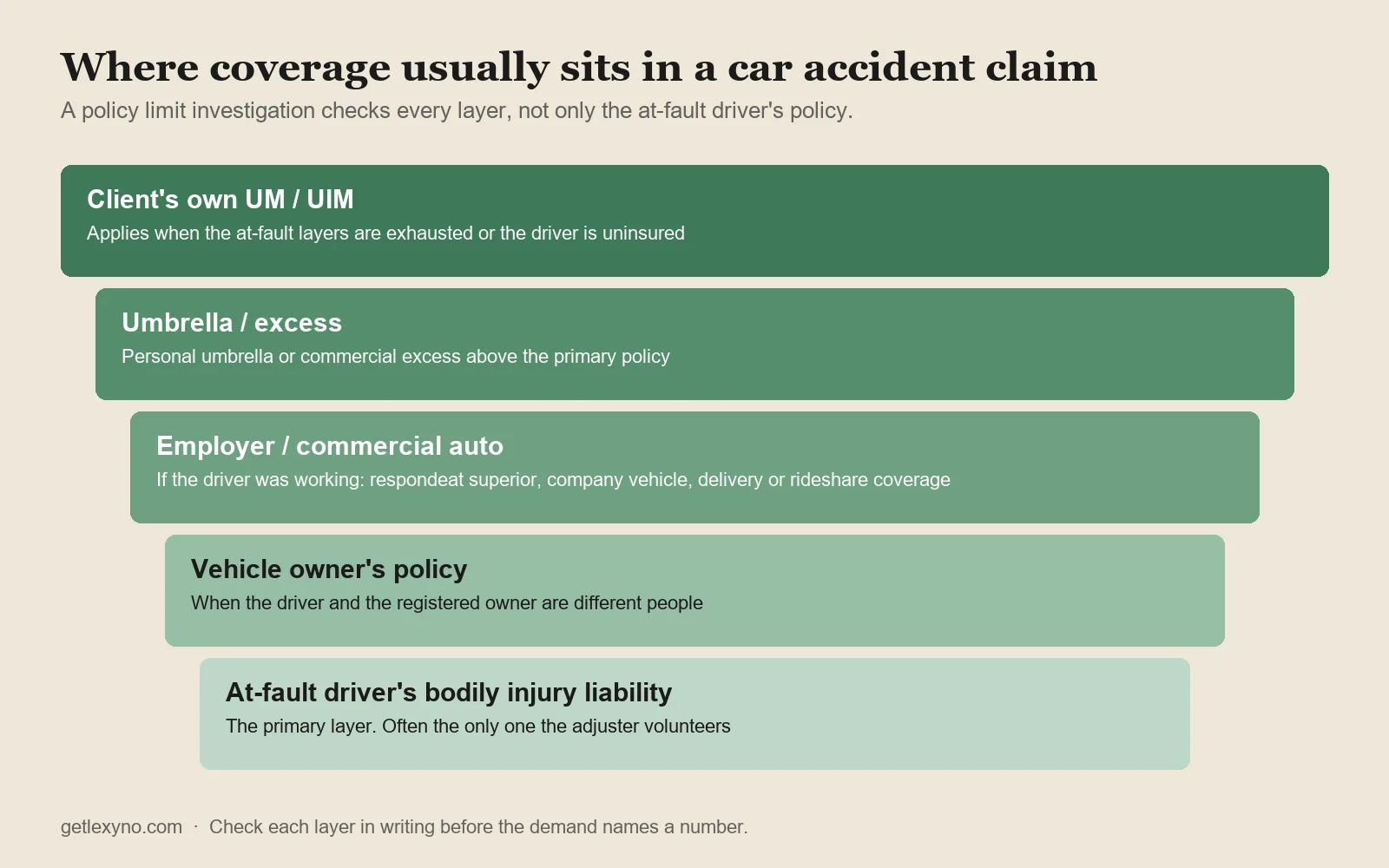
If coverage is in question, run the policy limit investigation in parallel. Then you know the damages and the ceiling at the same time.
Medical Record Review Checklist
Before the review is handed to the attorney:
- Every provider indexed, with date range and page count, and missing records listed
- Duplicates removed
- Chronology built across providers in date order, with a source page on every entry
- Diagnoses coded from clinical notes, services coded from itemized bills
- Objective findings and imaging impressions quoted verbatim
- Gaps measured and explained, or flagged
- Pre-incident records reviewed and the baseline documented
- Contradictions flagged with both page references
- Every billed date of service matched to an encounter
- A one-page issues list for the attorney
Done this way, medical record review for attorneys stops being a reading task. It becomes the evidence base for the whole case, and the demand letter is only as strong as the review underneath it.
Frequently asked questions
Collecting the complete records from every provider, reading them in date order, extracting diagnoses, treatment, objective findings, restrictions and billing, and flagging gaps in treatment, prior conditions and contradictions. The output is usually a chronology, a summary, or both, with every entry traced to a page in the records.
A chronology lists every encounter in date order with the provider, the findings and the source page. A summary is a narrative that explains the injuries, the course of treatment and the prognosis in plain language. Most demand letters need both: the chronology for accuracy and the summary for persuasion.
For most cases a trained paralegal does the first pass and the attorney reviews the result, with a nurse reviewer or physician consulted when causation, a prior condition or future care is disputed. The attorney remains responsible for what the demand letter says about the records.
It depends on page count, the number of providers, legibility and how complete the records are. Record review and extraction is typically the largest single block of time in preparing a demand letter, and missing records add delay because the review cannot be finished until they arrive.
Outside review companies commonly price per page, per hour or per report, and physician or nurse review costs more than a paralegal-level summary. In-house review costs staff time. Software-assisted review is usually priced per case or by subscription. Compare quotes against the page count and the output you actually need.
Software can assemble a chronology, extract codes and figures, and link each entry to its source page, which shortens the mechanical part of the work. A person still needs to verify the output and make the judgment calls about causation, prior conditions and what the records mean for the case. Use only tools whose contracts and safeguards cover handling client medical records.
Related posts

Medical Record Chronology: Template and Example for PI
How to build a medical record chronology for a PI case: a free template, a filled-in example from a demo case, the right format, and mistakes to avoid.

Demand Letter to Insurance Company: A PI Firm's Guide
How a PI firm sends a demand letter to an insurance company: what to finish first, what the adjuster reads, deadlines, state rules and what comes back.
Policy Limit Investigations: A Guide for PI Firms
How to run policy limit investigations before the demand: where hidden coverage sits, what to request in writing, and how the findings change the number.
What's next?
Ready to see the difference in your next case?
Put these strategies to work. Try a mock demand generated by Lexyno today.
Request Evaluation Access