 Rich Martin
Policy Limit Investigations: A Guide for PI Firms
Policy Limit Investigations: A Guide for PI Firms
How to run policy limit investigations before the demand: where hidden coverage sits, what to request in writing, and how the findings change the number.

Your demand letter names a number. That number only means something if you already know how much coverage is there to pay it. Policy limit investigations are the step most small personal injury firms run late or skip.
The cost shows up in two places. Your demand asks for less than the coverage would have paid. Or your policy-limits demand goes out against a policy nobody confirmed.
This guide covers where coverage hides, what to request in writing, which state rules compel disclosure, and how the findings change your letter.
What Is a Policy Limit Investigation?
A policy limit investigation identifies every insurance policy that may respond to a claim and confirms each one's limits in writing. In a motor vehicle case, that usually means more than the at-fault driver's liability policy. The vehicle owner, an employer, an umbrella carrier, and your client's own insurer can each add a layer.
The adjuster handling the primary claim has no reason to volunteer any of them. What you want is simple: a list of carriers, policies and confirmed limits, with the source document for each. Your demand is built on that list.
Why Find Coverage Before the Demand?
Confirmed coverage sets the ceiling on what your demand can ask for. It tells you whether you're writing an ordinary demand or a policy-limits demand, and whether an underinsured motorist claim follows. And a time-limited demand only works if it names the right policy, insured and limit.
The number depends on it
If your client's documented damages exceed the primary limits, the demand becomes a policy-limits demand. Your firm starts planning an underinsured motorist claim at the same time.
If damages fall well below the limits, the demand is an ordinary negotiation. Without confirmed limits, you're guessing which of those two letters you're writing.
Time-limited demands have no margin for error
A time-limited policy-limits demand creates leverage. An insurer that unreasonably refuses to pay its limits may face a bad-faith claim for the excess verdict. But that leverage only exists if your demand correctly identifies the policy, the insured and the limit.
A demand to the wrong carrier, or for the wrong amount, isn't a bad-faith setup. It's a letter the adjuster can ignore.
Uninsured and underinsured drivers are common
The Insurance Information Institute estimates that roughly one in seven drivers nationwide is uninsured, with wide variation by state (Source: Insurance Information Institute). Many more carry only the state minimum.
In a serious injury case, your client's own UM/UIM coverage is often the largest layer available. It's also the one most firms check last.
Where Hidden Coverage Usually Sits
Most missed coverage isn't hidden by fraud. It sits in a layer nobody asked about.
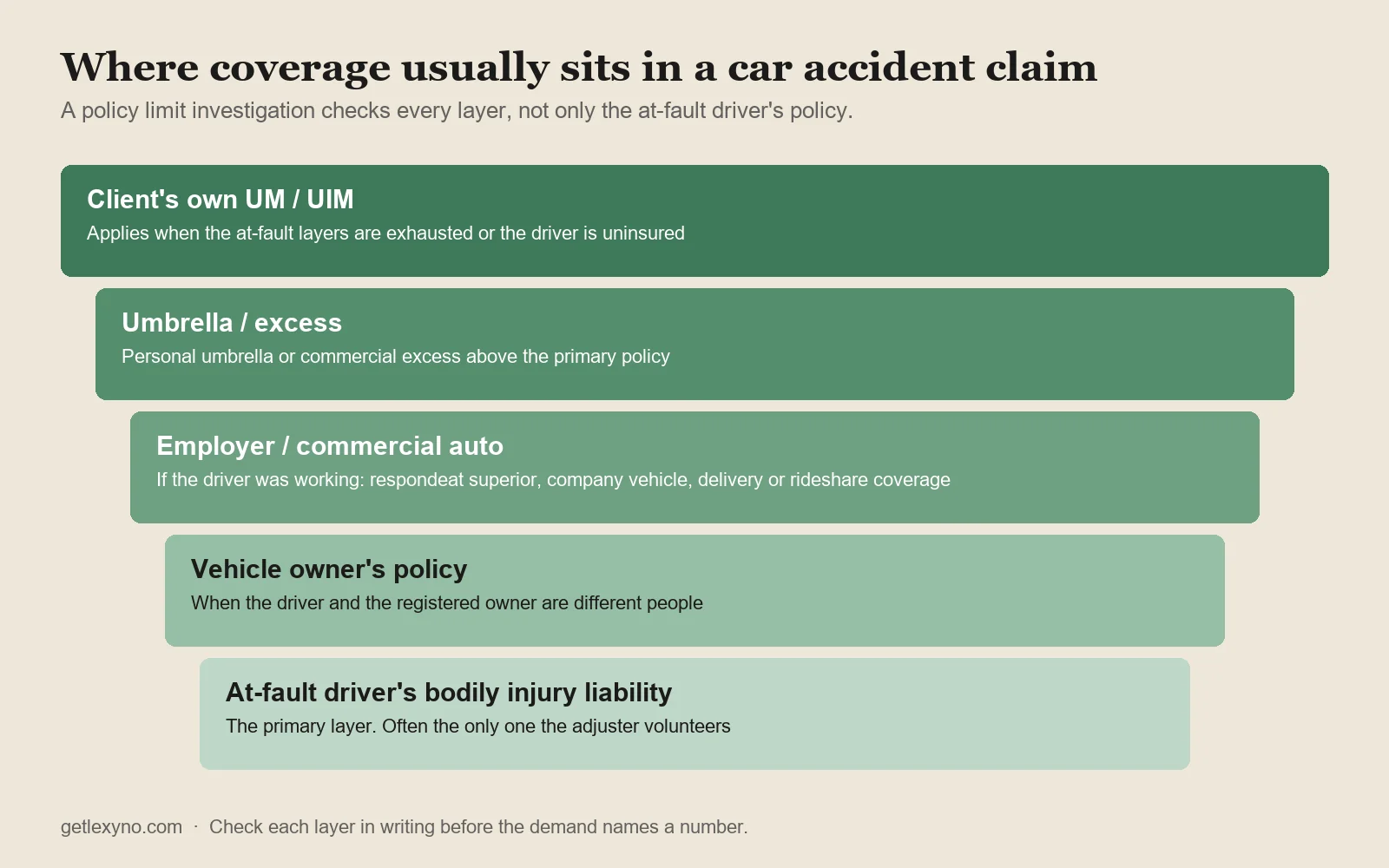
| Layer | When it applies | Where to look |
|---|---|---|
| At-fault driver's bodily injury liability | Always the starting point | Police report, claim acknowledgment, disclosure request |
| Vehicle owner's policy | Driver and registered owner are different people | Registration on the police report, owner's carrier |
| Employer or commercial auto | Driver was working, in a company vehicle, or driving for a delivery or rideshare platform | Employer identity, vehicle markings, platform status at the time of the crash |
| Umbrella or excess | Insured has a personal umbrella or the business carries excess coverage | Disclosure request that specifically asks for umbrella and excess policies |
| Client's own UM / UIM | At-fault layers are exhausted or the driver is uninsured | Client's declarations page, resident-relative policies |
Driver versus owner
When the driver borrowed the car, the owner's policy is usually primary. The driver's policy may be excess. Both carriers get your disclosure request.
Employer and platform coverage
A driver on the job brings the employer's policy into the case under respondeat superior. Rideshare and delivery drivers are covered by platform policies. Their limits depend on whether the app was on and whether a ride or delivery was in progress.
So the timestamp of the crash matters.
Umbrella and excess
Umbrella policies rarely come up unless your request names them. Ask for them by name in every disclosure letter.
The client's own policy
Pull your client's declarations page at intake. Check for resident relatives with their own policies. UM/UIM is the layer your firm controls, and its notice and consent-to-settle requirements start running early.
How Do You Conduct Policy Limit Investigations?
You start policy limit investigations at intake, before any demand is drafted. List every party who may be liable, send each carrier a written disclosure request, and check your client's own coverage. If a carrier won't answer, use discovery once suit is filed, and log every finding with its source.

- 1Identify every potentially liable party. Driver, owner, employer, platform, and anyone else the police report or the facts point to.
- 2Send a written disclosure request to each carrier. Ask for every policy, the named insureds, the limits, umbrella and excess layers, and a copy of each policy.
- 3Cite the statute where one exists. A request that names the disclosure rule and its deadline is answered faster than a courtesy request.
- 4Check the client's own coverage. Declarations page, resident relatives, and the UM/UIM notice requirements.
- 5Use discovery if the carrier will not answer. Once suit is filed, insurance agreements are discoverable and, in federal court, part of initial disclosures.
- 6Record every finding with its source. Carrier, policy number, limit, the document that confirmed it, and the date.
Sample Policy Limits Disclosure Request
The request is short and specific. It asks for every policy and every layer, and it cites the rule where one exists. It also says plainly that it isn't a settlement demand, so it doesn't start a settlement clock by accident.
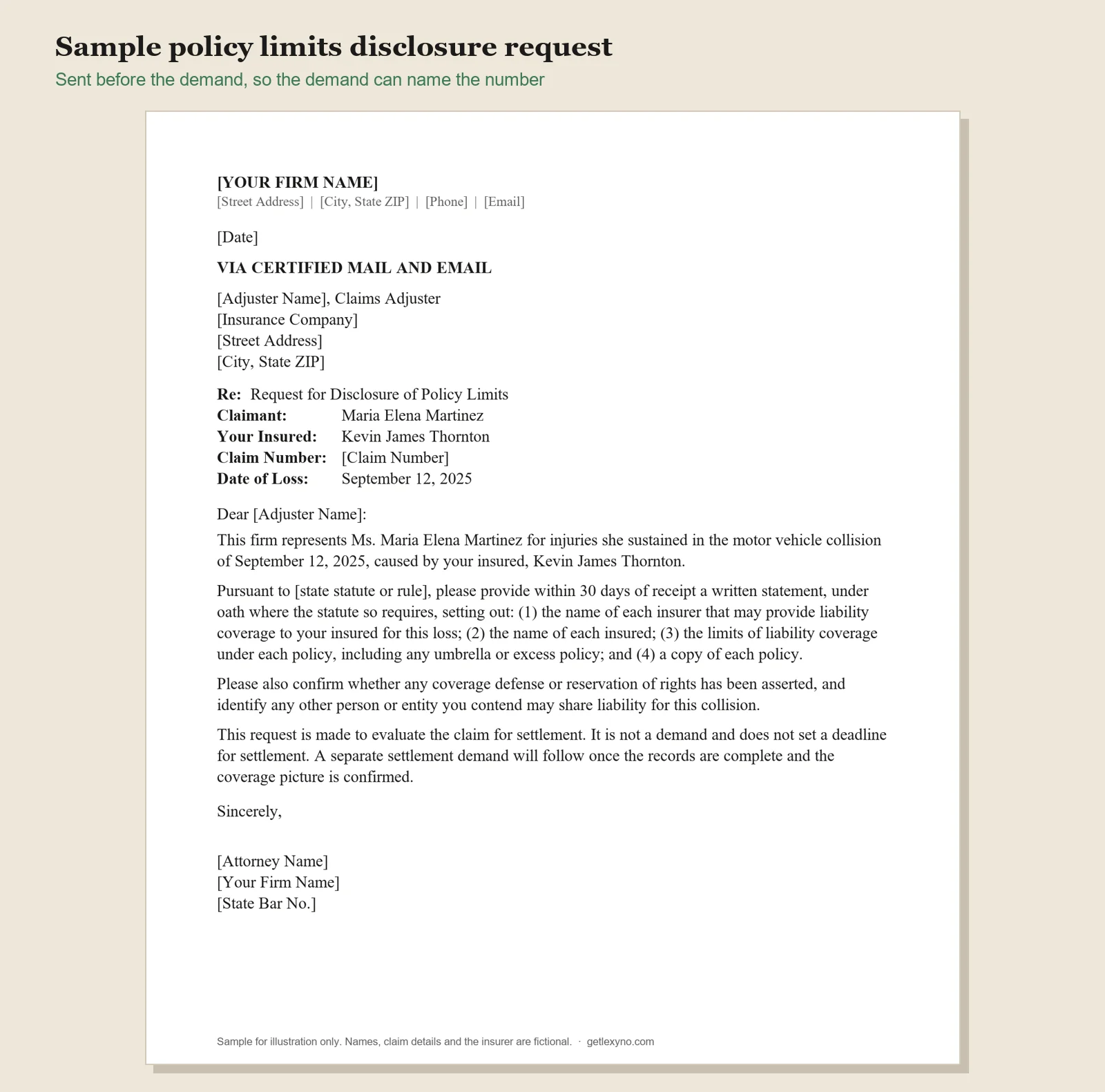
Please provide within 30 days of receipt a written statement setting out the name of each insurer that may provide liability coverage to your insured for this loss, the name of each insured, the limits of liability coverage under each policy including any umbrella or excess policy, and a copy of each policy.
Send the same request to the owner's carrier, the employer's carrier and any platform insurer. Change only the party and claim details. Your client's own carrier gets a UM/UIM notice instead, which is a different letter with its own requirements.
Do Insurers Have to Disclose Policy Limits?
It depends on the state and on whether you've filed suit. Some states make a carrier disclose limits on your written request before suit, within a set period. In others, there's no pre-suit duty, and the limits come out in discovery.
Here are a few examples of the kind of rule to look for. Confirm the current text and deadlines in your jurisdiction before you rely on any of them.
| Jurisdiction | Rule | What it does |
|---|---|---|
| Florida | Fla. Stat. § 627.4137 | Requires a liability insurer to disclose coverage information, including limits, on a claimant's written request within a set period |
| Georgia | O.C.G.A. § 33-3-28 | Requires an insurer to provide the claimant information about coverage and limits on written request within a set period |
| Federal court | Fed. R. Civ. P. 26(a)(1)(A)(iv) | Makes any insurance agreement that may satisfy a judgment part of initial disclosures once suit is filed |
| Other states | Varies | Some states have no pre-suit duty; limits come out in discovery. Some require disclosure only in motor vehicle claims or only with specified supporting documents |
When there is no statute
In a state without a pre-suit rule, send the disclosure request anyway. Carriers often answer it. And the letter documents that your firm asked, which matters if a later bad-faith claim turns on what the insurer knew and when.
Search Vendors Versus Doing It In-House
Policy limits search companies offer to locate coverage for a fee, often on a no-find, no-fee basis. They're useful when the insured is unresponsive, the carrier is unknown, or your firm suspects umbrella coverage it can't confirm.
But they're no substitute for the written disclosure request. That request costs nothing and produces a document your firm can cite.
| Written disclosure request | Search vendor | Discovery | |
|---|---|---|---|
| When | At intake, every case | Carrier unknown or unresponsive; suspected hidden layers | After suit is filed |
| Cost | Staff time only | Per-search fee | Litigation cost |
| Produces | Carrier's written statement, citable in a later bad-faith claim | Report of policies found; still needs carrier confirmation | Policy documents under oath |
| Limitation | Depends on state law and carrier cooperation | Cannot compel; may miss policies not in databases | Late; the demand has usually already gone out |
Turning the Findings Into the Demand
Once you've confirmed the limits, your demand changes in three places. The offer to settle names a figure or demands the limits, with the policy identified. The deadline is set with your state's time-limited demand rules in mind.
And before you send, you decide whether a UM/UIM claim follows and what notice your client's carrier needs. The rest of the letter, all fourteen core sections, is built the same way whatever the coverage picture. The coverage decides what the last section asks for.
What the adjuster already knows
The adjuster has the limits from day one and evaluates your claim against them. Reading the file from the insurer's side shows where a demand that ignores the coverage picture will be discounted. That's what an insurance POV report is for.
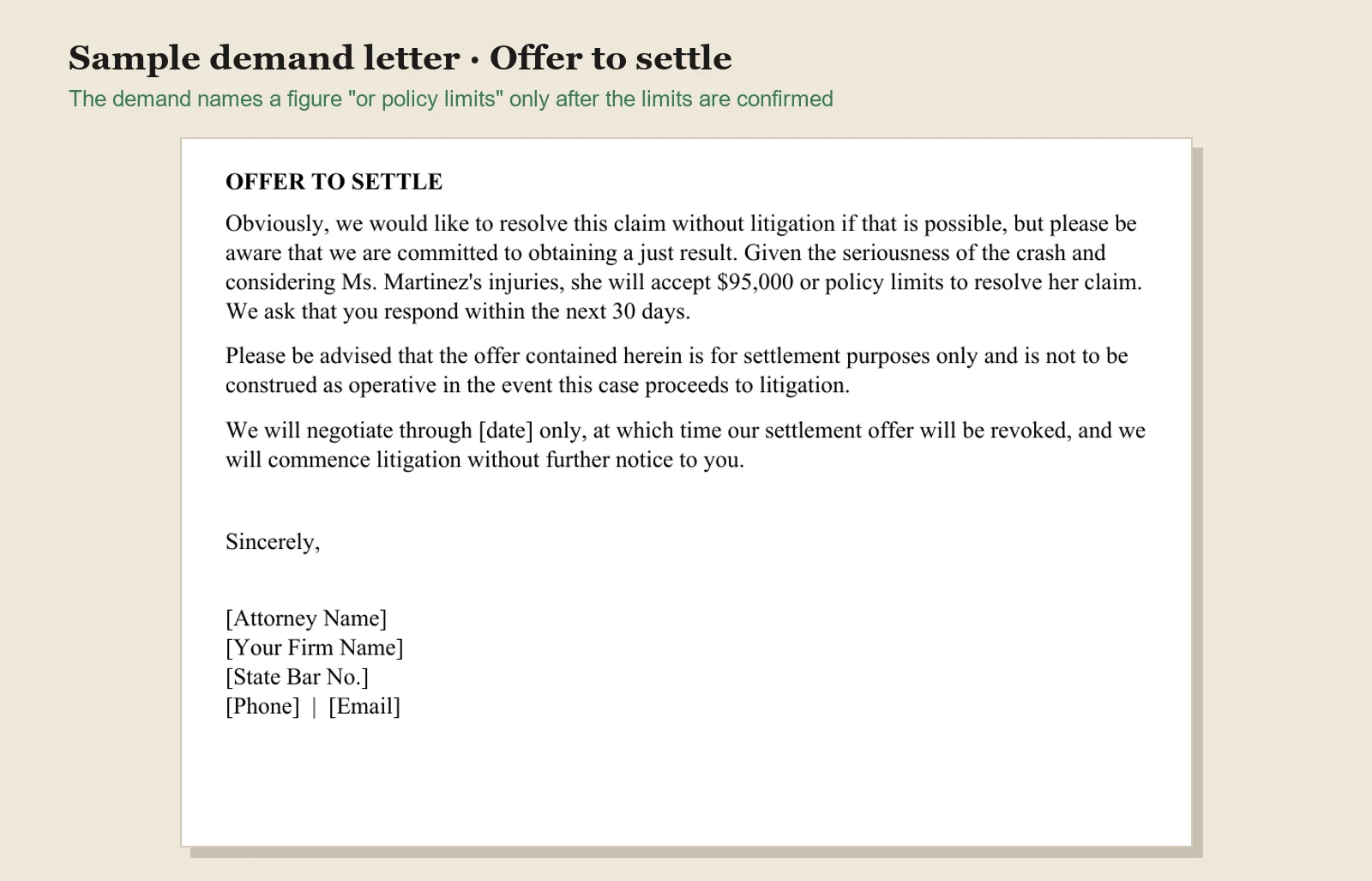
The sample above is from our free personal injury demand letter template. To see how the rest of the letter comes together in a motor vehicle case, read the sample demand letter for a car accident claim.
Common Mistakes in Policy Limit Investigations
| Mistake | What it costs | Fix |
|---|---|---|
| Taking the adjuster's word for the limits | Umbrella and excess layers go unfound | Written request that names umbrella and excess policies; ask for the declarations page |
| Checking only the driver | Owner, employer and platform coverage missed | Run the party list from the police report before the first request |
| Sending the demand before the limits are confirmed | Demand asks for less than the coverage, or a policy-limits demand targets the wrong policy | Finish the investigation at intake; the demand waits for records anyway |
| Forgetting the client's own policy | UM/UIM notice deadlines missed; largest layer unused | Declarations page at intake; calendar the notice requirements |
| No record of the source | Findings cannot be cited later | Log carrier, policy, limit, document and date for every layer |
Policy Limits and the Medical Record
Coverage and damages are decided separately, then compared. The medical record sets the damages. The investigation sets the ceiling.
When the two are close, you need the damages documented to the dollar. A policy-limits demand that overstates specials gives the carrier a reason to refuse. The medical records to settlement workflow covers the records side of that comparison.
Find the coverage first. Then document the damages up to it. A demand written in the other order asks for a number nobody has checked.
Intake Checklist
Before any demand is drafted, the file should show:
- Every potentially liable party listed, with the carrier for each
- A written disclosure request sent to each carrier, with the statute cited where one exists
- Umbrella and excess coverage asked for by name
- The client's declarations page and resident-relative policies reviewed
- UM/UIM notice requirements calendared
- Each confirmed limit logged with its source document and date
Get the Demand Letter Template
Free Word template with a complete 16-section sample
Including the offer to settle section shown above, with the policy-limits language and deadline in place.
Policy limit investigations are the part of the file that decides what your demand can ask for. Run them at intake, in writing, across every layer. Then the number in your letter is one the record and the coverage both support.
Frequently asked questions
A policy limit investigation is the process of identifying every insurance policy that may cover a claim and confirming the limits of each one, in writing, before the settlement demand is sent. It covers the at-fault driver's liability policy, the vehicle owner's policy, any employer or commercial coverage, umbrella or excess layers, and the client's own uninsured and underinsured motorist coverage.
Start with the police report and the claim acknowledgment, then send the carrier a written request for disclosure of limits. In states with a disclosure statute, cite it and the deadline it sets. If the carrier refuses and suit is filed, insurance agreements are discoverable, and in federal court they are part of initial disclosures under Rule 26.
It depends on the state. Several states require an insurer to disclose limits on a claimant's written request before suit, usually within a set number of days. In other states there is no pre-suit duty and limits come out in discovery. Check your jurisdiction before relying on a request.
A settlement in which the insurer pays the full limit of the applicable policy, typically because documented damages meet or exceed that limit. A policy limits demand asks for that amount by a deadline, and a carrier that unreasonably refuses may expose itself to a bad-faith claim, depending on state law.
At intake, before any demand is drafted. Coverage findings decide the demand number, whether to send a policy-limits demand, and whether an underinsured motorist claim is needed, so they have to be in hand before the letter is written.
Related posts

Medical Record Chronology: Template and Example for PI
How to build a medical record chronology for a PI case: a free template, a filled-in example from a demo case, the right format, and mistakes to avoid.

Demand Letter to Insurance Company: A PI Firm's Guide
How a PI firm sends a demand letter to an insurance company: what to finish first, what the adjuster reads, deadlines, state rules and what comes back.

Medical Record Review for Attorneys: A PI Guide
A working guide to medical record review for PI attorneys: which records to collect, what to extract, how to catch gaps, and who should do the review.
What's next?
Ready to see the difference in your next case?
Put these strategies to work. Try a mock demand generated by Lexyno today.
Request Evaluation Access