 Rich Martin
Medical Record Chronology: Template and Example for PI
Medical Record Chronology: Template and Example for PI
How to build a medical record chronology for a PI case: a free template, a filled-in example from a demo case, the right format, and mistakes to avoid.

The records are in. Six providers, a few hundred pages, and a demand due in two weeks. Before anyone writes a word of the letter, someone has to turn that stack into a medical record chronology.
This guide gives you a template you can copy, a filled-in example from one demo case, and the steps to build your own. It also shows the check most chronologies skip: making the billed column match the specials in your demand.

What Is a Medical Record Chronology?
A medical record chronology is a date-ordered list of every medical encounter in a case, across all providers. Each entry records the date, provider, complaints, findings, diagnosis, treatment, billed amount and the source page. It's the factual base for the medical sections of your demand letter.
A chronology answers "what happened, and when?" A medical summary answers "what does it mean for this client?" Our guide to medical record review for attorneys covers the difference and the reading work behind both.
What Should a Medical Chronology Template Include?
A medical chronology template needs ten columns: date of service, provider, visit type, complaints, objective findings, diagnosis with ICD-10 code, treatment and plan, billed amount, source page, and notes. Fill the same columns for every encounter, so the chronology can be sorted, filtered and checked against the bills.
Copy this into Word or a spreadsheet. The right-hand column says what belongs in each field.
| Column | What goes in it |
|---|---|
| Date of service | The date of the visit, not the date the note was signed or printed |
| Provider / facility | Treating provider and facility, as named in the record |
| Visit type | ER, primary care, imaging, therapy, specialist consult |
| Complaints | Symptoms and pain scores the client reported |
| Objective findings | Exam findings, range of motion, imaging impressions, quoted |
| Diagnosis (ICD-10) | Each diagnosis with its code, taken from the clinical note |
| Treatment / plan | Procedures, referrals, prescriptions, restrictions |
| Billed amount | The charge for this date of service, from the itemized bill |
| Source | File name and page number for this entry |
| Notes | Gaps, prior conditions, contradictions: anything the attorney must decide |
Take diagnosis codes from the clinical note, using the ICD-10-CM code set. Take procedure codes from the itemized bill; they use CPT.
What Does a Finished Medical Chronology Look Like?
Here's a finished chronology from one demo case: a rear-end collision on September 12, 2025. It has seven entries over three weeks. Every row carries a source page, and the billed column adds up to the same $16,681.50 the demand letter claims in special damages.
| Date | Provider | Findings | Diagnosis | Treatment | Billed | Source |
|---|---|---|---|---|---|---|
| 09/12/2025 | AMR Ambulance | Transport from the scene | — | Transport to emergency department | $1,847.00 | p. 3 |
| 09/12/2025 | Cedars-Sinai MC, ED | Paraspinal spasm C3–C7; flexion 20°, extension 10° | S13.4XXA cervical sprain; M54.2 cervicalgia; S23.3XXA thoracic sprain; S46.011A right rotator cuff strain | ED evaluation; cervical collar | $4,107.00 | pp. 4–8 |
| 09/12/2025 | Cedars-Sinai Radiology | X-ray cervical spine; CT head (impressions quoted from the reports) | — | Imaging | $2,105.00 | pp. 9–10 |
| 09/12/2025 | Cedars-Sinai Pharmacy | — | — | Naproxen, cyclobenzaprine, tramadol | $127.50 | p. 11 |
| 09/18–10/02/2025 | Pacific Coast Physical Therapy (5 visits) | Flexion 20°, extension 10°, rotation 30° bilateral (09/18) | — | Mobilization, manual therapy, exercise, traction | $4,500.00 | pp. 12–21 |
| 10/01/2025 | Beverly Advanced Imaging | MRI: C4-C5 2.1 mm protrusion with annular fissure; C5-C6 2.8 mm broad-based bulge | — | Cervical MRI | $2,850.00 | pp. 22–23 |
| 10/03/2025 | Dr. Robert Chen, Pacific Spine Institute | Reviewed MRI; work limited to 4 hours a day | M50.221 C4-C5 disc protrusion; M50.222 C5-C6 disc displacement | Continue PT; injections at C5-C6 considered | $1,145.00 | pp. 24–26 |
| Total billed | $16,681.50 | = specials | ||||
This is a demo case with synthetic data, and the page references are illustrative. The same case runs through our car accident sample demand letter and the free personal injury demand letter template.
Notice the disc diagnoses. The MRI found the injuries on October 1, but the treating physician first diagnosed them on October 3. Your chronology should keep both dates, because the adjuster will ask which one counts.

How Do You Build a Medical Record Chronology Step by Step?
Index the file, remove duplicates, and read every provider's records together in date order. Fill the same columns for each encounter with a source page, flag gaps and contradictions as you go, and total the billed column against the itemized bills before anyone drafts the demand.
- 1Index the file. List every provider, the date range received and the page count. Note what's missing.
- 2Remove duplicates. The same note often arrives from the clinic and again from the hospital system.
- 3Read across providers in date order. Gaps and causation problems only show up on one timeline.
- 4Fill every column for every encounter. Quote findings. Code diagnoses from the clinical note. Record the page.
- 5Flag issues in the notes column. Gaps, prior complaints, conflicting histories, missing reports.
- 6Reconcile the billed column. Total it and compare it with the itemized bills and the specials. Every difference is a missing visit or a missing bill.
Request the records before you start. Clients can get their own records under the HIPAA right of access, and firms usually request them with a signed authorization.
A chronology started on an incomplete file has to be reopened when the missing records arrive. Our medical records to settlement workflow covers collection.
Which Format Should a Medical Chronology Use?
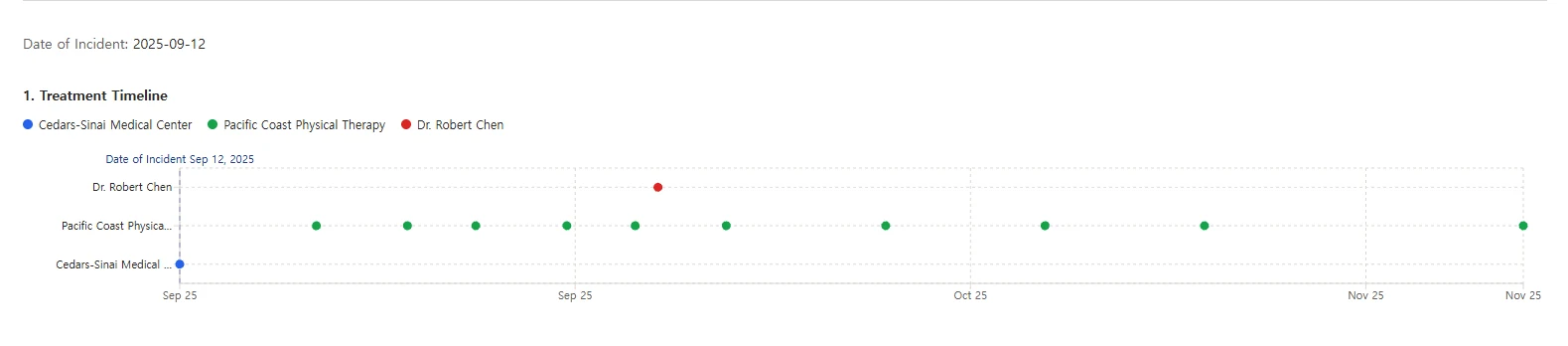
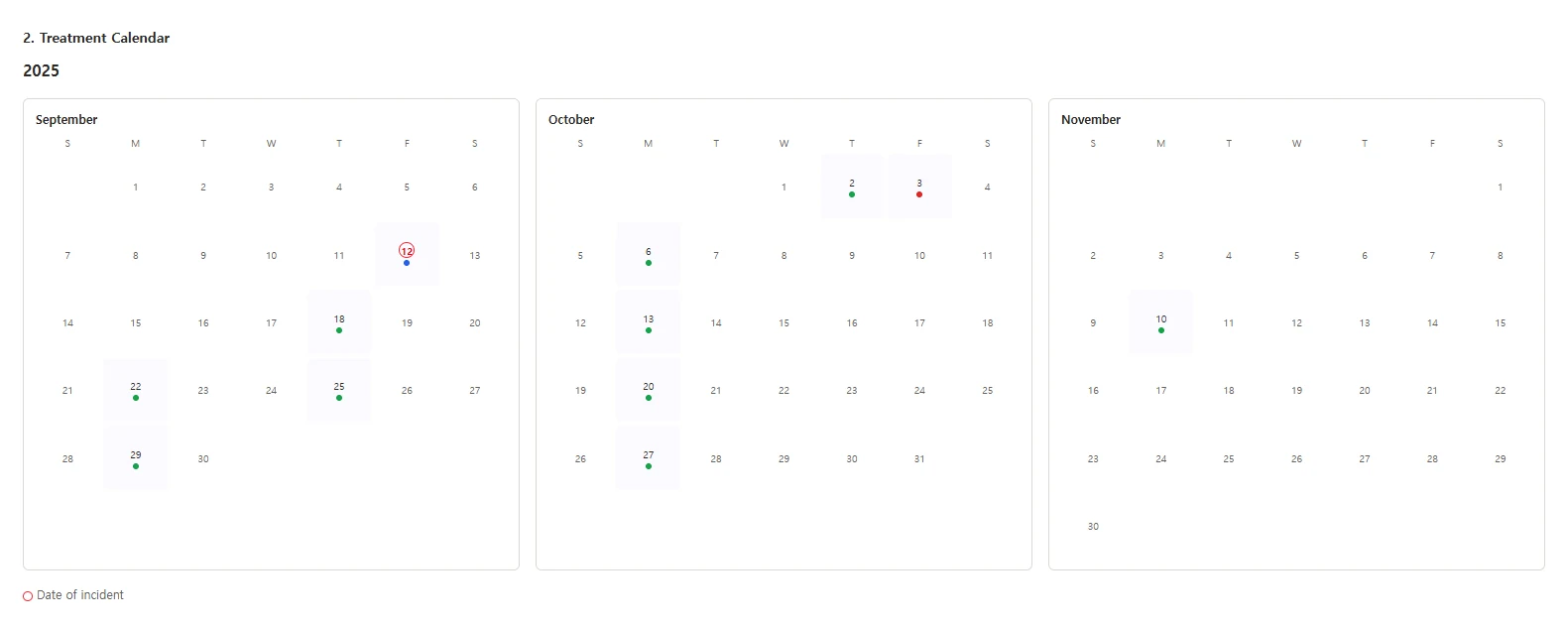
Use a table for the chronology itself, because adjusters check facts row by row. Add a calendar or timeline view to show gaps at a glance, and a short narrative summary for the demand. Most firms need all three, built from the same entries so they never disagree.
| Format | Best for | Weakness |
|---|---|---|
| Table (one row per encounter) | Accuracy, cross-checking bills, citing pages | Hard to read as a story |
| Calendar or timeline | Showing treatment gaps and continuity | Too little room for findings |
| Narrative summary | The medical sections of the demand | Easy to drift from the record if written separately |
Common Mistakes in Medical Chronologies
Most chronology mistakes are small and easy to fix. Each one hands the adjuster a reason to doubt the rest of the file.
Paraphrasing the findings
"Severe neck injury" isn't a finding. "C5-C6 2.8 mm broad-based bulge" is. Quote imaging impressions and exam findings as written.
Using the wrong date
Records carry several dates: service, signed, printed, faxed. Use the date of service, and keep the first-diagnosed date when it differs. Faxed pages often print the fax date at the top, so check the note itself.
Leaving gaps unexplained
A break in treatment invites the argument that your client recovered. Measure every gap and write the reason in the notes column, or flag it for the attorney.
Skipping the billing reconciliation
If the billed column doesn't match the specials, a visit or a bill is missing somewhere. Find it before the adjuster does.
Hiding a prior condition
Pre-incident records for the same body region belong in the chronology too, marked as prior. A disclosed prior condition can be argued as aggravation. A hidden one costs the letter its credibility once the adjuster pulls the claims history.
The billed column is the chronology's built-in audit. If it doesn't add up to the specials, something is missing, and it's better that you find it.

When a Record Is Still Missing
Sometimes the demand deadline arrives before every record does. Don't paper over it.
Add a row for the missing provider with the dates of service you know, the date you requested the records, and "records outstanding" in the notes. Keep the chronology open at that point.
A demand that names an outstanding record and reserves the right to supplement reads as careful. One that quietly skips a provider reads as a gap, and the adjuster will see the bill without the visit.
From Chronology to Demand Letter
The chronology feeds several sections of the demand: the summary of injuries, the summary of treatment, the radiology section, the objective findings and the specials. Our guide to writing a personal injury demand letter shows each one.
Medical records are generally admissible as business records, and statements made for medical diagnosis or treatment are a hearsay exception under Federal Rule of Evidence 803. That's why the chronology quotes the record instead of paraphrasing it.
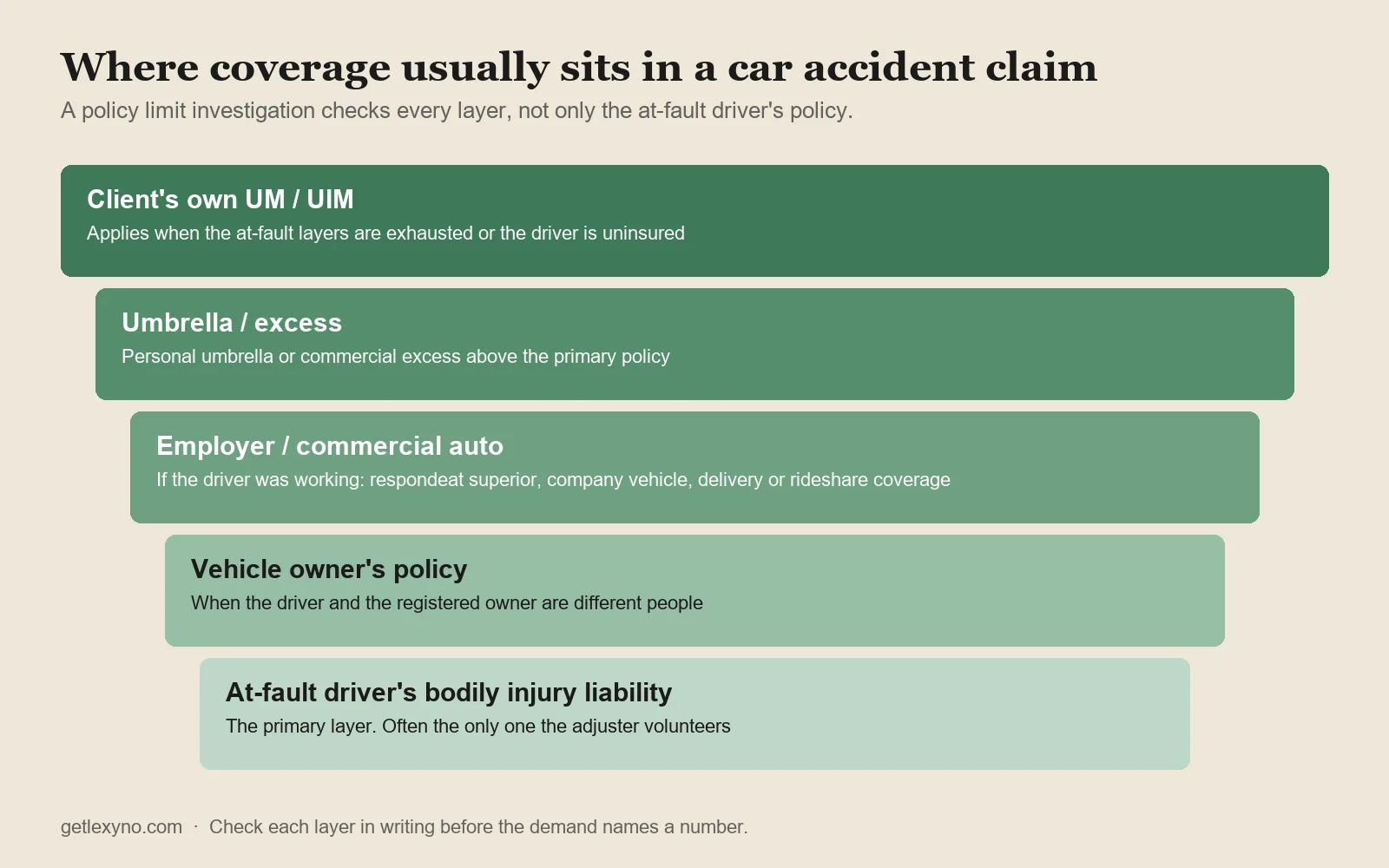
Two checks come next. Compare the chronology's total with the coverage you've confirmed in your policy limit investigation. Then read the file the way the adjuster will, as our guide to the demand letter to an insurance company explains.
Building all of this by hand is the largest single block of demand prep, as we break down in how long a demand letter takes. If software builds the first draft, check the numbers against the pages anyway. Our post on why AI demand letters get numbers wrong explains why.
How Lexyno Builds the Chronology
Lexyno's Medical Summary builds this chronology from the case's records. It extracts dates, providers, diagnoses, procedures and charges into events, each tied to its source page, and your team can review, correct or remove any event.
From those events, it produces a treatment timeline, a calendar that flags gaps over 30 days, a table of past visits, diagnostic highlights and a narrative summary. Everything exports to Word.
Before you send client records to any tool, check what its contracts cover. Our post on HIPAA and AI demand letters lists what to ask.
The same events feed the demand letter, so the chronology and the specials agree. Our guide to the AI medical chronology covers how software builds it and what to check. AI for assembly, humans for verification and strategy.
The Bottom Line
A medical record chronology is only as useful as its weakest row. Fill the same columns every time, quote the record, cite the page, and make the billed column match the specials.
Start from the template above. If you'd like to see it built from your own file, evaluate one real case with Lexyno.
Frequently asked questions
A date-ordered list of every medical encounter in a case, across all providers. Each entry records the date, provider, complaints, findings, diagnosis, treatment, billed amount and the page in the records where those facts appear. It is the factual base for the medical sections of a personal injury demand letter.
Columns for the date of service, provider and facility, visit type, complaints, objective findings, diagnosis with its ICD-10 code, treatment and plan, billed amount, and source page. Add a notes column for gaps, prior conditions and contradictions so the attorney can see what needs a decision.
Index the records and remove duplicates, then read every provider in date order on one timeline. Extract the same fields from each encounter with a source page, flag gaps and contradictions as you go, and reconcile the billed amounts against the itemized bills before the chronology is used in the demand.
A chronology lists each encounter in date order with the facts and the source page. A medical summary is a narrative that explains the injuries, the course of treatment and the prognosis in plain language. Most demand letters use both, built from the same records.
Yes. Put the billed amount on each entry. When the billed column is totaled, it should match the special damages in the demand letter. If the two totals differ, a bill or a visit is missing from one of them, and the adjuster will find it.
As long as the records require. One row per encounter is the rule, so a short soft-tissue case may fit on a page or two while a case with many providers runs much longer. Completeness and a source page on every entry matter more than length.
Related posts

Demand Letter to Insurance Company: A PI Firm's Guide
How a PI firm sends a demand letter to an insurance company: what to finish first, what the adjuster reads, deadlines, state rules and what comes back.

Medical Record Review for Attorneys: A PI Guide
A working guide to medical record review for PI attorneys: which records to collect, what to extract, how to catch gaps, and who should do the review.
Policy Limit Investigations: A Guide for PI Firms
How to run policy limit investigations before the demand: where hidden coverage sits, what to request in writing, and how the findings change the number.
What's next?
Ready to see the difference in your next case?
Put these strategies to work. Try a mock demand generated by Lexyno today.
Request Evaluation Access