 Rich Martin
Policy Limits Settlement: When and How to Demand the Limits
Policy Limits Settlement: When and How to Demand the Limits
What a policy limits settlement is, when to demand the limits, what makes the demand hard to refuse, and how state time-limited demand rules differ.

The specials are already past the at-fault driver's bodily injury limit. Your client isn't done treating. The adjuster has the same numbers you do, and both of you know where this is going.
This is when a policy limits settlement is on the table, and when the demand you send matters most. This guide covers what a policy limits settlement is and when to demand the limits. It also covers what makes the demand hard to refuse, and how state rules differ.
It isn't legal advice. Rules change, so check your jurisdiction.

What Is a Policy Limits Settlement?
A policy limits settlement is one where the at-fault party's liability insurer pays the full limit of the applicable policy, usually because documented damages meet or exceed it. Your client releases the insured in exchange. Any further recovery then depends on other coverage, such as umbrella, employer or your client's own UIM coverage.
Finding that coverage is its own job. Our guide to policy limit investigations covers where it hides and how to confirm it in writing. This post picks up once you know the number.
When Should You Demand the Policy Limits?
Demand the limits when the documented damages approach or exceed the confirmed coverage, the records prove it, and your client has agreed to the net recovery after fees and liens. If damages fall well below the limits, send an ordinary demand with a figure and a basis.
| Situation | Usual letter | Check first |
|---|---|---|
| Damages clearly exceed confirmed limits | Policy limits demand, often time-limited | Every layer of coverage, all claimants, liens |
| Damages close to the limits | A figure "or policy limits" | Records complete enough to carry the number |
| Damages well below the limits | Ordinary demand with a stated basis | The figure and its support |
| Limits not yet confirmed | None yet: finish the investigation | Written disclosure from each carrier |
Before You Send: Settle the Net With Your Client
A limits demand can be accepted fast. Once it is, your client is bound by it. So the money conversation happens first, not after.
Walk your client through the gross amount, your fee, the case costs, and every lien that will come out of it. Health plans, Medicare, Medicaid and provider liens can all take a share.
Get the client's approval of the net in writing. If the net is too small to be worth it, you'd rather know before the carrier says yes. Our medical records to settlement workflow covers where liens come in.
What Makes a Policy Limits Demand Hard to Refuse?
A strong policy limits demand names the right policy and insured, offers a full release of the insured within limits, accounts for liens and other claimants, proves the damages with records, and gives a clear, reasonable deadline and acceptance method. Each missing piece gives the insurer a reason to say the demand wasn't one it could accept.
- 1The right policy and insured. Confirmed in writing, with the claim number and every insured you're releasing.
- 2An amount within limits and a full release. A demand above the limits, or without a release of the insured, often doesn't trigger the insurer's duty to settle.
- 3Liens and other claimants addressed. Say how medical liens will be handled, and whether anyone else has a claim on the same limits.
- 4Proof. The records and bills that support the damages, organized so the adjuster can check them.
- 5A clear deadline and acceptance method. A specific date, a delivery method that proves receipt, and how acceptance must be made, all meeting any state rule that applies.
The proof is what most demands are thin on. A chronology whose billed column matches the specials makes the number hard to argue with. Our medical record chronology template shows how to build one.
How Do State Rules for Time-Limited Demands Differ?
Some states set the required terms of a time-limited demand by statute, others rely on case law, and many have no specific rule. Where a statute applies, it can control the deadline, the delivery method, the release, the records and how acceptance works. The table compares five states, each linked to its primary source.
| State | Source | What it does |
|---|---|---|
| Georgia | O.C.G.A. § 9-11-67.1 (as amended by SB 83, 2024) | Sets the material terms of a written offer in motor vehicle claims, including at least 30 days to accept from receipt by certified mail or statutory overnight delivery, and medical records sufficient to evaluate the claim. Applies from the claim's accrual until the defendants answer, so it isn't limited to pre-suit offers. The 2024 version covers offers made on or after April 22, 2024. |
| Florida | Fla. Stat. § 624.155(4) | No bad-faith action lies if the insurer tenders the lesser of its limits or the amount demanded within 90 days after notice of a claim with sufficient supporting evidence. Added in 2023; applies to causes of action filed after March 24, 2023. Limits can be requested under § 627.4137. |
| California | Code Civ. Proc. §§ 999–999.5 | For pre-suit demands on auto, motor vehicle, homeowner and commercial premises policies sent on or after January 1, 2023. The demand must be labeled or cite the statute, allow at least 30 days from transmission (33 if sent by regular mail), offer to settle within limits with a full release, and include reasonable proof. |
| Texas | Stowers doctrine, as restated in Garcia (1994) | Case law, not a statute. The insurer's duty arises when the claim is within coverage, the demand is within limits, and the terms are ones an ordinarily prudent insurer would accept given the insured's exposure. |
| Washington | Tank v. State Farm (1986); Besel v. Viking (2002) | A third-party claimant can't sue the insurer directly for bad faith. The insured's claim can be assigned, for example through a covenant judgment, and a settlement found reasonable sets the presumptive damages. |
Statutes in this area change, and each one has scope limits the table can't hold. Read the current text, check the effective date against your claim, and treat the table as a starting point. If you're in California, our upcoming guide to the CCP § 999 rules goes deeper.

Several Claimants, One Policy
A multi-car crash can leave several injured people chasing the same limits. That changes the demand.
The insurer may not be able to pay one claimant the full limits without exposing its insured to the others. Some states address this directly.
Florida's § 624.155(6), for example, sets out a route for competing claims, such as interpleader or arbitration. Elsewhere, a global settlement or an agreed split may be the way through.
Either way, say in the demand whether you know of other claimants. Pretending they don't exist gives the insurer an easy reason to wait.
What Happens If the Insurer Refuses?
In many states, an insurer that unreasonably refuses a reasonable settlement within limits can become liable for a later judgment above the limits. That claim usually belongs to the insured, not your client, and is often assigned to your client after an excess judgment. How it works depends on the state.
California set the pattern early. In Comunale (1958), an insurer refused a reasonable settlement within limits. The court held it liable for the whole judgment.
In Crisci (1967), it asked whether a prudent insurer without policy limits would have accepted the offer.
That's why the demand itself matters so much. If the demand was vague, above limits, or missing a required term, the insurer can argue there was nothing reasonable to accept.
If the insurer accepts, get the release and payment terms in writing and check them against your demand. A response that adds a new condition may not be an acceptance at all. Under California's CCP § 999.3, for example, asking for clarification or more time isn't a rejection.
A policy limits demand is written for two readers: the adjuster today, and a judge later if the insurer says no.

Common Mistakes in Policy Limits Demands
| Mistake | What it costs | Fix |
|---|---|---|
| Demanding more than the limits without a reason | May not trigger the duty to settle | Demand within limits; pursue other coverage separately |
| Sending before the limits are confirmed | The demand targets the wrong policy or amount | Written disclosure first |
| Releasing only some insureds | The insurer can't accept on its insured's behalf | Name and release every insured covered by the policy |
| Ignoring liens and other claimants | The insurer can't pay without risk | Address liens; flag other claimants on the same limits |
| A deadline that misses the state rule | The demand may lose its intended effect | Check the statute's minimum period and delivery method |
| Thin proof | Gives the insurer a reason to ask for more time | Attach organized records and bills that match the specials |
How Lexyno Helps With the Demand
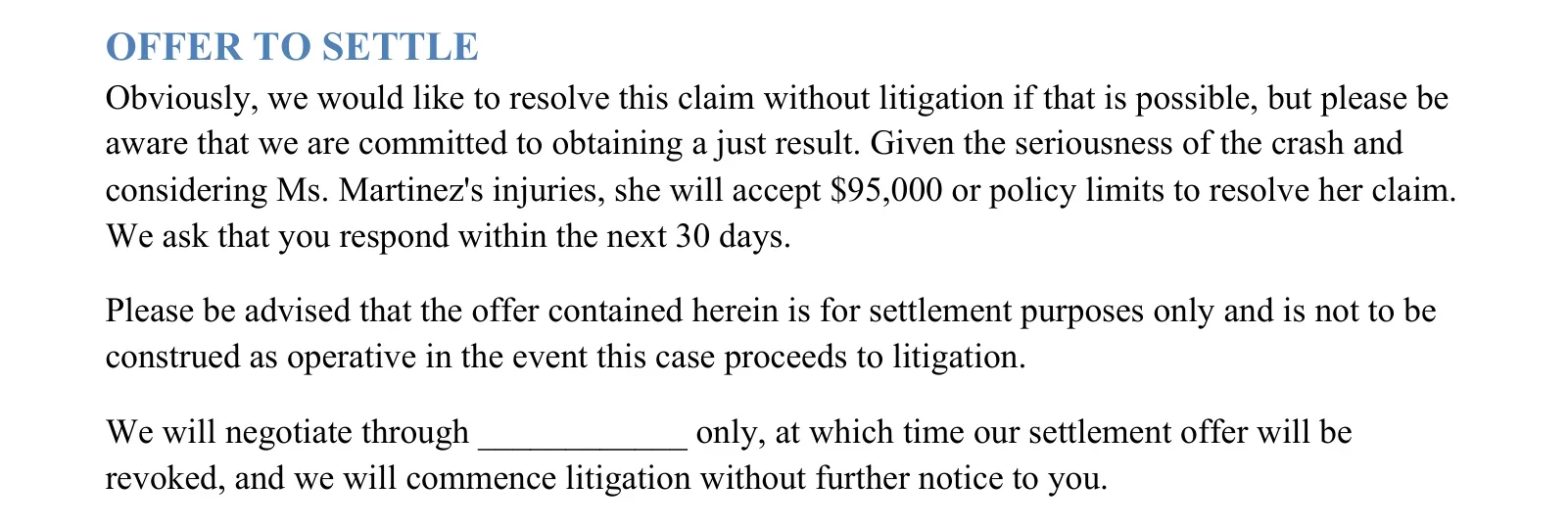
Lexyno's AI demand letter software drafts the demand, including the offer to settle, from the case's records and the strategy counsel chooses. Figures carry source references, so a reviewer can check them against the record.
On plans that include them, POV Reports read the same file from the insurer's side. You see the weak points before the adjuster does. The legal judgment, the deadline and the state rules stay with your firm. AI for assembly, humans for verification and strategy.
The Bottom Line
A policy limits settlement is won or lost in the demand.
Confirm every layer of coverage. Offer a full release within limits. Prove the damages. Meet your state's rules for the deadline and delivery.
Start from the free personal injury demand letter template, or evaluate one real case with Lexyno. For the rest of the letter, see our guides to the demand letter to an insurance company, writing each section, and the car accident sample.
Frequently asked questions
A settlement in which the at-fault party's liability insurer pays the full limit of the applicable policy, usually because documented damages meet or exceed that limit. The claimant gives the insured a release in exchange. Whether more money is available then depends on other coverage, such as umbrella, employer or the client's own UIM coverage.
When the documented damages approach or exceed the confirmed limits, the records are complete enough to prove it, and the client has agreed to the net recovery after fees and liens. Confirm the limits and the policy in writing first, and check whether your state regulates time-limited demands.
A settlement offer that must be accepted within a stated period. Several states regulate them. Georgia, for example, sets required terms in O.C.G.A. § 9-11-67.1, and California does so for pre-suit demands in Code of Civil Procedure §§ 999 to 999.5. A demand that misses a required term may lose the effect it was meant to have.
In many states, an insurer that unreasonably refuses a settlement within limits can become liable for a later judgment above the limits. That claim usually belongs to the insured, not the claimant, and is often assigned to the claimant after an excess judgment. The rules differ by state, so check yours.
No. Some states set required terms by statute, others rely on case law, and many have no specific rule. Where a statute applies, it can control the deadline, the delivery method, the release and what records must be included. Check the current text in your jurisdiction before you send the demand.
Related posts

Medical Record Chronology: Template and Example for PI
How to build a medical record chronology for a PI case: a free template, a filled-in example from a demo case, the right format, and mistakes to avoid.

Demand Letter to Insurance Company: A PI Firm's Guide
How a PI firm sends a demand letter to an insurance company: what to finish first, what the adjuster reads, deadlines, state rules and what comes back.

Medical Record Review for Attorneys: A PI Guide
A working guide to medical record review for PI attorneys: which records to collect, what to extract, how to catch gaps, and who should do the review.
What's next?
Ready to see the difference in your next case?
Put these strategies to work. Try a mock demand generated by Lexyno today.
Request Evaluation Access