 Rich Martin
CCP 998 Offers: A Guide for California PI Attorneys
CCP 998 Offers: A Guide for California PI Attorneys
How California PI attorneys use CCP 998 offers: what the offer must include, timing, what happens if it is rejected, recent cases, and setting the number.

The pre-suit demand didn't settle the case. The complaint is filed, discovery is under way, and the defense is waiting you out. In California, the next real lever is often a CCP 998 offer.
A 998 offer puts a price on saying no. This guide covers what section 998 requires, when to serve the offer and how long it stays open, what happens when it's rejected, and two recent California Supreme Court decisions. It also covers how the offer fits with the demand you already sent, and how to set the number from the same file.

What Is a CCP 998 Offer?
A CCP 998 offer is a written settlement offer under California Code of Civil Procedure section 998. Any party can serve one at least 10 days before trial or arbitration. If the other side rejects it and then does no better at trial, the statute shifts certain costs to them. Plaintiffs and defendants both use it.
The point isn't the document. It's the risk it creates. A defendant who ignores a reasonable plaintiff's offer, or a plaintiff who turns down a fair defense offer, may pay for that choice when the verdict comes in.
Demand Letter, CCP 999 or CCP 998: Which Offer When?
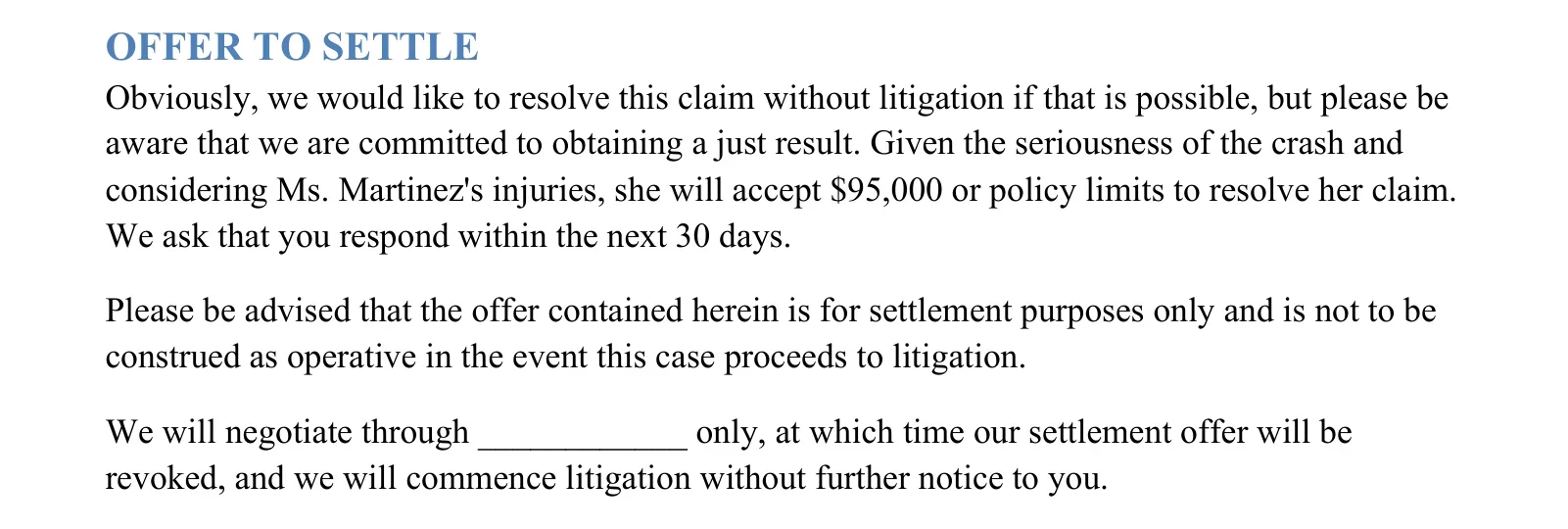
Use a demand letter before suit to lay out the case for the adjuster. Use a CCP 999 time-limited demand before suit when you want a statutory deadline to accept within limits. Use a 998 offer after suit to put cost risk on a rejection. The same case file supports all three.
Mixing them up is how a firm sends the wrong document at the wrong time. Here's how they compare.
| Pre-suit demand letter | CCP 999 time-limited demand | CCP 998 offer | |
|---|---|---|---|
| When | Before suit, once treatment is far enough along | Before suit | After suit, at least 10 days before trial or arbitration |
| Sent to | The carrier and adjuster | The carrier, under the statute's requirements | The opposing party, by service |
| Main job | Lay out the case and ask for a number | Set a statutory deadline to accept within limits | Shift costs if the offer is rejected and beaten |
| Open for | The deadline you set | 30 days, or 33 if sent by mail | Until trial starts or 30 days, whichever comes first |
The same file powers all three. Our guide to policy limits settlements and time-limited demands covers the pre-suit side, including California's section 999. Our guide to the demand letter to the insurance company covers the letter itself.
What Must a 998 Offer Include?
A 998 offer must be in writing and served on the other party. It needs the terms and conditions of the judgment or award, and a provision that lets the other side accept by signing a statement that the offer is accepted. Acceptance must also be in writing, signed by counsel or a self-represented party.
The California Supreme Court quoted the statute's requirements in full in Madrigal v. Hyundai Motor America (2025). Check the current statute before you serve, since it can be amended.
- Written and served: on the party you want to bind.
- Terms and conditions: what judgment or award you're offering to accept or pay.
- Acceptance provision: a line the other side can sign to accept.
- Certain enough to value: vague terms make an offer hard to enforce for cost-shifting.
The Judicial Council publishes an optional form, CIV-090. It's a plaintiff's offer for a money judgment, built for cases with one plaintiff and one defendant. With multiple defendants, liens or non-monetary terms, most attorneys draft their own.

When to Serve It and How Long It Stays Open
Serve the offer at least 10 days before trial or arbitration starts. Earlier is usually better, because cost-shifting runs from the time of the offer. An offer served early puts more of the case's costs at stake.
The offer is deemed withdrawn if it isn't accepted before trial or within 30 days after it's made, whichever comes first. For this rule, trial starts at the beginning of the plaintiff's opening statement. If there's no opening statement, it starts when the first witness is sworn or evidence is introduced.
Calendar the 30 days the day you serve. A missed acceptance window isn't something you can fix later. If you receive a defense offer, calendar it the same day too. Your client needs time to decide, and you need time to advise them before the window closes.
What Happens If a 998 Offer Is Rejected?
It depends on who made the offer and how the case ends. If a plaintiff rejects a defense offer and doesn't do better, the plaintiff loses post-offer costs and pays the defendant's costs from the offer date. If a defendant rejects a plaintiff's offer and the plaintiff does better, the defendant may pay the plaintiff's post-offer expert costs.
| Who offered | Rejected, and the result is | What the statute does |
|---|---|---|
| Defendant | Plaintiff doesn't get a more favorable judgment or award | Plaintiff doesn't recover post-offer costs and pays the defendant's costs from the offer date. The court may also order the plaintiff to pay the defendant's post-offer expert fees |
| Defendant | Those shifted costs | Are deducted from the plaintiff's damages; if they exceed the damages, the defendant gets a net judgment |
| Plaintiff | Plaintiff gets a more favorable judgment or award | The court may require the defendant to pay a reasonable amount for the plaintiff's post-offer expert witness costs |
For a plaintiff's firm, both rows matter. Your own 998 offer creates pressure on the defense. A defense 998 offer creates risk for your client, and the decision to reject it belongs to the client, with your advice.
Two Recent California Supreme Court Decisions
Two decisions changed how 998 offers work in practice. Both are lemon law cases under the Song-Beverly Act, not personal injury cases, but they interpret section 998 itself.
Settling before trial doesn't erase a lapsed offer. In Madrigal v. Hyundai Motor America (Mar. 20, 2025), a plaintiff let a defense 998 offer lapse and later settled before trial. The court held the plaintiff doesn't automatically avoid section 998's cost-shifting. Section 998 sets the default rule, and the parties can still agree to different cost terms in the settlement. Put costs in your settlement terms expressly.
An offer can give a choice. In Gorobets v. Jaguar Land Rover North America (Aug. 6, 2026), the court held that a single 998 offer can present alternative sets of terms. It's valid if it presents the alternatives clearly and at least one is certain enough to value when the offer is made. The party seeking cost-shifting has to show the offer was valid.

Setting the Number From Your Demand File
A plaintiff's 998 offer only works if the defense believes it may lose to it. That means the number has to be defensible, and the case behind it has to be on paper. The best source is the file you already built for the pre-suit demand.
- Specials: the billed totals from the itemized bills, matched to the chronology.
- The medical story: the treatment sequence, objective findings and the treating doctors' opinions.
- What changed since the demand: new treatment, new bills, a surgery recommendation, deposition testimony.
- The defense's view: what the carrier argued in response to the demand, and what discovery has done to those arguments.
If your chronology and specials were built carefully for the demand, updating them for a 998 offer is a short job. If they weren't, the 998 is a good reason to rebuild them. Our medical chronology template and guide to each section of a demand letter show the pieces.
The number is the attorney's call. Section 998 rewards an offer that's realistic, not one that's aspirational. An offer the defense can beat at trial puts no pressure on anyone.
It helps to look back at your pre-suit demand. If you asked for a figure then, ask yourself what has changed since. A 998 offer well below your demand can look like weakness, and one well above it needs new facts to explain it. Either way, you should be able to show the defense why the number moved.
Mistakes That Waste a 998 Offer
Most failed 998 offers fail on form or timing, not on the number. Check these before you serve.
- No acceptance provision. The statute requires a way to accept by signing. Leave it out and the offer may not count.
- Terms nobody can value. Conditions like confidentiality or releases of unnamed claims can make an offer too uncertain. Keep terms specific.
- One offer to several defendants. A joint offer to multiple parties raises its own problems. Draft carefully, and don't use CIV-090 for it.
- Served too late. Less than 10 days before trial or arbitration is too late.
- No calendar entry. Nobody tracks the 30 days, and nobody follows up.
- Costs left out of a settlement. After Madrigal, say what happens to costs when you settle.
Where Lexyno Fits
Lexyno doesn't draft 998 offers. It builds the file they depend on. Lexyno's AI demand letter software drafts the pre-suit demand from the case's records, with source references on the figures. Our car accident demand letter sample is written for California. Medical Summary keeps the chronology and specials current as new records arrive.
When the defense answers, POV reports read the same record from the insurer's side, which helps you see where a 998 number will be attacked. Plans are on the pricing page. Our post on the eggshell plaintiff rule covers one of the arguments that often moves the number.
Make the Offer They'd Regret Rejecting
A CCP 998 offer is a settlement offer with a cost attached to saying no. Serve it in writing with a way to accept, give it a number the record supports, calendar the 30 days, and put costs in any settlement.
The demand opened the conversation. The 998 offer gives it a deadline with consequences.
Start the pre-suit side from our PI demand letter template, or try Lexyno on one case from your own file, free.
Frequently asked questions
A written settlement offer under California Code of Civil Procedure section 998. Any party can serve one at least 10 days before trial or arbitration. If the other side rejects it and then does no better at trial, the statute shifts certain costs. Plaintiffs and defendants both use it.
Until trial or arbitration starts, or 30 days after it is made, whichever comes first. If it is not accepted by then, it is deemed withdrawn. For this rule, trial starts at the plaintiff’s opening statement, or when the first witness is sworn or evidence is introduced if there is no opening.
If the plaintiff then fails to get a more favorable judgment or award, the plaintiff does not recover post-offer costs and pays the defendant’s costs from the time of the offer. The court can also order the plaintiff to pay the defendant’s post-offer expert witness fees. Those costs come out of the damages.
Yes, an optional one. Judicial Council form CIV-090 is a plaintiff’s offer to compromise for a money judgment, for cases with one plaintiff and one defendant. Many attorneys draft their own offer instead, especially with multiple parties or non-monetary terms.
Yes, under the California Supreme Court’s 2026 decision in Gorobets v. Jaguar Land Rover North America. An offer can give a choice between sets of terms if it presents the alternatives clearly and at least one is certain enough to value when the offer is made.
A demand letter is a pre-suit request to the carrier to settle, with the case laid out for the adjuster. A 998 offer is a statutory offer served after a case is filed, with cost consequences if it is rejected and the result is no better. Many cases see both.
Related posts
How Long Do Hospitals Keep Medical Records? A PI Guide
How long hospitals and doctors keep medical records, state by state, and what a PI firm should check before requesting pre-accident records.

Eggshell Plaintiff Rule: Using It in a PI Demand Letter
How to use the eggshell plaintiff rule in a PI demand: how it differs from aggravation, the evidence that proves it, and how to write it into the letter.

Medical Record Retrieval for Lawyers: A PI Firm's Guide
Medical record retrieval for PI lawyers: the three request routes, what a HIPAA authorization needs, deadlines, fees, follow-up, and how to check the file.
What's next?
Ready to see the difference in your next case?
Put these strategies to work. Try a mock demand generated by Lexyno today.
Request Evaluation Access