 Rich Martin
Medical Record Retrieval for Lawyers: A PI Firm's Guide
Medical Record Retrieval for Lawyers: A PI Firm's Guide
Medical record retrieval for PI lawyers: the three request routes, what a HIPAA authorization needs, deadlines, fees, follow-up, and how to check the file.

The demand is ready except for one provider. The PT clinic sent the treatment notes but not the bill. The ER sent the bill but not the imaging report. And the orthopedist hasn't answered at all.
Every PI paralegal knows this week. This guide covers medical record retrieval for lawyers from the first request to the last missing page. You'll get the three ways to request records and the deadline and fee rules for each, what a HIPAA authorization has to say, a follow-up schedule, and how to check that the file is complete before the chronology starts.

What Is Medical Record Retrieval?
Medical record retrieval is the work of requesting, tracking and collecting a client's medical records and bills from every provider who treated them. For a PI firm, it's the step before the chronology and the demand. A record you never received can't support the claim, and the adjuster will notice the visit you didn't document.
Retrieval ends when you have a complete set: every provider, every date of service, the records and the bill for each. What happens next, the chronology and the summary, is covered in our medical record chronology template and medical record summary guide.
Build the Provider List Before You Send Anything
You can't request records from a provider you don't know about. Most missing records trace back to an incomplete provider list, not a slow provider. Build the list from several sources, because each one catches what the others miss.
- The client interview: every place they went, including urgent care, a chiropractor and a telehealth visit.
- Discharge papers: ER and urgent care instructions often name the follow-up provider.
- Referrals in the notes: each record you receive names the next provider. Read for "referred to" and "follow up with."
- Pharmacy history: the prescriber on each fill is a provider, even if the client forgot the visit.
- Health plan statements: the client's explanation of benefits lists every provider who billed their insurer.
- Imaging centers: an MRI is often done at a separate facility with its own records and its own bill.
Update the list every time a new record arrives. A new name in a note is a new request. Our post on how paralegals cut demand letter prep time covers tracking this kind of list without a spreadsheet nobody updates.
Prior Records: When to Ask for Treatment Before the Accident
The adjuster will look for a pre-existing condition. If your client had back pain three years before the crash, the carrier may find it before you do. Asking for prior records lets you see it first and address it in the demand on your terms.
Keep the request narrow. Ask for prior treatment of the same body parts, from the providers the client names, for the period your case needs. Describe that period in the authorization. A request for "all records, ever" takes longer, costs more, and hands you pages you'll have to read.
Talk to the client before you ask. They may remember a prior visit you can request directly. And if a prior condition was made worse by the accident, that's part of the damages, not a reason to hide the history. How you handle it in the letter is a decision for the attorney.
Three Ways to Request a Client's Medical Records
Most firms use one route for everything. There are three, and federal rules treat them differently. Which one you pick changes the deadline you can hold the provider to and the fee rule that applies.
| HIPAA authorization | Client's own access request | Client-directed copy to the firm | |
|---|---|---|---|
| Who sends it | The firm, with the client's signed authorization | The client | The client, in a signed written directive naming the firm |
| Federal rule | 45 CFR 164.508 | 45 CFR 164.524 | 45 CFR 164.524, as limited by the 2020 Ciox ruling |
| What it covers | What the authorization describes | The client's records | An electronic copy of the client's electronic health record |
| Federal response deadline | None in HIPAA; check state law | 30 days, plus one 30-day extension with written notice | Same as an access request |
| HIPAA fee limit | Doesn't apply; state law and provider policy | Reasonable, cost-based fee only | Doesn't apply since 2020 |
| Best for | Most requests, bills and non-electronic records | A slow provider, when the client can help | Electronic records from a large health system |
The 2020 ruling matters for your costs. In Ciox Health v. Azar, a federal court limited the client-directed route to an electronic copy of an electronic health record. HHS's notice on the ruling says the patient-rate fee limit now applies only to a patient's own access, not to records sent to a third party like your firm.
So the cheapest route on paper isn't always the cheapest in practice. Some firms have the client request the records directly, then forward them. That keeps the client's access rights and the 30-day clock in play. It also adds a step, and the client has to follow through. These are federal rules. Your state may add deadlines, fee caps or forms, so check them before you rely on any of this.
What Must a HIPAA Authorization Include?
A valid HIPAA authorization must describe the records, name who may disclose them and who receives them, state the purpose, and set an expiration date or event. The client signs and dates it. It also needs three notice statements, and it must be written in plain language. A missing element gives the provider a reason to reject it.
Here's the list, from 45 CFR 164.508(c). Check your form against it once, then reuse it.
- The records: described specifically, such as "all records and itemized bills for dates of service from 09/12/2025 to present."
- Who discloses: the provider, by name.
- Who receives: your firm, by name.
- The purpose: "at the request of the individual" is enough when the client starts it.
- Expiration: a date or an event.
- Signature and date: if a personal representative signs, a description of their authority.
- Right to revoke: a statement that the client can revoke in writing.
- No conditioning: a statement about whether treatment or payment can depend on signing.
- Redisclosure: a statement that disclosed records may be redisclosed and no longer protected by the rule.
Write the description of the records with the demand in mind. "Any and all records" sounds complete, but some providers read it narrowly and send only the visit notes. Name what you need: office notes, imaging reports, therapy notes, orders, referrals and itemized bills. If you need images themselves, not just the reports, ask for them separately. Radiology departments often treat images as a different request.
Some providers insist on their own form. Send theirs too when they do. Arguing about forms costs more time than signing a second one.
Why Providers Reject Records Requests
A rejected request is the slowest kind, because you usually find out weeks later. Most rejections come from a handful of fixable problems. Check for them before the request goes out, not after the provider sends it back.
| The problem | The fix |
|---|---|
| The authorization expired | Use an expiration event tied to the case, such as resolution of the claim, and track the date if you use one |
| The records aren't described specifically | Name the record types and the dates of service you need |
| The wrong entity is named | Use the provider's legal name; hospital groups often bill under a different name than the sign on the building |
| Someone else signed for the client | Describe the signer's authority, such as a parent of a minor or a court-appointed representative, and attach proof |
| The provider wants its own form | Send it with yours; don't argue |
| The fax was unreadable | Send a clean PDF, and confirm receipt by phone |
Keep one master authorization that passes all of these, and reuse it. Every custom edit is a new chance for a rejection.
Records and Bills: Ask Both Departments
The most common gap in a PI file isn't a missing provider. It's a provider whose records arrived without the bill, or the other way around. At many facilities, medical records and billing are different departments. A request to one doesn't reach the other.
Ask for both, by name, from every provider. Facility charges usually come on a UB-04 and professional charges on a CMS-1500. You need itemized charges for each date of service to prove the specials.
| Provider | Request these records | And this bill |
|---|---|---|
| Ambulance | Patient care report (run report) | Itemized transport bill |
| Emergency department | Triage, physician notes, orders, discharge instructions | Facility bill and separate physician bill |
| Radiology | Imaging reports; images on request | Facility and reading radiologist bills |
| Physical therapy | Initial evaluation, daily notes, re-evaluations, discharge summary | Itemized bill by visit |
| Specialist | Consult notes, procedure notes, referrals out | Itemized professional bill |
| Pharmacy | Prescription history printout | Receipts or pharmacy statement |

How Long Does Medical Record Retrieval Take?
It depends on the route, the provider and the state. When a patient requests their own records, HIPAA gives the provider 30 days, plus one 30-day extension if it explains the delay in writing. HIPAA sets no deadline for disclosures under an authorization. In practice, retrieval takes as long as your follow-up allows.
The rule is in 45 CFR 164.524(b)(2). For authorizations, check whether your state sets its own response time. Either way, put the request date on your calendar the day it goes out.

A Follow-Up Schedule That Keeps Requests Moving
Requests rarely fail at the provider. They fail in your office, when nobody follows up. A simple schedule fixes most of it. Adjust the days to your state and your providers.
- 1Day 0: send and log. Send the request with the authorization. Log the provider, the department, the date and how it went out.
- 2About a week in: confirm receipt. Call and confirm they have it and the authorization is accepted. Ask for a reference number.
- 3Pay fast. If they send an invoice first, pay it the day it arrives. An unpaid invoice stops the clock on your side.
- 4Every week or two: check status. Same contact, same reference number. Note every answer.
- 5When it stalls: change routes. Escalate to the records supervisor, or have the client make an access request with its 30-day clock.
The log does a second job. If a carrier later questions a gap, you can show when you asked and what the provider said. Our records-to-settlement workflow shows where retrieval sits in the whole demand timeline, and how long a demand letter takes shows why retrieval is usually the longest wait.
Should You Use a Record Retrieval Company?
Use a record retrieval company when a case has many providers, out-of-state facilities, or more requests than your staff can follow up on. The company sends the requests and chases them. Before you sign, ask how they report status, how they pass through provider fees, and what security terms cover the records.
Retrieval companies don't remove the work on your side. Someone still collects the authorization, tells the company which providers exist, and checks what comes back. They're a capacity tool, not a substitute for knowing the file.
- Status: Can you see each request's status without calling?
- Fees: Do they pass provider fees through at cost, or mark them up?
- Bills: Do they request itemized bills as well as records, by default?
- Delivery: Do you get searchable PDFs, organized by provider?
- Security: Who can access the records, where are they stored, and which subcontractors touch them?
The same evaluation questions apply to review vendors. Our guide to choosing a medical record review service covers them, and our HIPAA guide for PI firms covers the security side.

How to Check the Records You Got Back
A package arriving doesn't mean the request is complete. Before you close it, run these checks. Each one is yes or no.
- Dates match: every date of service on the bill has a matching note in the records.
- Referrals land: every referral or order in the notes has a record from the provider it went to.
- Imaging is complete: every study ordered has a report.
- Pages are whole: no missing page numbers, cut-off scans or blank fax pages.
- The right patient: name and date of birth match on every page.
A gap in treatment can mean the client stopped going. It can also mean a record never came. Before you explain a gap to the adjuster, confirm it's real.
Completeness matters most when the demand has a deadline. A time-limited policy limits demand sent with records missing gives the carrier a reason to say it couldn't evaluate the claim.
Where Lexyno Fits
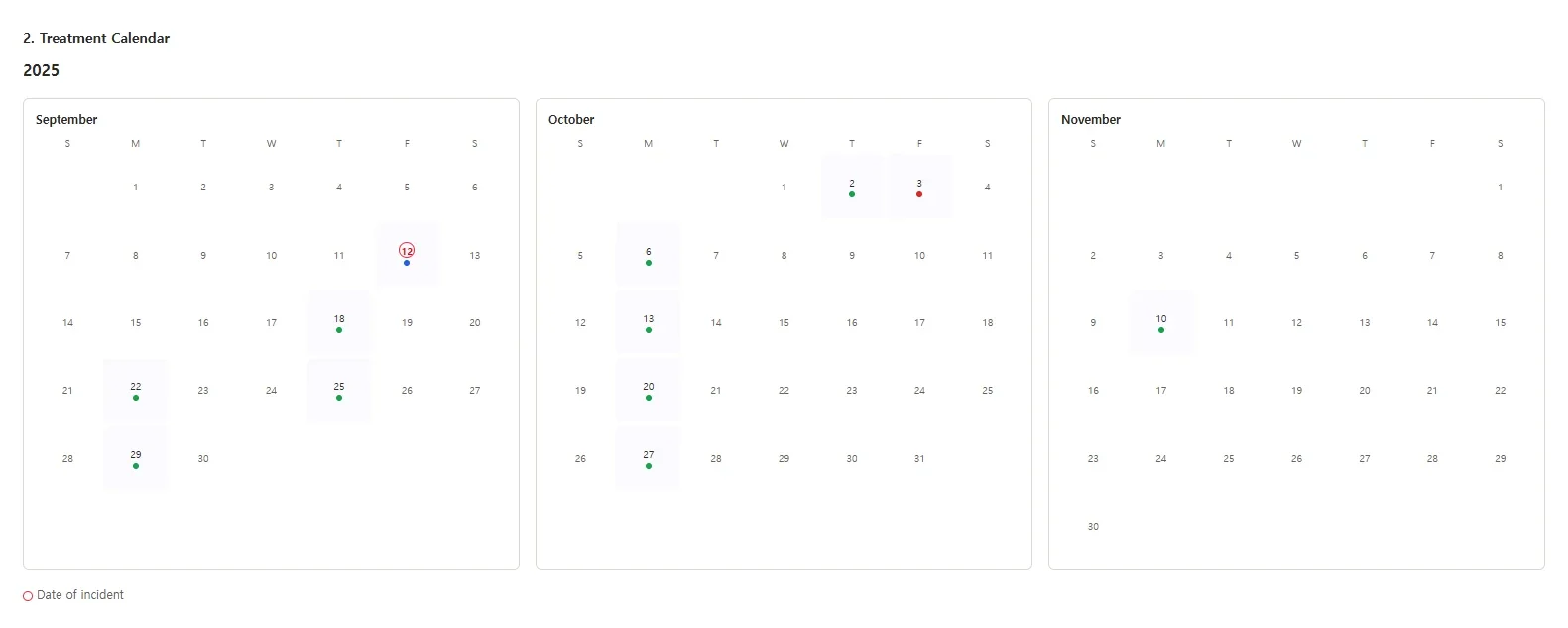
Lexyno doesn't retrieve records. It starts once they arrive. Medical Summary extracts dates, providers, diagnoses, procedures and charges from the records into events, each tied to its source page. The treatment calendar flags gaps over 30 days, which is often the first sign a record is missing.
Your team can review, correct or remove any event, and the same events feed the demand letter. Our guide to AI medical chronology explains how the extraction works, and our guide to medical record review covers the reading that comes next. Plans are on the pricing page.
The Demand Is Only as Complete as the Records
Medical record retrieval is slow, manual and easy to put off. It's also where most weak demands start. Pick the right route, use an authorization that can't be rejected, ask for the bills, follow up on a schedule, and check what comes back.
A visit you never requested is a visit the adjuster gets to ignore.
When the records are in, start the letter from our PI demand letter template, or try Lexyno on one case from your own file, free. For what to send once the file is complete, see our guides to the demand letter to the insurance company, each section of the letter, and a finished car accident sample.
Frequently asked questions
Usually with a HIPAA authorization the client signs, naming the firm as the recipient. The client can also request their own records under the HIPAA right of access, or direct the provider to send an electronic copy of their health record to the firm. Each route has different deadlines and fee rules.
For a patient’s own access request, HIPAA gives the provider 30 days, with one extension of up to 30 more days if it tells the patient why in writing. HIPAA sets no response deadline for a disclosure under an authorization, though state law may. Follow up on a schedule either way.
A specific description of the records, who may disclose them, who receives them, the purpose, an expiration date or event, and the client’s signature and date. It also needs statements about the right to revoke, that treatment cannot be conditioned on signing, and that disclosed information may be redisclosed. It must be in plain language.
It depends on the route and the state. HIPAA limits fees to a reasonable, cost-based amount only when patients request their own records. Since a 2020 federal court ruling, that limit does not apply when records go to a third party such as a law firm. State law and provider policies set most other fees.
Yes. Billing is often handled by a different department than medical records. Ask for an itemized bill for each date of service along with the records. Facility charges usually come on a UB-04 and professional charges on a CMS-1500, and you need both to prove the specials.
When a case has many providers, out-of-state facilities, or a volume your staff cannot chase in time. A retrieval company handles requests and follow-up. Before you sign, ask how they track status, how they pass through provider fees, and what security terms cover the records they handle.
Related posts

Medical Record Review Services: How PI Firms Choose One
How PI firms choose medical record review services: which reviewer a case needs, what to ask a vendor, how to test one, and what stays on your desk.

Medical Record Summary: How to Write One for a PI Demand
How to write a medical record summary for a PI demand: what to include, a worked example from a demo case, how adjusters read it, and mistakes to avoid.

Policy Limits Settlement: When and How to Demand the Limits
What a policy limits settlement is, when to demand the limits, what makes the demand hard to refuse, and how state time-limited demand rules differ.
What's next?
Ready to see the difference in your next case?
Put these strategies to work. Try a mock demand generated by Lexyno today.
Request Evaluation Access