 Rich Martin
Eggshell Plaintiff Rule: Using It in a PI Demand Letter
Eggshell Plaintiff Rule: Using It in a PI Demand Letter
How to use the eggshell plaintiff rule in a PI demand: how it differs from aggravation, the evidence that proves it, and how to write it into the letter.

The adjuster's response arrives two weeks after the demand. "The MRI shows degenerative disc disease. These findings predate the accident." Your client had never complained about their neck before the crash. Now the carrier wants to pay for a sprain.
That letter is why the eggshell plaintiff rule matters in pre-lit, not just at trial. This guide covers what the rule says and how it differs from the aggravation rule. Then it covers the evidence that makes either one stick, and how to write it into the demand so the adjuster has nothing easy to argue.

What Is the Eggshell Plaintiff Rule?
The eggshell plaintiff rule holds a defendant liable for the full harm their wrongful act causes. That's true even if the injured person was unusually fragile and a healthier person would have been hurt less. The defendant takes the plaintiff as they find them. It's a common law doctrine, also called the eggshell skull or thin skull rule.
Cornell's Legal Information Institute defines it the same way. If the wrongful act was the proximate cause of the injury, the defendant answers for the harm, however severe. The classic example is a person with a thin skull. A blow that wouldn't hurt most people gives them a serious head injury.
California's pattern jury instruction puts it in one sentence. Under CACI 3928, jurors award full compensation for the harm caused. That holds "even if" the plaintiff was more susceptible to injury than a normally healthy person. Other states have their own pattern instructions. Check yours before you quote one.
Eggshell Plaintiff vs. Aggravation of a Preexisting Condition
Two rules usually travel together, and mixing them up is how demands overreach. The eggshell rule is about fragility: the defendant pays for the full harm caused. The aggravation rule is about an existing condition: the defendant pays for the worsening, not for the condition your client already had.
| Eggshell plaintiff (thin skull) | Aggravation of a preexisting condition | |
|---|---|---|
| California instruction | CACI 3928, Unusually Susceptible Plaintiff | CACI 3927, Aggravation of Preexisting Condition or Disability |
| The idea | A fragile plaintiff recovers the full harm caused, even if a healthy person would have been hurt less | No damages for the condition itself; damages for the effect the conduct had on it |
| What you claim | All the harm the incident caused | The difference between before and after |
| What you must prove | The incident caused this harm, in this person | A baseline before, a change after, and a doctor linking the change to the incident |
| What the carrier argues | The harm was unforeseeable or came from something else | Nothing changed; the symptoms would have come anyway |
In a demand, you'll usually lean on both. The eggshell rule answers "a healthy person wouldn't have been hurt this badly." The aggravation rule frames what you're claiming for the old condition. Claim the change, prove the change, and the rules do the rest.

How Do Adjusters Attack Preexisting Conditions?
Adjusters attack preexisting conditions by arguing the symptoms would have happened anyway. They cite degenerative findings on imaging, prior treatment for the same body part, the client's age, or a gap in care. Each argument shifts the cause away from the incident. Your demand should answer each one before the adjuster raises it.
- "Degenerative" on the MRI report. A finding on a scan isn't the same as a condition that hurt. Ask whether your client had symptoms or treatment before the crash, not whether the scan shows wear.
- Prior treatment. A chiropractic visit three years ago becomes "ongoing back problems." Show when that treatment ended and what the client could do after it.
- Age. The adjuster says older spines hurt. The eggshell rule says that's the defendant's problem, not your client's.
- A gap before the incident. This one helps you. A long stretch with no treatment is evidence of a stable baseline.
- "No objective change." Answer with new findings, new restrictions, or new treatment that didn't exist before.
What Evidence Proves an Aggravation?
Proving an aggravation takes three things. You need the client's baseline before the incident and the change after it. You also need a treating doctor who connects the change to the incident in their own words. The records carry the claim. The client's account and people who saw the change support it, but they don't replace the paper.
| What you need | Where it comes from |
|---|---|
| The baseline | Prior records of the same body part: the last visit, how the client was doing, any restrictions. Also work and activity before the crash |
| The change | New symptoms, new findings, new diagnoses, new treatment or restrictions after the incident, with dates |
| The link | A treating doctor's note or letter connecting the change to the incident |
| Support | The client's own account, family or coworkers who saw the difference, employer records |
Get the prior records before the carrier does. Our guide to medical record retrieval covers how to request prior treatment narrowly, for the same body parts and the period the case needs. Build the before-and-after into the medical chronology so the change is visible by date. Our guide to medical record review covers flagging prior conditions while you read.

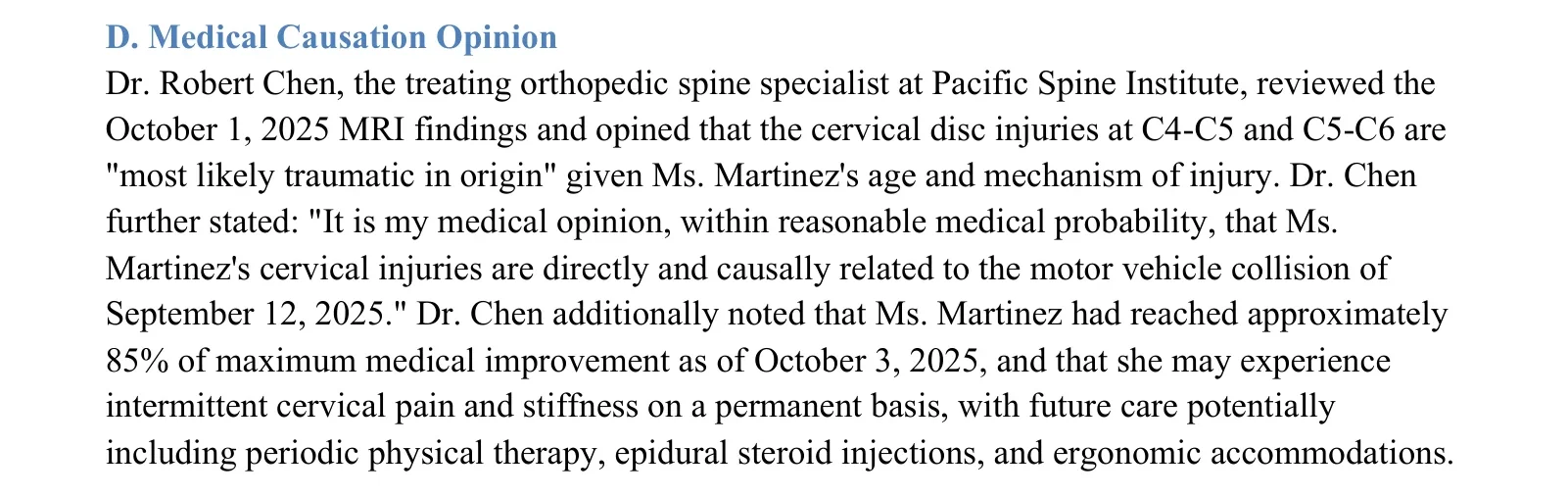
The doctor's words matter most. Ask the treating physician to address the prior condition directly: what it looked like before, what changed, and whether the incident caused the change. In the demo case below, the spine specialist answers the age question before the carrier asks it. He calls the disc injuries "most likely traumatic in origin" given the client's age and the mechanism of injury.
How to Write It Into the Demand Letter
Put the prior condition in the letter yourself, in the causation section, before the injuries. Say what it was, how the client was doing before the crash, what changed, and who says the crash caused the change. Then claim the change. Don't argue the doctrine at length. Adjusters know the rule; they want the facts that trigger it.
Here's an illustration. It's a made-up client, not a real case.
Weak: Mr. Alvarez's preexisting condition was severely aggravated by the collision, and under the eggshell plaintiff rule your insured is liable for all of his damages.
Better: Mr. Alvarez treated for low back pain at Valley Chiropractic in 2022 and was discharged with no restrictions (p. 14). He worked full shifts as a warehouse lead for the next three years without further treatment. Two days after the collision, he reported new pain radiating to his left leg (p. 31). His MRI showed a new disc herniation at L4-5 (p. 40). His treating physician wrote that the collision caused the herniation and aggravated his prior condition (p. 52).
The weak version asserts a conclusion and names a doctrine. The better version gives the adjuster a baseline, a change, a doctor and a page for each fact. It never says "eggshell." It doesn't need to.
Our guide to writing each section of a demand letter shows where causation sits. The PI demand letter template includes an optional subsection for preexisting conditions under causation.

When the Eggshell Rule Won't Carry the Claim
The rule has limits, and a demand that ignores them loses credibility. It doesn't pay for the condition your client already had. California's CACI 3927 is direct about it. There are no damages for a condition the plaintiff already had, only for the effect the conduct had on it.
It also doesn't prove causation for you. If nothing in the records shows a change, the rule has nothing to work with. Watch for events in between, too. If your client had a second accident or a fall before the new symptoms, expect the carrier to blame that event.
When the prior condition was serious and active right up to the crash, be honest about what you're claiming. A demand that claims the whole condition invites a low offer on everything. A demand that claims the change, and proves it, keeps the rest of the letter credible.
Where Lexyno Fits
Lexyno's AI demand letter includes a causation section with a subsection for preexisting conditions, drafted from the case's records. Medical Summary lists each diagnosis with the date it was first diagnosed and its source page. A prior diagnosis and a new one sit side by side.
The causation theory, including how to frame a prior condition, stays with the attorney. Your team can review, correct or remove any extracted event before the letter goes out. Our post on what AI should and shouldn't do for PI lawyers explains that split. Our medical record summary guide shows how to quote the treating doctor instead of arguing causation yourself.
Prove the Change, Claim the Change
The eggshell rule means a fragile client isn't a discounted client. The aggravation rule means you claim what changed. Get the prior records, show the baseline, show the change, and let the treating doctor connect them.
The defendant takes your client as they found them. Your demand should show the adjuster exactly how that was.
For the rest of the letter, see the demand letter to the insurance company, the car accident sample and the records-to-settlement workflow. Or try Lexyno on one case from your own file, free.
Frequently asked questions
A common law rule that a defendant takes the injured person as they find them. If the defendant’s wrongful act causes the injury, the defendant is liable for the full harm, even if a healthier person would have been hurt less. It is also called the eggshell skull or thin skull rule.
The eggshell rule says a fragile plaintiff can recover the full harm the defendant caused. The aggravation rule limits recovery for an existing condition to the worsening the defendant caused, not the condition itself. Most demands with a prior condition rely on both, and the evidence has to show the change.
Generally yes, for the harm the incident caused, including making an existing condition worse. Under California’s pattern instruction, for example, a plaintiff is not compensated for the condition they already had, but is compensated for the effect the defendant’s conduct had on it. Check your state’s instructions.
They point to the preexisting condition and say the symptoms would have happened anyway. Common moves are citing degenerative findings on imaging, prior treatment for the same body part, the client’s age, or a gap in care. The answer is evidence of the client’s baseline before the incident and the change after it.
Records showing the baseline before the incident, records showing new symptoms, findings or treatment after it, and a treating doctor who connects the change to the incident in their own words. The client’s account and people who saw the change help, but the medical records carry the claim.
If the carrier can find it in the records, address it first. A demand that explains the prior condition and proves the change reads as credible. A demand that ignores it hands the adjuster the first argument. How much to say is the attorney’s call in each case.
Related posts

Medical Record Retrieval for Lawyers: A PI Firm's Guide
Medical record retrieval for PI lawyers: the three request routes, what a HIPAA authorization needs, deadlines, fees, follow-up, and how to check the file.

Medical Record Review Services: How PI Firms Choose One
How PI firms choose medical record review services: which reviewer a case needs, what to ask a vendor, how to test one, and what stays on your desk.

Medical Record Summary: How to Write One for a PI Demand
How to write a medical record summary for a PI demand: what to include, a worked example from a demo case, how adjusters read it, and mistakes to avoid.
What's next?
Ready to see the difference in your next case?
Put these strategies to work. Try a mock demand generated by Lexyno today.
Request Evaluation Access