 Rich Martin
NJ Verbal Threshold: A Guide for PI Attorneys
NJ Verbal Threshold: A Guide for PI Attorneys
The NJ verbal threshold for PI attorneys: who is bound, the six categories, the physician certification and its 60-day deadline, and how to prove it.

Your new client's declarations page says "limitation on lawsuit." That one line decides whether the case has a pain and suffering claim at all. In New Jersey, it means the NJ verbal threshold applies, and the injury has to fit one of six categories.
This guide covers what the verbal threshold is and who it binds. It walks through the six categories and the physician certification. Then it shows how to prove a permanent injury and what to put in your demand.

What Is the NJ Verbal Threshold?
The NJ verbal threshold is the limitation on lawsuit option in New Jersey auto policies. If your client is bound by it, they can recover pain and suffering only for six kinds of injury: death, dismemberment, significant disfigurement or scarring, a displaced fracture, loss of a fetus, or a permanent injury. The rule is in N.J.S.A. 39:6A-8(a).
The alternative is the no limitation on lawsuit option in subsection (b), which keeps the full right to sue. It costs more. The Department of Banking and Insurance puts it plainly in its consumer guide. The limited option "will save you money, but will limit your right to sue."
An Intake Checklist for New Jersey Auto Cases
You can spot most threshold problems in the first two weeks. Run these questions on every New Jersey auto case before you take on the work of a full demand.
- Which policy and which option? Ask your client for the declarations page, or request it from the carrier. Note the tort option and the PIP limit.
- Who was the named insured? If your client lives with a parent or spouse, their policy's option may be the one that binds your client.
- Was the car insured? If your client was driving their own uninsured car, the claim may be gone entirely.
- Which category is realistic? Look at the first records for a displaced fracture, imaging findings or measured limits.
- Who will certify? Identify the treating physician, and whether a specialist referral is likely.
- Any prior injuries? Ask about earlier treatment to the same body part, and plan to request those records.
Write the answers into the file. When you draft the demand months later, you'll know which category you're proving and what the carrier will push back on. If the answers point to a weak threshold case, you'll know that early too, and you can advise your client honestly.
Who Is Bound by the Limitation on Lawsuit Option?
The option follows the policy, not the person. If the named insured chose it, it applies to them and to immediate family in the household. The same is true if they didn't choose either option in writing. The default rule is in N.J.S.A. 39:6A-8.1.
| Who | Threshold? | Source |
|---|---|---|
| Named insured who chose the limitation on lawsuit option | Yes | 39:6A-8(a) |
| Named insured who didn't choose either option in writing | Yes, by default | 39:6A-8.1(b) |
| Spouse and resident children of the named insured (immediate family, as defined) | Same option as the named insured | 39:6A-8.1(a), (d) |
| Named insured under a Basic or Special policy | Yes | 39:6A-8 |
| Person eligible for PIP who isn't required to carry it and isn't an immediate family member under a policy | No; the no limitation option applies | 39:6A-8 |
| Person who was required to insure their car and was driving it uninsured | No claim for economic or noneconomic loss at all | 39:6A-4.5(a) |
Get the declarations page and the coverage selection form at intake. Don't assume the option from the client's memory. Many people don't remember choosing, and the default applies if they didn't.
What Are the Six Verbal Threshold Categories?
Under N.J.S.A. 39:6A-8(a), the injury must result in one of six things. Death, dismemberment, significant disfigurement or scarring, displaced fractures and loss of a fetus are usually easy to show. The sixth, a permanent injury, is where most contested cases are fought. Here is the list as the statute frames it:
- death
- dismemberment
- significant disfigurement or significant scarring
- displaced fractures
- loss of a fetus
- a permanent injury within a reasonable degree of medical probability, other than scarring or disfigurement
The statute defines permanent. The body part or organ "has not healed to function normally and will not heal to function normally with further medical treatment." Notice the two parts. The body part hasn't healed, and further treatment won't heal it.
What Must the Physician Certification Say?
Within 60 days after the defendant answers, the plaintiff must serve a physician's certification. It comes from the treating physician, or a board-certified physician the treating physician referred the plaintiff to. It's made under penalty of perjury and must rest on objective clinical evidence. The court can allow one more 60-day period for good cause.
- Who signs: the treating physician, or a board-certified physician on referral from the treating physician.
- What it rests on: objective clinical evidence, which may include medical testing.
- What doesn't count: testing that is experimental or depends entirely on the patient's subjective response.
- When: within 60 days after the answer, with one possible extension of up to 60 days for good cause.
- The stakes: the statute makes a false certification a crime of the fourth degree.
The certification is a litigation step, but it starts in pre-suit. If the treating records don't show objective findings, no certification can rest on them later. Build the proof while the client is still treating.

Proving a Permanent Injury With Objective Evidence
"Objective clinical evidence" means findings someone else can measure or see, not just the client's report of pain. That usually means imaging, measured range of motion, and documented test results, recorded over time by the treating providers.
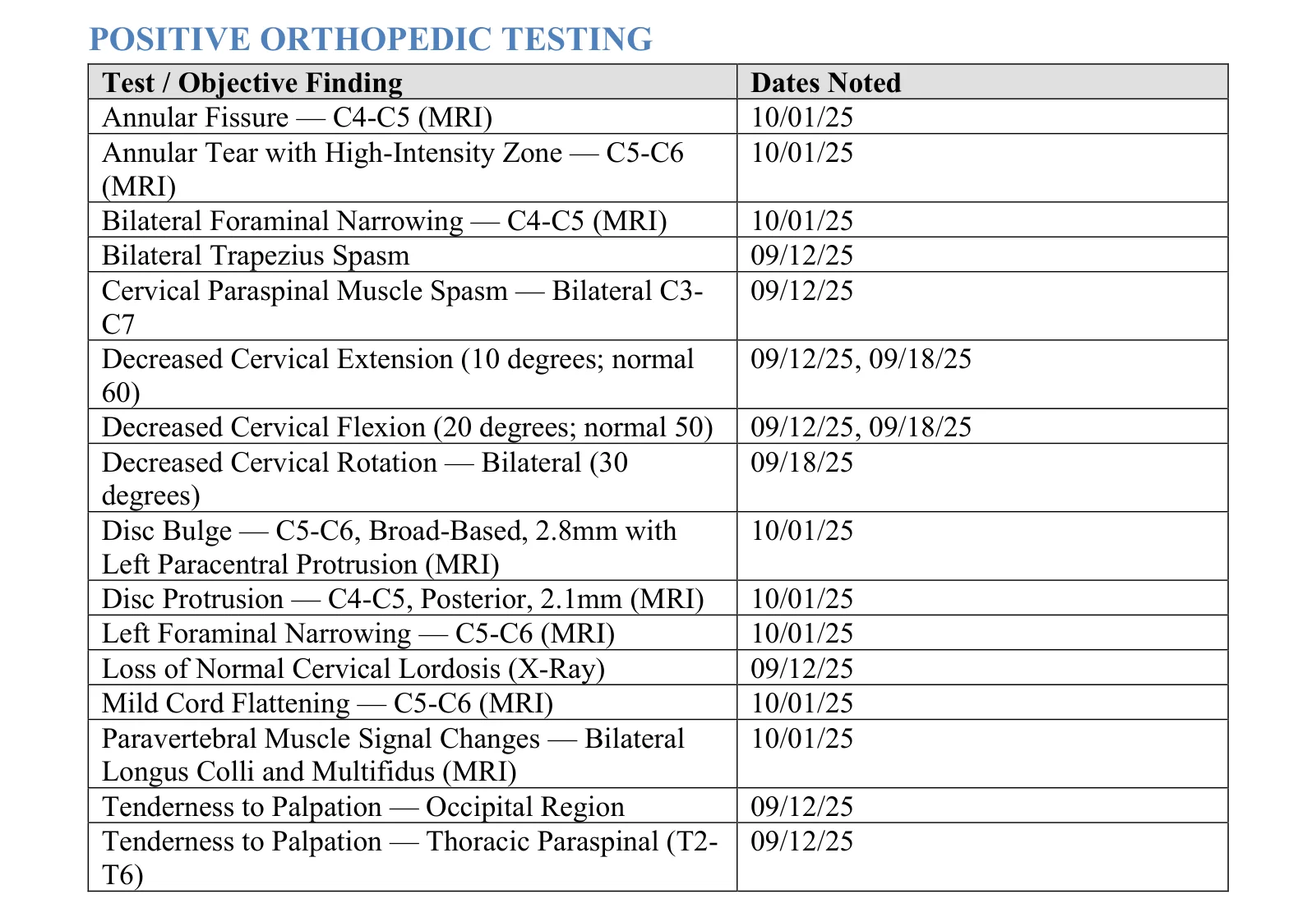
Look at what the table carries. MRI findings at specific levels. Range of motion in degrees, next to the normal value. The date each finding was noted. That's the kind of record a certification can point to. Subjective entries, like a pain score, help the damages story but won't carry the threshold alone.
Our guide to the medical record chronology shows how to keep each finding tied to its page. Our eggshell plaintiff guide covers prior conditions the defense will raise.
What It Means for Your Demand
Your demand has to show the carrier that the case clears the threshold. Showing that your client was hurt isn't enough.
- 1Confirm the tort option. Get the declarations page and the selection form, and note which option applies to your client.
- 2Name the category. Say which of the six categories the claim relies on.
- 3Lead with objective findings. Imaging, measured range of motion, test results, with dates and pages.
- 4Quote the treating doctor on permanence. In the doctor's words, with the page.
- 5Plan the certification now. Know which physician will sign it and what they'll rely on, before suit.
Our guide to each section of a demand letter shows where the injury proof sits. For how other states set a threshold, see our New York no fault guide, which covers New York's 2026 changes.
Mistakes That Sink a Verbal Threshold Case
Most threshold problems start long before suit. Watch for these in your own files.
- Guessing the tort option. You assume "full coverage" means no limitation. Get the declarations page and check.
- Treatment that stops too early. If your client stops treating before anyone measures the limits, there's nothing objective to certify.
- Pain scores without measurements. A record full of "8/10 pain" and no degrees of motion won't carry permanence.
- No referral trail. If you plan to use a specialist for the certification, make sure the treating physician referred your client to them.
- A missed 60 days. The clock runs from the answer. Calendar it the day the answer comes in.
- Ignoring prior conditions. If your client had treatment for the same body part before, you need records that show the change.
Each of these is fixable early and hard to fix late. That's why the threshold is an intake issue as much as a litigation issue. Our post on how long a demand letter takes covers building that time into the file.
New Jersey PIP Limits
The verbal threshold limits noneconomic damages. Medical bills are first paid through personal injury protection. On the standard policy, PIP medical coverage defaults to $250,000 per person per accident unless the insured chose a lower amount in writing.
| PIP medical option | Note | Source |
|---|---|---|
| $250,000 | Default on the standard policy if no lower option is chosen in writing | 39:6A-4(a), 4.3(e) |
| $150,000, $75,000, $50,000 or $15,000 | Lower options the insured can choose | 39:6A-4.3(e) |
| Up to $250,000 regardless of the option | For certain injuries, including permanent or significant brain injury, spinal cord injury or disfigurement | 39:6A-4.3(e) |
The Department of Banking and Insurance's 2026 Buyer's Guide lays out both policy types and the tort options in plain language. It's a good document to send a client who asks why their option matters.
Check the Law Before You Rely on It
We checked the statute against the official New Jersey statutes database, updated through P.L.2026, c.50. Section 39:6A-8 was last amended in 2003, and we found no enacted change to the threshold in 2024 through 2026. Bills to change it have been introduced. New York changed its own threshold in 2026, so check New Jersey's current text before you rely on any of this.
Where Lexyno Fits
Lexyno doesn't decide whether an injury clears the threshold or prepare the physician certification. Those are the attorney's and the doctor's calls. Lexyno's AI demand letter software drafts the demand from the case's records. That includes a positive orthopedic testing table and the radiology findings, with source references on the figures.
Medical Summary builds the chronology that shows when each objective finding was first noted and by whom. Plans are on the pricing page. Our guide to medical record retrieval covers getting the imaging reports and the treating notes in time.
The Threshold Starts at Intake
The NJ verbal threshold limits pain and suffering claims to six categories, and most cases turn on permanent injury. Confirm the tort option early, build the objective record while the client is treating, and plan the physician certification before you file.
The policy choice was made long before the crash. Your proof has to be built long before the certification is due. Start building it the week your client signs.
Start the demand from our PI demand letter template. See our guide to the demand letter to the insurance company. Or try Lexyno on one case from your own file, free.
Frequently asked questions
It is the limitation on lawsuit option in N.J.S.A. 39:6A-8(a). A person bound by it can recover noneconomic loss, like pain and suffering, only for an injury that results in death, dismemberment, significant disfigurement or scarring, a displaced fracture, loss of a fetus, or a permanent injury.
The statute says an injury is permanent when the body part or organ has not healed to function normally and will not heal to function normally with further medical treatment, within a reasonable degree of medical probability. Scarring and disfigurement are separate categories.
Within 60 days after the defendant answers the complaint. The court can allow one additional period of up to 60 days for good cause. The certification must come from the treating physician or a board-certified physician the treating physician referred the plaintiff to.
Objective clinical evidence, which may include medical testing. The testing may not be experimental or depend entirely on the patient’s subjective response. The certification is made under penalty of perjury, and a false certification is a crime of the fourth degree.
The named insured who chose it, or who did not choose either option in writing, and immediate family members living in the household. It also applies to people insured under New Jersey’s Basic and Special policies. Other rules apply to people who are not required to carry PIP.
On the standard policy, $250,000 per person per accident, unless the insured chose a lower option in writing. Lower options are $150,000, $75,000, $50,000 and $15,000, with up to $250,000 still available for certain serious injuries such as permanent or significant brain or spinal cord injury.
Related posts

New York No Fault in 2026: Serious Injury After the Reforms
New York no fault and serious injury after the 2026 reforms: the eight categories left, the new fault rules, deadlines, and what it means for your demand.

IFCA Notice: Washington's 20-Day Rule for PI Attorneys
When Washington’s IFCA applies in a PI case, who can send the 20-day notice, how to send it to the carrier and the OIC, and how it fits with your demand.

CCP 999: California Time-Limited Demand Requirements
What CCP 999 requires in a California time-limited demand: covered claims, each 999.1 element, where to send it, the deadline, and the carrier’s duties.
What's next?
Ready to see the difference in your next case?
Put these strategies to work. Try a mock demand generated by Lexyno today.
Request Evaluation Access