 Rich Martin
New York No Fault in 2026: Serious Injury After the Reforms
New York No Fault in 2026: Serious Injury After the Reforms
New York no fault and serious injury after the 2026 reforms: the eight categories left, the new fault rules, deadlines, and what it means for your demand.

Your New York demand template probably still argues the 90/180-day category. For cases filed after May 26, 2026, that argument is gone. New York's 2026 reforms rewrote the serious injury definition, added a fault bar, and capped some claims. The demand has to catch up.
This guide covers how New York no fault insurance works, what changed in 2026, the serious injury categories that remain, the no-fault deadlines, and what all of it means for the demand you send to the at-fault driver's carrier.
How Does New York No Fault Work?
New York no fault insurance pays an injured person's basic economic loss, up to $50,000, regardless of fault. To recover non-economic loss like pain and suffering from the at-fault driver, the injured person needs a serious injury under Insurance Law 5102(d). Economic loss above the no-fault amount can also be claimed against the at-fault driver.
The bar on suing is in Insurance Law 5104(a). Between covered persons, there's no recovery for non-economic loss except for a serious injury, and no recovery for basic economic loss. Basic economic loss is defined in Insurance Law 5102(a).
| Basic economic loss item | Limit |
|---|---|
| Total per person | $50,000 combined |
| Necessary medical and related expenses | Within the $50,000 |
| Lost earnings | Up to $2,000 a month, for up to three years from the accident |
| Other reasonable and necessary expenses | Up to $25 a day, for up to one year |
What Changed in New York in 2026?
Part EE of Chapter 58 of the Laws of 2026 changed four things for motor vehicle injury cases. It deleted the 90/180-day serious injury category, put fault before serious injury at trial, added a fault bar, and capped non-economic damages for some at-fault drivers. The changes apply to actions commenced on or after May 26, 2026.
The New York Department of Financial Services summarized the changes in Insurance Circular Letter No. 3 (2026).
| Change | Before | After (actions commenced on or after May 26, 2026) |
|---|---|---|
| 90/180-day category | A non-permanent injury that kept the person from substantially all usual daily activities for 90 of the first 180 days counted as a serious injury | Deleted from Insurance Law 5102(d) |
| Order of questions | No statutory order | The trier of fact decides fault first, then whether the injury is serious; non-economic liability is fixed only after a serious injury is found |
| Comparative fault | Pure comparative fault | New CPLR 1411(b): recovery is barred if the claimant's culpable conduct is greater than the defendants' combined |
| Non-economic cap | None | $100,000 cap for at-fault claimants who were driving uninsured (unless the lapse was under 30 days), or were impaired or committing a felony and convicted; not for death cases |
Two cautions. Many websites, including some statute copies, still show the old nine-category definition. And cases commenced before May 26, 2026 may still be governed by the old rules. Check the current text and the filing date before you rely on either version.
What Counts as a Serious Injury Now?
For actions commenced on or after May 26, 2026, a serious injury is death, dismemberment, significant disfigurement, a fracture, loss of a fetus, permanent loss of use of a body organ, member, function or system, permanent consequential limitation of use of a body organ or member, or significant limitation of use of a body function or system.
That's eight categories. For many soft-tissue cases, the 90/180 category used to be the fallback when there was no fracture and no permanent finding. That fallback is gone for new cases. The remaining categories turn on objective proof.
- Fracture: the imaging report and the diagnosis.
- Permanent consequential limitation: a treating doctor's opinion that the limitation is permanent, with findings behind it.
- Significant limitation of use: measured findings, such as range of motion in degrees, compared with normal, from the treating providers.
- Significant disfigurement: photographs and the treating records.

What It Means for the Demand Letter
Your demand to the at-fault driver's carrier now has to do three things well. If you get these right, you give the adjuster little room to argue the threshold.
- 1Name the category. Say which serious injury category the claim relies on, and point to the records that prove it.
- 2Put the numbers in. Range of motion in degrees, imaging findings, and the treating doctor's words on permanence. A carrier reading for the threshold looks for measurements.
- 3Make liability airtight. With the new fault bar, a client found more at fault than the defendants recovers nothing. Lead with the liability facts.
Daily limitations still matter. They support the damages story, even if they no longer qualify as a threshold category on their own in new cases. Here's how a demand can show them, provider by provider, with dates.
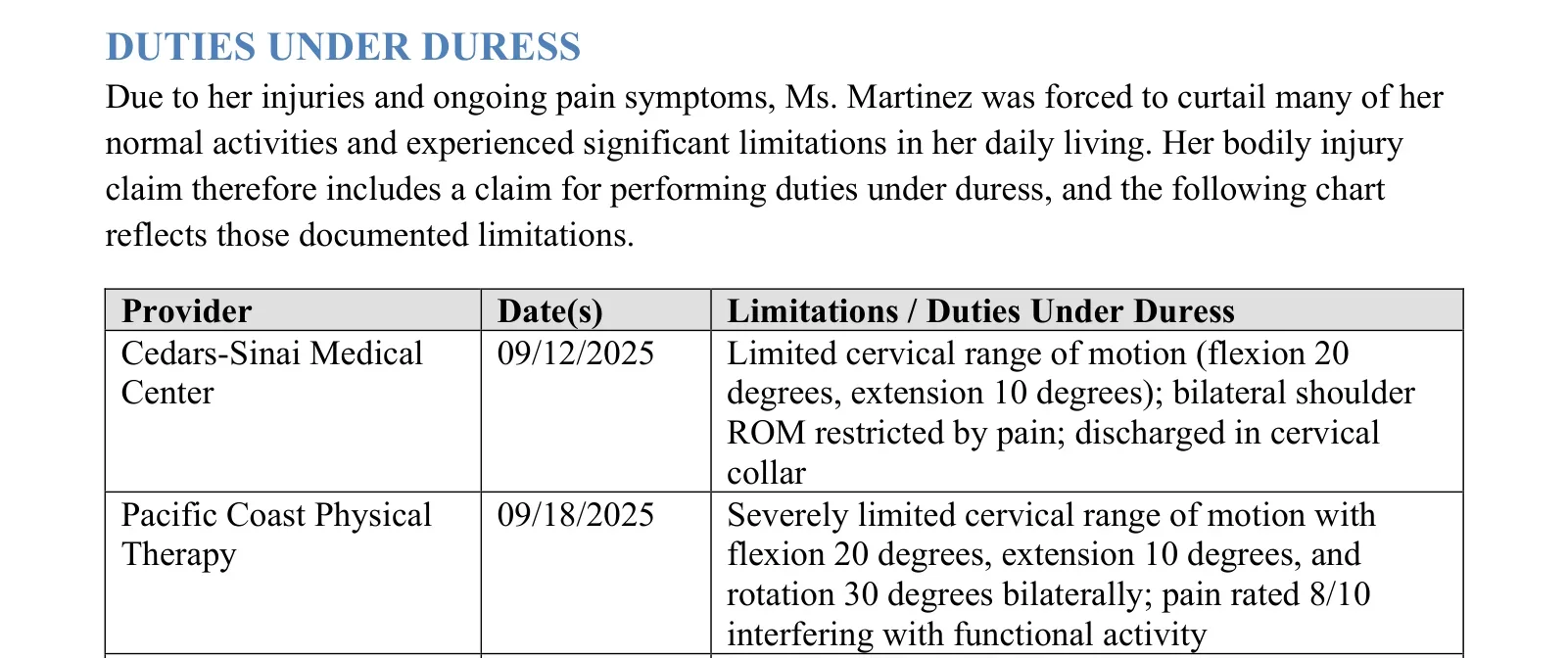
Notice what the table carries: degrees of motion, pain scores and the provider for each finding. That's the kind of detail a significant limitation argument needs. Our guide to writing a medical record summary shows how to keep each finding tied to its page.
Economic Loss Above $50,000
No-fault caps basic economic loss at $50,000, and the monthly and daily limits apply inside that cap. Economic loss above basic economic loss isn't barred by Insurance Law 5104(a). That makes it a separate part of the claim against the at-fault driver, alongside non-economic loss.
In practice, you'll want the numbers that sit outside no-fault, laid out the way an adjuster checks them:
- Medical expenses after the $50,000 is used up, with itemized bills and dates.
- Lost earnings above $2,000 a month, or past three years, with employer records.
- Other expenses above $25 a day, or past one year, with receipts.
- What no-fault paid, so the carrier can see you're not claiming the same dollars twice.
Build these from the same chronology and billing table as the rest of the demand. Our medical chronology template shows the format, and our car accident demand sample shows a specials table in a finished letter.
No-Fault Deadlines That Still Apply
The 2026 reforms didn't change the no-fault claim deadlines. They're in the mandatory personal injury protection endorsement, 11 NYCRR 65-1.1, and the DFS no-fault FAQ repeats them.
| What | Deadline |
|---|---|
| Written notice of the claim | Within 30 days after the accident |
| Medical bills | Within 45 days after the services |
| Lost wages and other necessary expenses | Within 90 days |
| Late submissions | Excused only with written proof of clear and reasonable justification |
Missed no-fault deadlines don't just cost no-fault benefits. They leave gaps in the treatment and billing record you'll rely on later. Our guide to medical record retrieval covers keeping the records complete.
Questions to Add to Your New York Intake
The reforms change what you need to know on day one. Add these to your intake for every New York motor vehicle case, so you can see early whether the case clears the threshold and whether a cap or the fault bar could apply.
- 1Was your client insured? If your client was driving an uninsured vehicle they were responsible for insuring, the $100,000 cap may apply, unless the lapse was under 30 days.
- 2Any impairment or felony charges? A conviction for driving while impaired, or a felony at the time of the accident, can also trigger the cap.
- 3How strong is liability? Under the new fault bar, you need to know early whether your client could be found more at fault than the other side.
- 4Which category is realistic? Look for a fracture, measured limitation or permanence in the first records, before you promise the client anything.
- 5Are the no-fault deadlines covered? Confirm the notice went in within 30 days and that providers are billing within 45.
The attorney still makes the call on each case. These questions just put the reforms in front of you before the file gets expensive.
Cases Filed Before May 26, 2026
DFS says the Part EE changes apply to actions commenced on or after May 26, 2026. For a case already in suit before then, the earlier version of the law may still govern, including the 90/180 category. Courts will work out the edges. Check the filing date first, and let the attorney decide which version applies.
For pre-suit claims today, assume the new rules. Any suit you file now will be commenced after May 26, 2026, so your demand should be built for them.
Where Lexyno Fits
Lexyno doesn't decide which serious injury category a case meets. That's the attorney's call. Lexyno's AI demand letter software drafts the demand from the case's records, including the injuries, the objective findings and a duties-under-duress table, with source references on the figures.
Medical Summary lists each diagnosis with the date it was first made and its source page, which helps when the threshold turns on a fracture or a measured limitation. Plans are on the pricing page. Our guide to prior conditions and the eggshell plaintiff rule covers a related argument carriers raise.
Update the Template Before the Next Demand
New York no fault still pays the first $50,000 of basic economic loss. What changed is everything after it: one fewer path to serious injury, fault decided first, a fault bar, and a cap for some drivers. Prove the category with measured findings, and make liability hard to argue with.
The law changed in May. Make sure the demand did too.
For the rest of the letter, see our guides to the demand letter to the insurance company and each section of a demand letter, start from the PI demand letter template, or try Lexyno on one case from your own file, free.
Frequently asked questions
Yes. Part EE of Chapter 58 of the Laws of 2026 deleted the 90/180-day category from the serious injury definition in Insurance Law 5102(d). The Department of Financial Services says the change took effect on May 26, 2026 and applies to actions and proceedings commenced on or after that date.
For actions commenced on or after May 26, 2026, the definition lists death, dismemberment, significant disfigurement, a fracture, loss of a fetus, permanent loss of use of a body organ, member, function or system, permanent consequential limitation of use, and significant limitation of use of a body function or system.
Basic economic loss is capped at $50,000 per person under Insurance Law 5102(a). It covers necessary medical expenses, lost earnings up to $2,000 a month for up to three years, and other reasonable expenses up to $25 a day for up to one year.
Written notice of the claim within 30 days of the accident, medical bills within 45 days after services, and lost wage and other expense claims within 90 days. Late submissions can be excused with written proof of clear and reasonable justification.
Yes, for actions under Insurance Law Article 51 commenced on or after May 26, 2026. New CPLR 1411(b) bars recovery if the claimant’s culpable conduct is greater than that of the defendant or defendants combined.
Not for basic economic loss, which no-fault covers. Insurance Law 5104(a) bars recovery of basic economic loss between covered persons. Economic loss above basic economic loss, and non-economic loss when there is a serious injury, can be claimed against the at-fault party.
Related posts
NJ Verbal Threshold: A Guide for PI Attorneys
The NJ verbal threshold for PI attorneys: who is bound, the six categories, the physician certification and its 60-day deadline, and how to prove it.

IFCA Notice: Washington's 20-Day Rule for PI Attorneys
When Washington’s IFCA applies in a PI case, who can send the 20-day notice, how to send it to the carrier and the OIC, and how it fits with your demand.

CCP 999: California Time-Limited Demand Requirements
What CCP 999 requires in a California time-limited demand: covered claims, each 999.1 element, where to send it, the deadline, and the carrier’s duties.
What's next?
Ready to see the difference in your next case?
Put these strategies to work. Try a mock demand generated by Lexyno today.
Request Evaluation Access