 Rich Martin
CCP 999: California Time-Limited Demand Requirements
CCP 999: California Time-Limited Demand Requirements
What CCP 999 requires in a California time-limited demand: covered claims, each 999.1 element, where to send it, the deadline, and the carrier’s duties.

You sent a policy limits demand with a 30-day deadline. The carrier's response came back on day 29: the demand "does not comply with Code of Civil Procedure section 999.1." The question isn't what the case is worth anymore. It's whether the demand counted.
Since 2023, CCP 999 sets the terms of a time-limited policy limits demand in California for most auto, homeowner and commercial premises claims. This guide covers what the statute covers, every element section 999.1 requires, where to send the demand, how long to keep it open, and what the carrier has to do in response. It ends with a checklist you can run before you send.

What Is CCP 999?
CCP 999 is the group of California Code of Civil Procedure sections, 999 through 999.5, that sets the rules for time-limited demands. A time-limited demand is a pre-suit offer to settle within the limits of a liability policy that must be accepted by a deadline. The rules apply to covered policies for demands sent on or after January 1, 2023.
The Legislature passed the rules as SB 1155 in 2022. The California Department of Insurance notice on the bill confirms it took effect on January 1, 2023. The goal is predictable demands for both sides. For you, a demand either meets the terms or risks its value in a later bad-faith case.
Which Demands Does Section 999 Cover?
The statute covers pre-suit demands to settle within the limits of automobile, motor vehicle, homeowner and commercial premises liability policies. It applies to property damage, personal or bodily injury and wrongful death claims, for demands sent on or after January 1, 2023. Not every demand is a 999 demand, and the scope is narrower than many firms assume.
| Question | Answer | Section |
|---|---|---|
| When? | Before the complaint or demand for arbitration is filed | 999(b)(2) |
| Which policies? | Automobile, motor vehicle, homeowner and commercial premises liability policies | 999.5(a) |
| Which claims? | Property damage, personal or bodily injury, and wrongful death | 999.5(a) |
| Since when? | Demands transmitted on or after January 1, 2023 | 999.5(c) |
| Unrepresented claimants? | The non-compliance rule in 999.4 doesn't apply to them | 999.4(b) |
After suit is filed, section 999 no longer applies. California's statutory offer at that stage is a CCP 998 offer, which works differently. Our guide to CCP 998 offers covers it.
What Must a Time-Limited Demand Include?
Under section 999.1, the demand must be in writing and labeled as a time-limited demand or reference the section. It must state the time to accept, offer to settle all claims within limits including liens, and offer a complete release. It also needs the date and location of loss, the claim number if known, the injuries and reasonable proof.
Here is each element, with what to write and where it comes from. Read the current text of section 999.1 before you rely on any of it.
| Element | What to write | 999.1 |
|---|---|---|
| In writing, labeled | Title the letter "Time-Limited Demand" or reference the section | Intro |
| Time to accept | At least 30 days from transmission by email, fax or certified mail; at least 33 days by regular mail | (a) |
| Offer within limits | A clear, unequivocal offer to settle all claims within policy limits, including the satisfaction of all liens | (b) |
| Release | An offer of a complete release of the insureds from all present and future liability for the occurrence | (c) |
| Date and location | The date and location of the loss | (d) |
| Claim number | The claim number, if known | (e) |
| Injuries | A description of all known injuries | (f) |
| Proof | Reasonable proof to support the claim, which may include medical records or bills | (g) |
The liens line catches more firms than any other. "Within limits, including the satisfaction of all liens" means your offer has to account for them. Know the liens before you send.
Where Do You Send a Time-Limited Demand?
Send it to the email or physical address the insurer designated for time-limited demands, if the insurer gave one to the California Department of Insurance and the Department made it public. You can also send it to the insurance representative assigned to the claim, if you know who that is. The Department publishes the insurers' designated addresses.
The Department's list of insurer contacts for time-limited demands is the place to check. Insurers update their entries. Look it up for each demand. Save the page you used with the file.
How Long Must the Demand Stay Open?
At least 30 days from the date of transmission if you send it by email, fax or certified mail. At least 33 days if you send it by regular mail. These are minimums. Count from transmission, not from when you think the adjuster opened it.
Pick the method first. Then compute the date. Then write it into the letter. A demand that gives 30 days by regular mail fails element (a). It's an easy mistake when a template says "30 days."

What the Carrier Has to Do
Section 999.3 sets the insurer's side. It can accept by giving written acceptance of all the material terms in section 999.1. Asking for clarification or more information, or asking for an extension because it needs more information or investigation, is not by itself a counteroffer or rejection.
If the insurer doesn't accept, it must tell you in writing, with the basis for its decision, before the demand expires. Under section 999.3(c), that notice is relevant in any later lawsuit for damages beyond the limits against the insurer. Keep every response in the file. Note the date it arrived.
What Happens If a Demand Doesn't Comply?
Under section 999.4, a time-limited demand that doesn't substantially comply with the chapter is not considered a reasonable offer to settle within limits in a later suit for damages beyond the policy limits. In plain terms, the demand loses the pressure it was meant to create. That rule doesn't apply to a claimant without a lawyer.
Section 999.5(b) adds that the chapter doesn't otherwise change existing law on claims, damages and defenses. How the rest of a bad-faith case plays out is beyond this guide. For the broader picture, see our guide to policy limits settlements, which compares time-limited demand rules in several states.
A Normal Demand vs. a 999 Demand
Most demands end with an offer and a deadline. That alone isn't a 999 demand. Here's the offer section from our blank template. It's a fine close for an ordinary demand, but it's missing what section 999.1 requires.
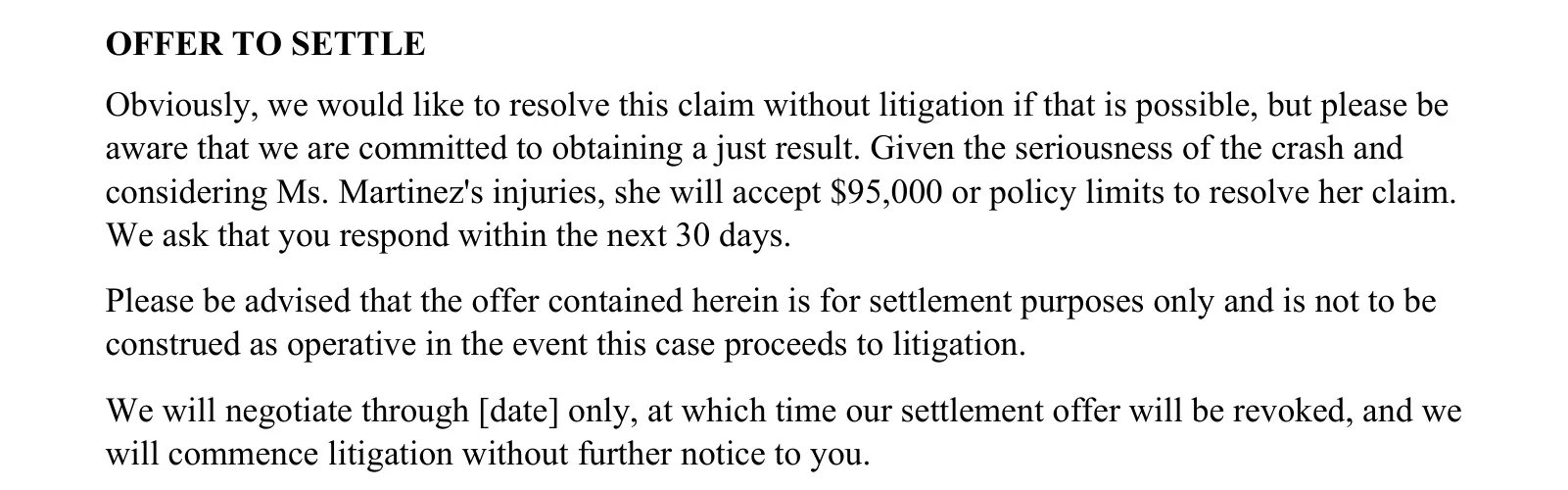
To turn it into a 999 demand, you'd add these:
- The label: "Time-Limited Demand" at the top, or a reference to the section.
- The period: a date computed from the transmission method, not a bare "30 days."
- Within limits, with liens: an offer to settle all claims within policy limits, including all liens.
- The release: a complete release of the insureds for the occurrence.
- The facts: date and location of loss, claim number if known, and all known injuries.
- The proof: the records and bills that support the claim, attached.
Get the template from our PI demand letter template page. Our California car accident sample shows the rest of the letter.
Mistakes That Cost a Time-Limited Demand Its Value
- A 30-day deadline sent by regular mail. Mail needs at least 33 days.
- Liens left out. The offer has to cover the satisfaction of all liens.
- A partial release. The statute calls for a complete release of the insureds for the occurrence.
- Thin proof. Send the records and bills that support the claim. Our guide to medical record retrieval covers getting them in time.
- The wrong address. Check the Department of Insurance list for the insurer's designated address each time.
- A demand sent after suit is filed. At that point, look at a 998 offer instead.
- No record of transmission. Keep proof of how and when it went out.
Where Lexyno Fits
Lexyno doesn't decide whether a demand complies with section 999. That's the attorney's call. Lexyno's AI demand letter software drafts the demand from the case's records, including the injuries section and an offer to settle, with source references on the figures. Your team adds the 999 terms and sets the period.
The same records feed Medical Summary, which builds the chronology and the injury list that support element (f). The records themselves are your proof under element (g). Plans are on the pricing page. Our guide to policy limit investigations covers confirming the limits before you demand them.
Check It Before It Goes Out
A 999 demand is a short list of required terms, a delivery rule and a deadline. Miss one and the demand may not count when it matters most. Label it, cover the liens, release the insureds, prove the claim, send it to the right address, and give it the full period.
The time to check a CCP 999 demand is before you send it, not after the carrier does.
For the rest of the letter, see our guide to the demand letter to the insurance company, or try Lexyno on one case from your own file, free.
Frequently asked questions
A pre-suit offer to settle a personal injury, property damage, bodily injury or wrongful death claim within the limits of a liability policy, which must be accepted within a set time. California’s Code of Civil Procedure sections 999 to 999.5 set its required terms for covered policies, for demands sent on or after January 1, 2023.
At least 30 days from transmission if you send it by email, fax or certified mail, or at least 33 days if you send it by regular mail. The statute sets these as minimums. Calendar the deadline from the transmission date and the method you used.
It must be in writing and labeled as a time-limited demand or reference the section. It needs the acceptance period, a clear offer to settle all claims within limits including liens, a complete release of the insureds, the date and location of loss, the claim number if known, a description of known injuries, and reasonable proof.
To the email or physical address the insurer designated for time-limited demands, if it gave one to the California Department of Insurance and the Department made it public. You can also send it to the insurance representative assigned to the claim, if known. The Department publishes the designated addresses.
Under section 999.4, a demand that does not substantially comply is not considered a reasonable offer to settle within limits in a later suit for damages beyond the policy limits. That rule does not apply to a claimant who is not represented by counsel.
No. The statute defines a time-limited demand as an offer made before the complaint or demand for arbitration is filed. After suit, California’s statutory settlement offer is a CCP 998 offer, which works differently.
Related posts

CCP 998 Offers: A Guide for California PI Attorneys
How California PI attorneys use CCP 998 offers: what the offer must include, timing, what happens if it is rejected, recent cases, and setting the number.
How Long Do Hospitals Keep Medical Records? A PI Guide
How long hospitals and doctors keep medical records, state by state, and what a PI firm should check before requesting pre-accident records.

Eggshell Plaintiff Rule: Using It in a PI Demand Letter
How to use the eggshell plaintiff rule in a PI demand: how it differs from aggravation, the evidence that proves it, and how to write it into the letter.
What's next?
Ready to see the difference in your next case?
Put these strategies to work. Try a mock demand generated by Lexyno today.
Request Evaluation Access