 Rich Martin
Medical Record Summary: How to Write One for a PI Demand
Medical Record Summary: How to Write One for a PI Demand
How to write a medical record summary for a PI demand: what to include, a worked example from a demo case, how adjusters read it, and mistakes to avoid.

The chronology is done. Forty rows, every one with a date, a provider and a page number. Then you hand it to the attorney, and the first question is: "So what happened to her?"
That answer is the medical record summary. This guide shows what goes in one, how to write it from your chronology, and a finished example from a demo case. It also shows the order the adjuster checks it in, so you can write it the way it'll be read.

What Is a Medical Record Summary?
A medical record summary is a short narrative of a client's injuries, treatment and current condition, written in plain English from the medical chronology. Each factual sentence cites the page it came from. In a personal injury demand, it feeds the injury and treatment sections, so the adjuster reads a story instead of a spreadsheet.
Think of it as the chronology with the reasons put back in. The chronology says the client saw a spine specialist on October 3. The summary says why: the MRI showed two disc injuries, and therapy hadn't fixed the range of motion.
Medical Summary vs. Medical Chronology: Do You Need Both?
For most demands you need both, and you build them in order. The chronology lists every encounter in date order with a source page, so it proves the facts. The summary explains what those facts add up to, so it persuades. Write the summary from the chronology, and the two can't disagree.

| Medical chronology | Medical summary | |
|---|---|---|
| Answers | What happened, and when? | What does it mean for this client? |
| Format | Table, one row per encounter | Paragraphs, grouped by provider or phase of care |
| Source pages | On every row | On every factual sentence |
| Bills | Charge on each row; totals to the specials | Total once, at most |
| Who reads it closely | The paralegal checking the file; the adjuster checking a fact | The adjuster deciding what the case is worth |
| Where it goes | Exhibit or internal file | Injury and treatment sections of the demand |
If the difference is new to your team, start with our guide to medical record review for attorneys. To build the chronology itself, use our medical record chronology template and example.
What Should a Medical Record Summary Include?
A good medical summary should cover six things: how the injury happened, the first treatment and its findings, the diagnoses, the treatment that followed, the objective findings that back the complaints, and where the client stands now. Add any gap in care with its reason. Each of these comes straight from rows already in your chronology.
| Part | What to write | Where it comes from |
|---|---|---|
| Mechanism | How the injury happened, in one sentence | ER triage note, police report |
| First treatment | When and where care started; what they found | First chronology row |
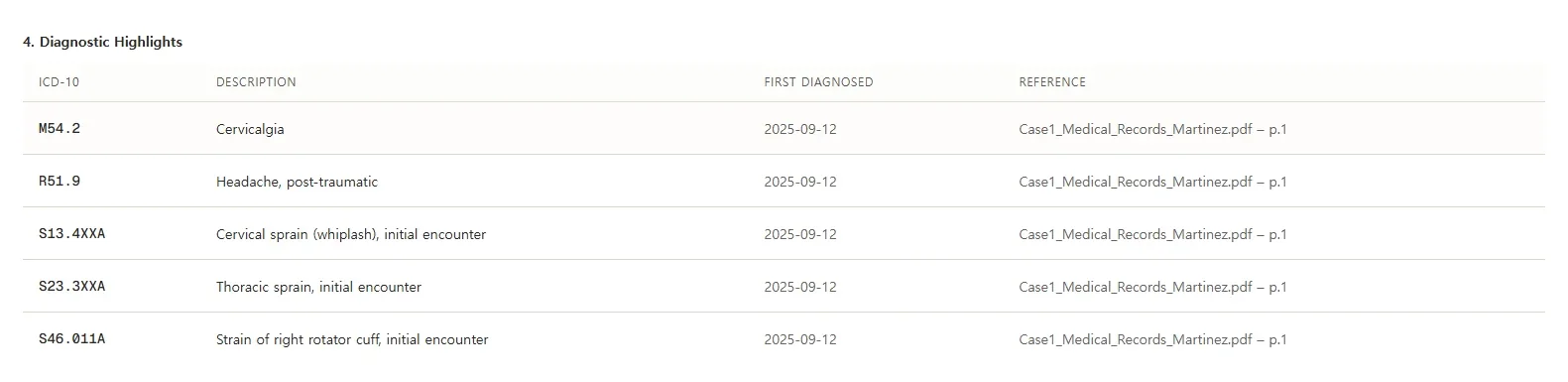
| Diagnoses | Each diagnosis in plain English, code optional | Clinical notes (ICD-10) |
| Course of treatment | Who treated, for how long, and what changed | Therapy, specialist and imaging rows |
| Objective findings | Imaging, range of motion, positive tests | Reports and exam notes, quoted |
| Current status | Discharge, MMI, restrictions, future care | Last treating provider's note |
| Gaps | Any break in care and why | Chronology notes column |
Use plain English for diagnoses. "Cervical sprain" is fine for a lawyer. "S13.4XXA" isn't for anyone outside a billing office.
If you need a term explained, MedlinePlus has plain-language definitions from the National Library of Medicine. Codes come from the ICD-10-CM set; keep them in the chronology.
How to Write a Medical Summary From Your Chronology
Don't write the summary from the raw records. Write it from the chronology, where every fact is already pulled, dated and paged.
Your job is to choose what matters and say it in order.
- 1Finish the chronology first. Every row needs a date, a provider and a source page. A summary written from a half-built chronology inherits its holes.
- 2Group the rows. Use phases of care (emergency, therapy, imaging, specialist) or providers. Pick one and stick to it.
- 3Write one sentence per fact. Date, provider, finding, page. Keep the client as the subject where you can.
- 4Quote the objective findings. Use the radiologist's and the doctor's words for imaging and exam results. Paraphrase only the complaints.
- 5Explain every gap. If care stopped for more than a few weeks, say why, with a source. Silence reads as recovery.
- 6End on current status. Restrictions, future care, or the doctor's prognosis. That's what the adjuster prices.
- 7Check it against the chronology. Read each sentence, find its row, match the date and the number. Then hand it to the attorney.
Medical Summary Example: Four Rows Become One Paragraph
Here's the step most guides skip. These are four rows from the chronology of a demo case, a rear-end collision on September 12, 2025.
| Date | Provider | Findings / plan | Source |
|---|---|---|---|
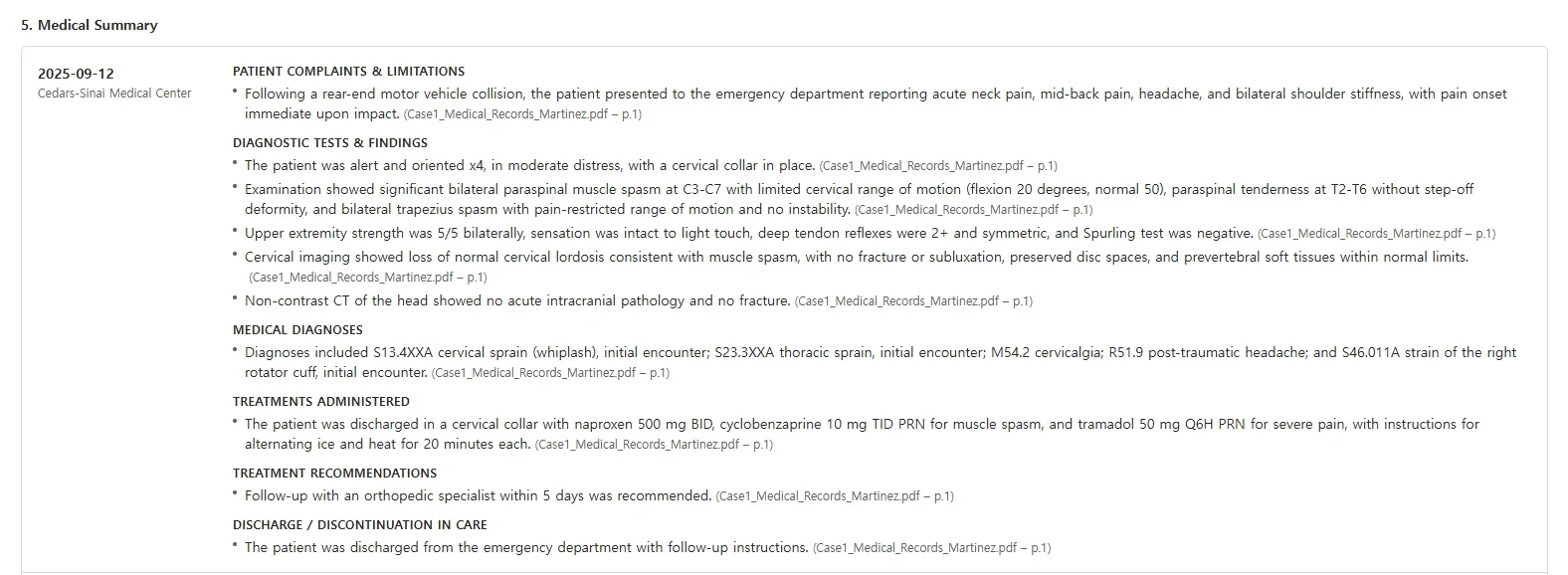
| 09/12/2025 | Cedars-Sinai MC, ED | Paraspinal spasm C3–C7; flexion 20°, extension 10°. Cervical sprain, thoracic sprain, right rotator cuff strain. Cervical collar. | pp. 4–8 |
| 09/18–10/02/2025 | Pacific Coast Physical Therapy (5 visits) | Flexion 20°, extension 10°, rotation 30° bilateral at evaluation. Mobilization, manual therapy, traction. | pp. 12–21 |
| 10/01/2025 | Beverly Advanced Imaging | MRI: C4-C5 2.1 mm protrusion with annular fissure; C5-C6 2.8 mm broad-based bulge. | pp. 22–23 |
| 10/03/2025 | Dr. Robert Chen, Pacific Spine Institute | Reviewed MRI. Continue PT; injections at C5-C6 considered. Work limited to 4 hours a day. | pp. 24–26 |
And here's the summary written from them:
Ms. Martinez went by ambulance from the collision to the Cedars-Sinai emergency department on September 12, 2025. The ED found muscle spasm from C3 to C7 and cervical flexion limited to 20 degrees (pp. 4–8). She was diagnosed with cervical and thoracic sprains and a right rotator cuff strain, and was sent home in a cervical collar (pp. 4–8).
She started physical therapy six days later. At her evaluation, her range of motion hadn't improved (pp. 12–21). A cervical MRI on October 1 showed a 2.1 mm protrusion with an annular fissure at C4-C5 and a 2.8 mm bulge at C5-C6 (pp. 22–23).
On October 3, spine specialist Dr. Robert Chen reviewed the MRI. He kept her in therapy, considered injections at C5-C6, and limited her to four hours of work a day (pp. 24–26).
Notice what changed. The rows became a sequence with a reason at each step.
Every sentence still has a page. And nothing in the paragraph is missing from the chronology, so the adjuster can't find a fact you didn't give them.
How Does an Adjuster Read a Medical Summary?
Adjusters tend to read a medical summary looking for reasons to discount it. They check whether treatment started soon after the incident, whether objective findings back the complaints, whether there are gaps, and whether a doctor connects the injuries to the incident. Write the summary in that order, and answer each question before they ask it.
| The adjuster checks | Your summary answers with |
|---|---|
| Did care start right away? | The first treatment date, next to the incident date |
| Is there anything objective? | Imaging and exam findings, quoted, with pages |
| Are there gaps? | Each gap, with its reason and a source |
| Who says the crash caused this? | The treating doctor's words, attributed to the doctor |
| Where does the client stand now? | Restrictions, future care, prognosis |
Causation is the one to handle with care. Don't argue it in your own voice. Quote the doctor.
In the demo case, Dr. Chen wrote that the cervical injuries are "directly and causally related to the motor vehicle collision" (pp. 24–26). That sentence does more work attributed to him than any adjective you could add.
The summary then feeds the letter. Our guide to writing a personal injury demand letter shows where it lands, and the PI demand letter template has the sections ready to fill. For a finished letter built from this same demo case, see our sample car accident demand letter.
Mistakes That Weaken a Medical Summary
Most weak summaries fail the same way. They tell the adjuster how to feel instead of showing what the records say.
Adjectives instead of findings.
Weak: The client suffered severe neck injuries and underwent extensive treatment.
Better: The ED found spasm from C3 to C7 and flexion limited to 20 degrees (pp. 4–8).
Causation in your own voice.
Weak: The MRI proves the crash caused her disc injuries.
Better: The MRI showed injuries at C4-C5 and C5-C6. Dr. Chen related them to the collision (pp. 24–26).
A gap left unexplained.
Weak: Treatment resumed in January.
Better: Therapy paused for six weeks while the client waited for authorization, then resumed in January (p. 31). (Illustration only; the demo case has no gap.)
Numbers that don't match. If the summary says ten therapy visits and the chronology shows five, the adjuster will trust neither. Check every count and date against the rows.
Our post on why AI demand letters get numbers wrong covers where these mismatches start.
Filler from the chart. "Patient tolerated treatment well" appears in a lot of therapy notes. Leave it out. It tells the adjuster your client was fine.
Should Your Firm Outsource Medical Summaries?
It depends on volume and who's free to read. Small firms usually write medical summaries in-house, because the paralegal already knows the file. Firms with heavy caseloads often send records to outside services or use software to draft them. In every model, someone at the firm still checks the summary against the records before the demand goes out.
| In-house paralegal | Outside summary service | Software-assisted | |
|---|---|---|---|
| Who reads the records | Your staff | Their reviewers (often nurses or physicians) | The tool extracts; your staff checks |
| Knows the case theory | Yes | Only what you tell them | Only what you tell it |
| Source pages | If your template requires them | Ask before you buy | Ask before you buy |
| What you still do | Attorney review | Check the output; attorney review | Check the output; attorney review |
When you compare medical summaries for law firms from outside vendors, ask three things. What do you get: a chronology, a narrative, or both? Does every sentence cite a page? Can you edit it in Word?
Our post on how paralegals cut demand letter prep time covers the in-house side, and the HIPAA guide for AI demand letters covers what to ask any vendor that handles records.
Where AI Helps With Medical Summaries, and Where It Doesn't
AI is good at the assembly. It can pull every date, provider and finding out of a few hundred pages and lay them out in order. That's the slow part of a medical summary, and it's where software earns its place.
It's not good at knowing what matters. A language model predicts the next word; it doesn't look facts up. It can write a smooth paragraph with a wrong date in it.
That's why the source page on each sentence isn't optional. It lets you check each sentence without rereading the whole chart. Our explainer on Fact-Lock™ shows how we handle that check.
The attorney still decides the causation theory, what to emphasize, and whether the summary is ready to send. AI for assembly, humans for verification and strategy.
How Lexyno Builds the Medical Summary
Lexyno's Medical Summary builds the chronology and the narrative from the same extracted events. You get a treatment timeline by provider, a calendar that flags gaps over 30 days, a visit table, diagnostic highlights with codes, and a plain-English narrative.
Each entry points to its source page, and your team can review, correct or remove any event. It exports to Word.
The same events feed the demand letter, so the dates in the summary match the dates in the letter. Medical Summary is included in the Professional and Enterprise plans and in the free evaluation; see pricing for the details. Our guide to AI medical chronology walks through how the extraction works, and the records-to-settlement workflow shows where the summary fits in the whole demand.
The Summary Is the Argument
A chronology proves the facts. A medical record summary makes the adjuster care about them. Write it from the rows, cite every sentence, quote the doctors, and explain the gaps before anyone asks.
The records don't change. The way you tell them does.
Want to see one built from your own file? Try Lexyno on one case, free.
Frequently asked questions
A short narrative that explains the injuries, the course of treatment and where the client stands now, in plain English. It is written from the medical chronology, and each factual sentence points to the page in the records it came from. The demand letter uses it in the injury and treatment sections.
For most demands, yes. The chronology proves each date, finding and charge, row by row. The summary tells the adjuster what those rows add up to. Build the chronology first and write the summary from it, so the two never disagree.
Usually a paragraph or two per provider, or a page or two for a straightforward soft-tissue case. Length follows the records. What matters is that every fact has a source page and nothing the adjuster will find in the chronology is missing from the story.
Paralegals and case managers write most of them in-house. Some firms send records to outside services that use nurses or physicians as reviewers. Others use software to extract the events and draft the narrative. In every model, the attorney still reads the summary before it goes to the carrier.
Keep the bills in the chronology and the specials table, not in the narrative. The summary can mention the total once, but each charge belongs where the adjuster can add it up. If the narrative and the specials table show different figures, fix them before the demand goes out.
AI can extract the events and draft the narrative, but someone at the firm has to check it. Language models can state a wrong date or figure with confidence. A tool that links each sentence to its source page makes that check practical. The attorney still owns the causation theory and the final read.
Related posts

Policy Limits Settlement: When and How to Demand the Limits
What a policy limits settlement is, when to demand the limits, what makes the demand hard to refuse, and how state time-limited demand rules differ.

Medical Record Chronology: Template and Example for PI
How to build a medical record chronology for a PI case: a free template, a filled-in example from a demo case, the right format, and mistakes to avoid.

Demand Letter to Insurance Company: A PI Firm's Guide
How a PI firm sends a demand letter to an insurance company: what to finish first, what the adjuster reads, deadlines, state rules and what comes back.
What's next?
Ready to see the difference in your next case?
Put these strategies to work. Try a mock demand generated by Lexyno today.
Request Evaluation Access