 Jun Lee
Will AI Replace Lawyers? What PI Firms Should Watch
Will AI Replace Lawyers? What PI Firms Should Watch
Will AI replace lawyers? What the evidence says about AI accuracy, what courts and the California bar require, and which decisions stay with the attorney.

Every legal tech demo seems to end the same way. A draft appears on the screen, and someone says that's the work an associate used to spend two days on. The room goes quiet. Somebody asks the question everyone was thinking.
Will AI replace lawyers? I build AI software for personal injury firms, so I have a stake in the answer, and you should read this with that in mind. My answer is no, not under the rules that govern law practice today. But the reasons are more specific than "AI lacks empathy." They come from what the evidence shows about AI accuracy, what courts have said about it, and which decisions in a PI file can't be handed off.

Will AI Replace Lawyers?
Not under the law as it stands. Practicing law takes a license, courts hold attorneys responsible for what they file, and California's 2026 bar guidance says AI can't make substantive legal determinations without meaningful attorney supervision. AI is taking over assembly work. The judgment and the responsibility stay with the attorney.
That doesn't mean nothing changes. Washington's bar put it plainly in its 2025 advisory opinion: "Artificial intelligence has long been predicted to fundamentally reshape the legal profession." Some tasks that filled an associate's week now take an hour of checking. The question worth asking is narrower: which parts of your work change, and which don't?
The Myth: AI Is Accurate Enough to Work Alone
The strongest version of the replacement argument rests on a claim about accuracy. If the tool doesn't make mistakes, why would you pay someone to check it? Some vendors have said close to exactly that. Researchers tested it.
In 2024, Stanford RegLab researchers ran what they called "the first preregistered empirical evaluation of AI-driven legal research tools." The study looked at tools from LexisNexis and Thomson Reuters. Their makers had described retrieval methods as "eliminating" or "avoid[ing]" hallucinations, or as producing citations free of them. The researchers found the claims "overstated." The tools did better than a general chatbot, but each one still hallucinated "between 17% and 33% of the time."
Fewer errors is real progress. It still isn't zero.
Why the Errors Happen
A language model writes by predicting the next likely word. It doesn't look a fact up unless the system around it is built to make it do that. So a model can produce a case name that sounds right, a date that fits the pattern, or a total that's close but wrong. The sentence reads well. Fluent text with a wrong fact inside is the hardest kind of error to catch.
That's why the useful question for your firm isn't "how accurate is it?" It's "how fast can my team find what's wrong?" Ask every vendor you talk to, including us. If the answer is a percentage with no way to check the draft yourself, keep looking. Our post on why AI demand letters get numbers wrong goes deeper on the mechanism.
What Have Courts and Regulators Said?
Courts and bar regulators have said the same thing in different words: using AI is allowed, and the attorney stays responsible. A federal court sanctioned lawyers who filed AI-invented cases. California's licensing law limits who may practice. California's 2026 guidance bars letting AI act without meaningful attorney review.
| Source | What it says |
|---|---|
| Mata v. Avianca (S.D.N.Y. June 22, 2023) | "There is nothing inherently improper about using a reliable artificial intelligence tool for assistance. But existing rules impose a gatekeeping role on attorneys to ensure the accuracy of their filings." The court imposed a $5,000 penalty |
| California Business and Professions Code 6125 | "No person shall practice law in California unless the person is an active licensee of the State Bar." |
| California State Bar, Practical Guidance on Generative AI (May 14, 2026) | Attorneys must not let an AI system make substantive legal determinations, communicate legal advice, or file pleadings "without meaningful attorney supervision and review" |
| WSBA Advisory Opinion 2025-05 | The lawyer, "not the tool," is "ultimately responsible for the work concerned" |
In Mata, the court found the lawyers "abandoned their responsibilities." They had submitted opinions that ChatGPT made up, then stood by them after the court questioned whether they existed. The tool made the error. The lawyers paid for it.
What Can AI Do in a PI File?
AI handles assembly well: pulling dates, providers and findings from records, building a first chronology, drafting routine sections and organizing the file. Those tasks take hours by hand and minutes to check when the draft points to its source. Judgment calls stay with people, along with anything that commits the client.
| Task | What AI does | What the attorney does |
|---|---|---|
| Medical records | Extracts dates, providers, diagnoses and bills | Decides which findings matter for causation and damages |
| Chronology | Builds a first timeline with page references | Spots the gap or prior injury the adjuster will use |
| Demand letter | Drafts sections from the record | Sets the theory, the tone and the number |
| Insurer's view | Flags where a claim looks weak | Decides how to answer it, or whether to settle |
| Client | Drafts a routine update | Advises, explains risk, takes the hard calls |
Our guides to the medical record chronology and demand letter sections show where each of these sits in a file. The staff side of the same shift is in our post on paralegals and AI.
What Stays With the Attorney?
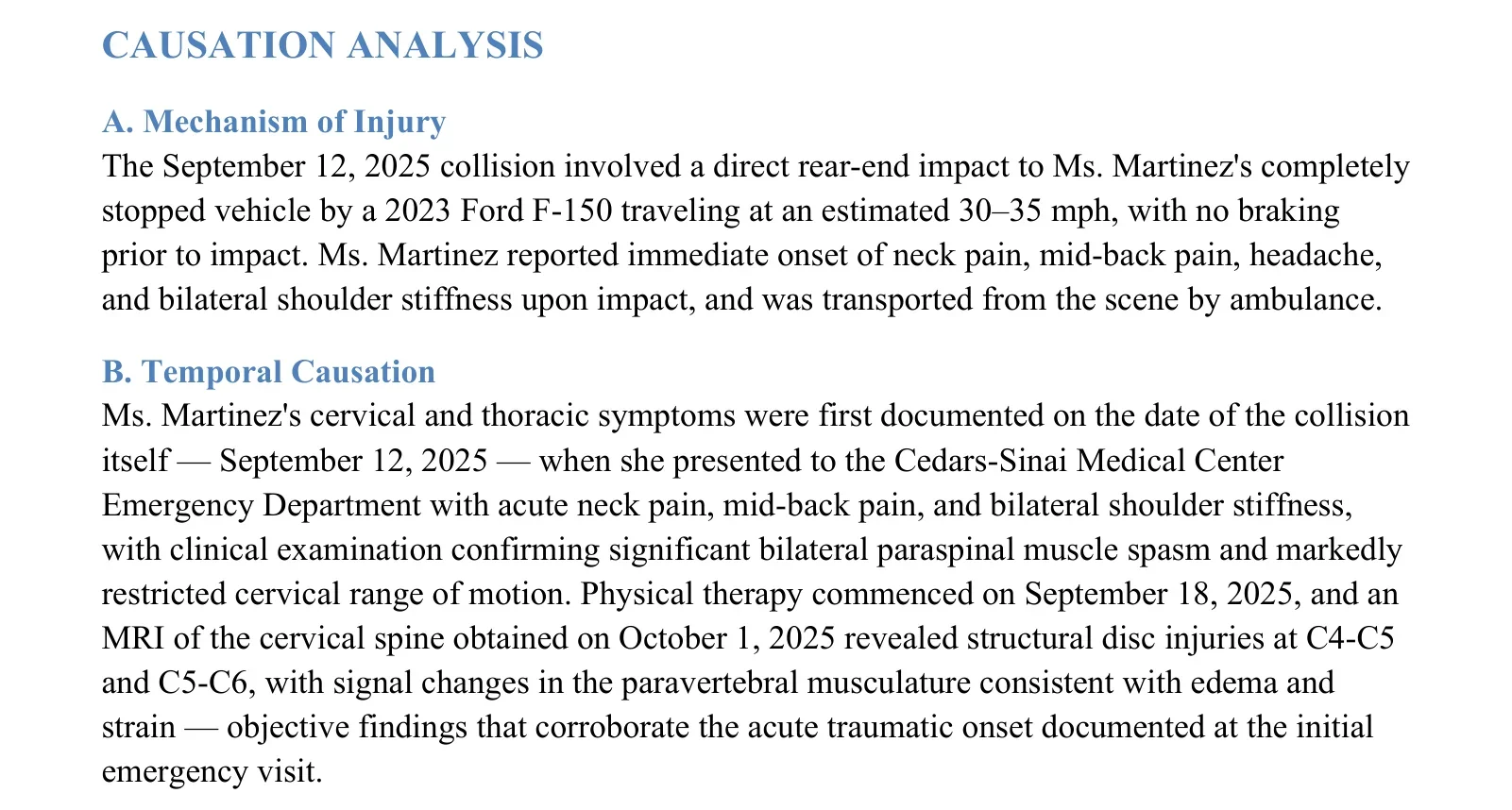
The decisions that commit the client stay with the attorney: the causation theory, the settlement number, strategy, advice, and the final read before anything leaves the office. These aren't tasks AI does slowly. They're responsibilities the law assigns to a licensed person, and they depend on judgment about this client and this case.
- Causation theory. Which mechanism you argue, and how you handle a prior injury.
- The number. What the case is worth and what you'll accept. Our pain and suffering guide covers why examples don't transfer.
- Strategy. Whether to send a time-limited demand, file, or wait for more records.
- Advice. What you tell a client about risk, and what you recommend.
- The final read. Your name goes on the letter, so you read it last.
When Could This Answer Be Wrong?
It could be wrong in three places. Firms may hire fewer people for the same files. Some firms will skip the review step and take the risk. And the licensing and supervision rules could change. I'd rather name those limits than pretend they don't exist, so here they are in more detail.
- Firm size and staffing. If a firm needs fewer hours to produce the same file, some firms will hire fewer people. That's a business choice, and it's already happening in some practices. The rules don't stop it.
- Firms that skip the check. A firm that sends AI output without review isn't using AI as a tool. It's taking the risk the Mata lawyers took.
- The rules themselves. Licensing and supervision rules can change. If they do, this answer changes too. California updated its AI guidance in 2026, and other states are working on theirs.

How Should You Evaluate an AI Tool for Your Firm?
Judge an AI tool by how easily you can check its work, not by the accuracy figure on its website. Ask where each fact in a draft comes from, what happens to your client data, and who reviews the output before it leaves your office. If a vendor can't answer those, you'll be the one answering for it later.
- Traceability. Can you click from a fact in the draft to the page it came from?
- Data handling. Where are your records stored, and are they used to train anything?
- Limits. Does the vendor tell you what the tool gets wrong, or only what it gets right?
- Your review step. Who on your team checks the draft, and how long does that take on a real file?
Try it on one of your own closed cases, where you already know the answers. You'll learn more in an afternoon than from any demo.
What We Promise Instead
We don't claim our AI makes no mistakes, and you should be wary of anyone who does. The Stanford study shows what happens to that claim when someone tests it. Our position is narrower, and we can stand behind it: AI for assembly, humans for verification and strategy.
In practice, that means a draft where each fact traces back to its source in the records. Your paralegal can check a date against the page it came from, instead of reading the whole file again. Errors become fast to find, not hidden in good prose. Our post on Fact-Lock explains how that works and why we won't claim zero.

Where Lexyno Fits
Lexyno doesn't decide causation, value a case or give advice. Those are the attorney's decisions. Lexyno's AI demand letter software drafts the demand from the case's records, with source references you can check.
Medical Summary builds the treatment chronology and flags gaps over 30 days. POV reports read the same record from the insurer's side. If you're weighing tools, our guides to AI for personal injury lawyers and HIPAA and AI demand letters cover what to ask. Plans are on the pricing page.
The Tool Changes. The Signature Doesn't.
Will AI replace lawyers? Not while the law requires a licensed person to give advice and stand behind the filing. What AI changes is how much assembly work sits between the records and that decision.
Use the time it saves on the parts only you can do: the call with a worried client, the theory you'll argue, the number you'll stand behind.
Start from our PI demand letter template, or try Lexyno on one case from your own file, free.
Frequently asked questions
Not under the law as it stands. Practicing law requires a license, courts hold the attorney responsible for every filing, and California’s 2026 guidance says AI must not make substantive legal determinations without meaningful attorney supervision. AI is taking over assembly work, not responsibility.
No. In California, Business and Professions Code 6125 says no person may practice law unless the person is an active licensee of the State Bar. An AI tool can help a licensed attorney prepare work, but the attorney gives the advice and signs the filing.
No. A 2024 Stanford RegLab study tested legal research tools marketed as eliminating or avoiding hallucinations and found they still produced hallucinations between 17% and 33% of the time. Fewer errors is real progress, but it is not zero.
Lawyers filed a brief citing court opinions that ChatGPT had invented, then kept defending them. In June 2023, a federal judge in New York sanctioned them and their firm, noting that using AI is not improper but attorneys have a gatekeeping role over the accuracy of filings.
Assembly work: pulling dates and providers from records, building a first chronology, drafting routine sections of a demand, and organizing a file. Causation theory, the settlement number, strategy, client advice and the final read stay with the attorney.
No. We don’t claim zero errors. Lexyno is built so that each fact in a draft traces back to its source in the records, which makes errors faster to find and fix. Review by a paralegal and the attorney is part of the process.
Related posts

Legal Document Management Software: Security for PI Records
How to choose legal document management software for a PI firm: the security checks that matter for medical records, and where records leak instead.

Personal Injury Case Management Software: How to Choose
How to choose personal injury case management software: test deadlines, records, liens and settlement money on a closed file before you sign.

AI Policies for Law Firms: A Framework PI Firms Can Use
AI policies for law firms, built for PI practice: the eight sections a policy needs, sample wording, and the bar duties each section answers.
What's next?
Ready to see the difference in your next case?
Put these strategies to work. Try a mock demand generated by Lexyno today.
Request Evaluation Access