 Rich Martin
Pain and Suffering Settlement Examples: What a Demand Needs
Pain and Suffering Settlement Examples: What a Demand Needs
Why pain and suffering settlement examples rarely transfer to your case, and the evidence and demand language that make noneconomic damages credible.

The client asks what their pain is worth. You've seen the lists online: a verdict here, a settlement there, a number with a lot of zeros. None of them is your client's case. And the adjuster reading your demand won't care what someone else got.
This guide is about pain and suffering settlement examples from the other side of the desk. It covers why published examples rarely transfer, what the law actually says about valuing noneconomic damages, and the evidence that makes your number credible. It also shows example demand language, built from the record.

Why Don't Pain and Suffering Settlement Examples Transfer?
Published pain and suffering examples rarely fit your case because almost nothing about them matches. They come from different injuries, venues, policy limits, liability facts and clients. Many are jury verdicts, not settlements, and some were later reduced or appealed. The adjuster values your client's documented losses, not another case's number.
Most lists online also come from firms showing their best results. That's fine for marketing. It's a poor guide for valuing a soft-tissue claim with $16,000 in specials and a policy that may cap what's collectible.
| What the example shows | What it hides |
|---|---|
| A large dollar figure | Whether it was a verdict or a settlement, and whether it was reduced later |
| The injury type | How severe, how long, and what the records proved |
| The state or city | The venue, the jury pool and the judge |
| The total | The policy limits, liens and how much was economic loss |
| The result | The liability facts and any comparative fault |
If you want comparables, the better sources are closer to home: your own firm's closed files, and verdicts from your venue that you can read in full. Even then, use them to sanity-check a range, not to justify a demand.
What Does the Law Say About Valuing Pain and Suffering?
The law gives no formula. California's jury instruction on noneconomic damages, CACI 3905A, says "No fixed standard exists for deciding the amount of these noneconomic damages." Jurors use their judgment, based on the evidence and common sense. Other states phrase it differently, but the idea is common: the evidence drives the number.
The 2026 CACI instructions list the kinds of loss a jury can consider. They include physical pain, mental suffering, loss of enjoyment of life, disfigurement, physical impairment, inconvenience, grief, anxiety, humiliation and emotional distress. For future pain, the plaintiff must prove they're reasonably certain to suffer it.
Cornell's Legal Information Institute defines pain and suffering the same way: physical discomfort and emotional distress compensable as noneconomic damages. Some states also cap these damages in certain cases. New York added a $100,000 cap in 2026 for some at-fault drivers, described in the state's DFS circular letter. Our New York no fault guide covers who it applies to.
What About Multipliers and Daily Rates?
You'll see two shorthand methods online: a multiplier applied to medical bills, and a daily rate for each day of pain. Adjusters and attorneys sometimes talk in these terms. Neither is in the law, and neither proves anything on its own. A number with no evidence behind it is easy for an adjuster to cut.
If you use either as a starting point, back it with the record. A daily rate means little unless the records show the pain lasted that many days. A multiplier means little unless the records show why this case is worse than an ordinary one.

What Evidence Makes Pain and Suffering Credible?
Specific, dated facts from the records make pain and suffering credible. That means how long the pain lasted and how it changed, objective findings behind it, what the client could do before and can't do now, sleep and work limits, emotional effects a provider noted, and the treating doctor's prognosis. Adjectives don't carry weight; documented changes do.
| Loss | Evidence that shows it |
|---|---|
| Physical pain | Pain scores over time, from first visit to discharge; medications |
| Physical impairment | Range of motion in degrees, imaging, restrictions |
| Loss of enjoyment of life | Activities before the incident and after, from the client and the records |
| Sleep and daily function | Provider notes on sleep, driving, household tasks |
| Work | Reduced hours or duties, from the employer and the doctor |
| Emotional distress | Anxiety or depression noted by providers or a counselor |
| Future pain | The treating doctor's prognosis and future care plan |

Pull these facts into one place before you draft. A medical record chronology puts each pain score, finding and restriction next to its date and page, so the section writes itself from the timeline.
How Do You Prove Future Pain and Suffering?
You prove future pain and suffering with the treating doctor's prognosis. The record should say whether the pain or limitation is expected to continue, for how long, and what care the client will need. A demand that claims future pain without that opinion asks the adjuster to guess, and adjusters don't guess in your client's favor.
Look for these in the records before you claim it:
- A plateau. Therapy notes that show progress stopped, with the same limits at the last several visits.
- A future care plan. Injections, surgery consults, ongoing therapy or medication the doctor expects the client to need.
- Permanent restrictions. Lifting, work or activity limits the doctor says won't lift.
- A written opinion. If the records are silent, ask the treating doctor for a narrative report before you send the demand.
Be careful with the words. "Will likely continue" from a doctor carries weight. "May have some ongoing discomfort" invites a discount. Quote what the doctor wrote, and cite the page.
What Do Adjusters Push Back On?
Adjusters push back on gaps in treatment, low pain scores at discharge, missing objective findings, prior injuries and claims that rest only on the client's word. Most of these come from holes in the record, not from the law. Expect them, and answer each one in the demand before the adjuster raises it.
| Pushback | How to answer it |
|---|---|
| Gaps in treatment | Explain the gap with a record or a reason, like a scheduling delay or a lost job |
| Low pain scores at discharge | Show the course of the pain, and the limits that remained |
| No objective findings | Point to measured range of motion, imaging or positive tests |
| A prior injury to the same area | Show the change from the prior baseline, with the earlier records |
| Only the client's word | Tie each loss to a provider note, an employer letter or a witness |
Every row has the same fix: a specific record. Our guide to the demand letter to the insurance company covers how adjusters read the rest of the letter.
Example Demand Language, Weak and Better
The best pain and suffering example you can give an adjuster is your own client's record, written plainly. Here are three sentences, weak and better. They're illustrations, built on our demo case.
Pain.
Weak: Ms. Martinez has suffered tremendous pain since the accident.
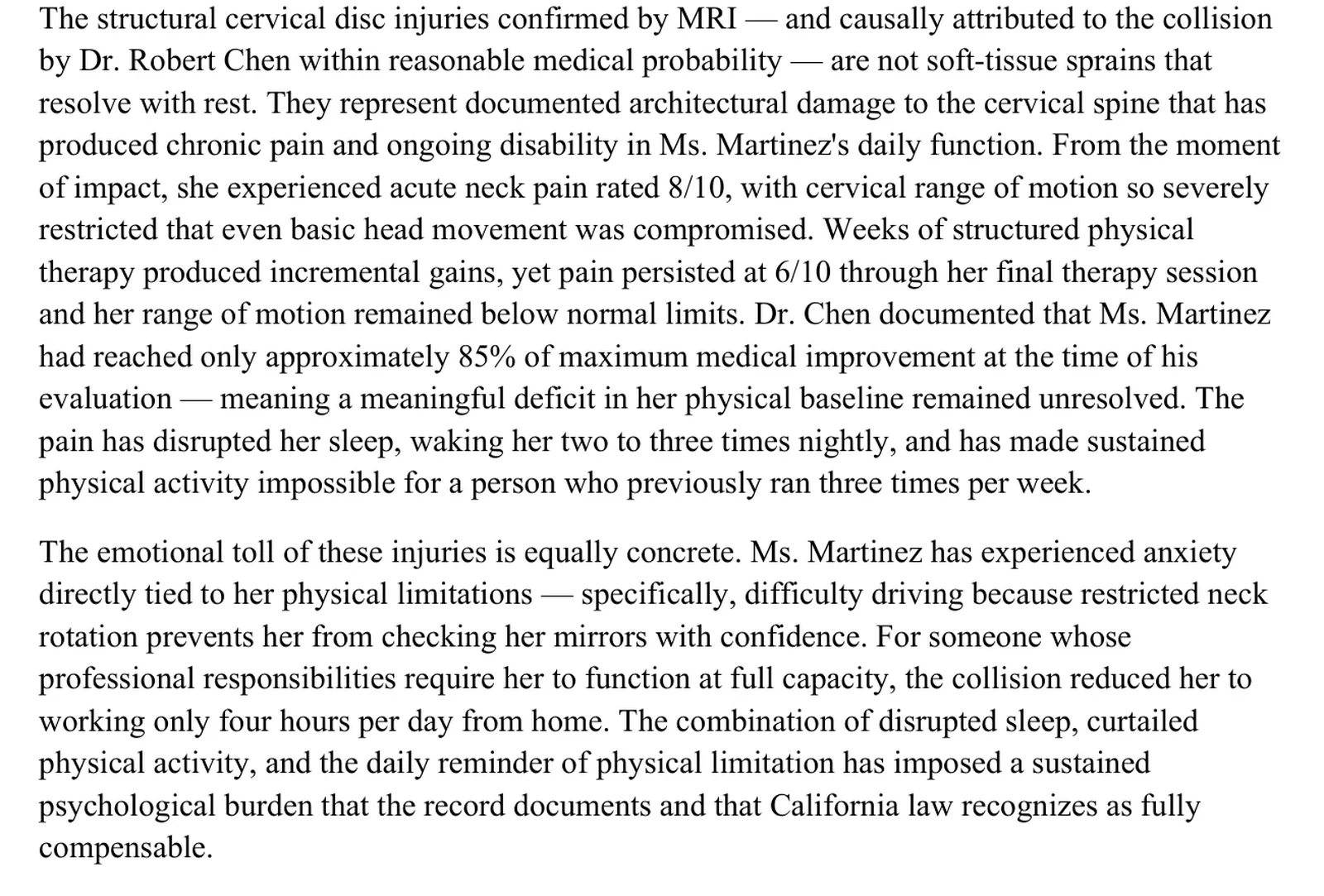
Better: Ms. Martinez rated her neck pain 8/10 at the emergency room. After weeks of therapy, it was still 6/10 at her last session.
Loss of enjoyment.
Weak: Her quality of life has been destroyed.
Better: She ran three times a week before the crash. Since then, she hasn't been able to run at all.
Daily function.
Weak: She struggles with everyday activities.
Better: She wakes two to three times a night from neck pain, and she can't check her mirrors with confidence when she drives.
Notice what the better versions do. They give the adjuster numbers, dates and specific losses, and every one can be traced to a record. Here is how the demo letter puts those facts together.
A Checklist Before You Write the Section
- Pain over time: you have pain scores from the first visit and the last.
- Objective findings: imaging or measured limits support the pain.
- Before and after: you know what your client did before the incident, in specifics.
- Daily limits: sleep, driving, work and household tasks are documented by a provider.
- Emotional effects: any anxiety or distress is noted in a record, not just the client's account.
- Prognosis: the treating doctor has addressed whether it will last.
- Prior conditions: you've addressed them, so the adjuster can't use them to discount everything.
If a box is empty, the fix is usually more records, not more adjectives. Our guide to medical record retrieval covers getting them, and our eggshell plaintiff guide covers prior conditions.
Where the Section Fits in the Demand
Pain and suffering usually comes after the medical sections and the specials. By then, the adjuster has seen the treatment, the findings and the bills. The noneconomic section should read as the human result of that record, not as a separate argument. Our guide to each section of a demand letter shows the order, and our car accident sample shows a finished letter.
The number in the offer to settle is the attorney's call. It should be one the record supports, not one copied from a list.
Where Lexyno Fits
Lexyno doesn't put a dollar value on pain and suffering. That's the attorney's judgment. Lexyno's AI demand letter software drafts the noneconomic damages section from the case's records, using the pain scores, limits and prognosis that appear there, with source references.
Medical Summary builds the chronology that shows how pain and function changed over time. POV reports read the same record from the insurer's side, to show where the noneconomic claim will be discounted. Plans are on the pricing page.
Your Client's Record Is the Example
Pain and suffering settlement examples make good headlines and poor evidence. The law gives no formula, so the record has to do the work. Show how long it hurt, what it stopped, and what the doctor expects next, with a date and a page for each.
The adjuster can argue with a number. It's harder to argue with a record.
Start from our PI demand letter template, read our medical record summary guide, or try Lexyno on one case from your own file, free.
Frequently asked questions
As a rough sense of range, sometimes. As a basis for your demand, rarely. Published examples come from different injuries, venues, policy limits and facts, and many are verdicts, not settlements. The adjuster values your client’s documented losses, not another case’s number.
There is no fixed formula. California’s jury instruction says no fixed standard exists for deciding noneconomic damages, and jurors use judgment based on the evidence. Some people use shorthand like a multiplier or a daily rate, but the evidence of what the client lost is what moves the number.
Records that show how long the pain lasted and how it changed, objective findings, what the client could do before and cannot do now, sleep and work limits, emotional effects documented by providers, and the treating doctor’s prognosis. Specific, dated facts carry more weight than adjectives.
Noneconomic losses such as physical pain, mental suffering, loss of enjoyment of life, disfigurement, physical impairment, inconvenience, grief, anxiety, humiliation and emotional distress. The exact list and terms vary by state, so check your state’s jury instructions.
Yes, if the evidence supports it. In California, for example, the plaintiff must prove they are reasonably certain to suffer the future harm. In a demand, that usually means a treating doctor’s prognosis that the pain or limitation will continue.
Some states cap noneconomic damages in certain cases. New York, for example, added a $100,000 cap in 2026 for some at-fault drivers, such as uninsured or convicted impaired drivers. Check your state’s rules for the type of case you have.
Related posts

New York No Fault in 2026: Serious Injury After the Reforms
New York no fault and serious injury after the 2026 reforms: the eight categories left, the new fault rules, deadlines, and what it means for your demand.

NJ Verbal Threshold: A Guide for PI Attorneys
The NJ verbal threshold for PI attorneys: who is bound, the six categories, the physician certification and its 60-day deadline, and how to prove it.

IFCA Notice: Washington's 20-Day Rule for PI Attorneys
When Washington’s IFCA applies in a PI case, who can send the 20-day notice, how to send it to the carrier and the OIC, and how it fits with your demand.
What's next?
Ready to see the difference in your next case?
Put these strategies to work. Try a mock demand generated by Lexyno today.
Request Evaluation Access