 Rich Martin
Requests for Admission in California PI Cases: A Guide
Requests for Admission in California PI Cases: A Guide
How requests for admission work in a California PI case: the 35 limit, the 30-day response, what happens when a deadline is missed, and cost of proof.

The envelope arrives on a Friday: sixty numbered sentences, each starting with "Admit that." Your client has 30 days. Nobody calendars it, because it looks like more paperwork. Six weeks later, opposing counsel files a motion, and half your case is about to be treated as conceded.
Requests for admission are the shortest discovery tool and one of the riskiest to ignore. This guide covers how they work in a California personal injury case. It walks through the limits, how to draft them, how to respond, what happens when a deadline is missed, and how other courts differ.

What Are Requests for Admission?
Requests for admission, or RFAs, are written requests that another party admit something so it doesn't have to be proved at trial. In California, a party can ask about the genuineness of documents. It can also ask about facts, opinions relating to fact, and the application of law to fact. Anything admitted is conclusively established in that case.
The scope is in Code of Civil Procedure 2033.010. Under that section, "a matter that is in controversy between the parties" is fair game. You can ask the other side to admit the heart of the case. The California Supreme Court explained why in Cembrook v. Superior Court: RFAs "are primarily aimed at setting at rest a triable issue so that it will not have to be tried."
| RFAs | Interrogatories | Document demands | |
|---|---|---|---|
| What you get | Admit or deny | A written answer | Documents |
| Main purpose | Remove issues from trial | Learn facts and contentions | Get the evidence |
| Effect of the response | An admission is conclusive in the case | Evidence, but not conclusive | The documents speak for themselves |
What Does Propounding Mean?
To propound discovery is to serve it. The propounding party is the side that serves the requests, and the responding party is the side that must answer them. California's statute also uses the term "requesting party" for the propounding party. You'll see both terms in motions and court opinions, and they mean the same thing.
When Can You Serve RFAs, and How Many?
A defendant can serve RFAs at any time. A plaintiff can serve them 10 days after the summons is served on that party, or after that party appears, whichever comes first. Each side can ask for 35 admissions as a matter of right. Requests about the genuineness of documents don't count toward the 35.
| Rule | What it says | Section |
|---|---|---|
| Timing, defendant | Any time, without leave of court | 2033.020(a) |
| Timing, plaintiff | 10 days after service of the summons or appearance, whichever is first | 2033.020(b) |
| Number | 35 matters that don't relate to the genuineness of documents | 2033.030 |
| More than 35 | Attach a declaration that the number is warranted by the complexity or quantity of issues | 2033.040, 2033.050 |
| Limited civil cases | Any combination of 35 interrogatories, document demands and RFAs | CCP 94 |
| Cutoff | Discovery complete by the 30th day before the initial trial date | 2024.020 |
That last row means your RFAs need to go out early enough for the response to come back before the cutoff. The Judicial Council also publishes an optional form, DISC-020, for RFAs.
How Do You Draft RFAs That Work?
Write one fact per request, in plain words the other side can only admit or deny. California's format rules require it: each request must be full and complete in itself, with no subparts and no compound requests. If you want a document admitted as genuine, attach a copy of it.
The format rules are in section 2033.060:
- Number each set, and identify the requesting party, the set number and the responding party.
- Set out each request separately, by letter or number.
- Don't add a preface or instructions, unless they come from an approved form.
- Type specially defined terms in capital letters each time they appear.
- Attach copies of any documents you want admitted as genuine.
- Don't combine RFAs with another discovery method in one document.
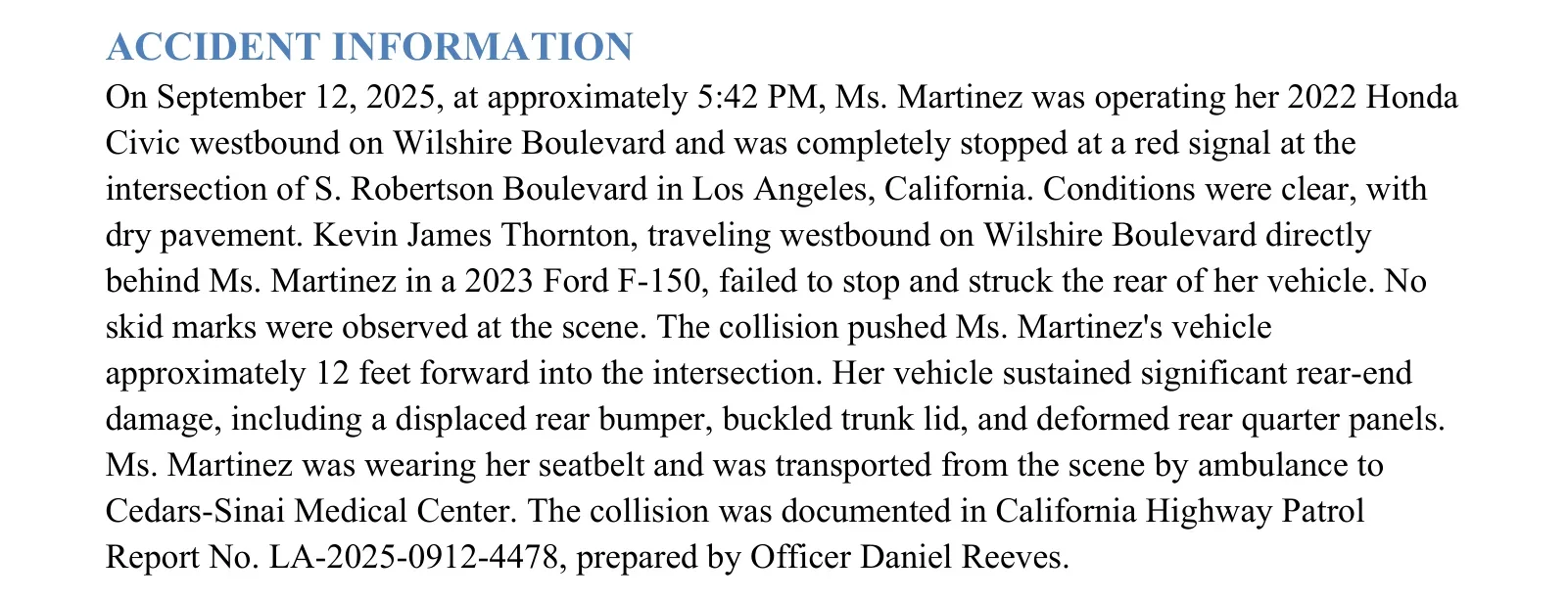
Here's the difference in practice. These are illustrations built on our demo case.
Weak. Admit that you were negligent and that your negligence caused the collision and plaintiff's injuries.
Better. Admit that YOUR VEHICLE struck the rear of PLAINTIFF's vehicle on September 12, 2025.
Admit that PLAINTIFF's vehicle was stopped at a red signal when YOUR VEHICLE struck it.
Admit that Exhibit A is a genuine copy of California Highway Patrol Report No. LA-2025-0912-4478.
The weak version packs three issues into one sentence and invites an objection. The better versions each ask for one fact that's hard to deny. Admissions like these narrow what's left to fight about.
What to Ask For in a PI Case
- Basic liability facts. Who was driving, who owned the vehicle, where each car was.
- Employment. Whether the driver was working at the time, if an employer may be liable.
- Citations and statements. Whether the driver was cited, or told the officer what the report says.
- Genuineness of documents. Medical records, bills, photos and the crash report. These don't count toward the 35.
- Things the defense won't seriously contest. Date, time, location, weather.
Serve RFAs with Form Interrogatory 17.1. That question is in Judicial Council form DISC-001. It asks the other side to explain every response that isn't an unqualified admission. They must give the facts, the people who know them and the supporting documents. A bare denial then costs the other side an explanation.

How Do You Respond to RFAs?
Respond in writing, under oath, to each request separately, within 30 days after service. For each one, admit what's true, deny what's untrue, or say you lack enough information after a reasonable inquiry. State any objection specifically. The party signs the response under oath, unless it contains only objections.
The response rules are in sections 2033.210 through 2033.250. The standard is high: each answer must be "as complete and straightforward" as the reasonably available information permits. If your client can't admit or deny, section 2033.220 asks for more. The answer must state that a reasonable inquiry was made and the information isn't enough.
| How the RFAs were served | Time to respond | Example, served Monday, November 2, 2026 |
|---|---|---|
| Personal service | 30 days | Wednesday, December 2 |
| Mail within California | 30 days plus 5 calendar days (CCP 1013) | Monday, December 7 |
| Electronic service | 30 days plus 2 court days (CCP 1010.6) | Friday, December 4 |
Treat the example as a starting point and count your own dates, including court holidays. If you need more time, ask early. Under section 2033.260, an extension can be informal, but it "shall be confirmed in a writing that specifies the extended date."
If your team handles the response, run this list:
- Calendar the due date and a reminder a week before it.
- Send the requests to the client the same day, with a call to walk through them.
- Check each request against the records before you admit or deny.
- Count the requests. Past 35 with no declaration, you can object to the balance.
- Get the client's signed verification before the due date, not on it.
- Serve the original on the requesting party and copies on everyone who has appeared.

What Happens If You Miss the Deadline?
In California, the requests aren't admitted automatically. A late party waives its objections, including privilege. The other side can then move for an order deeming everything admitted. The court must grant it, unless a substantially compliant response is served before the hearing. A monetary sanction is mandatory either way.
That's the structure of section 2033.280. The Court of Appeal explained it in St. Mary v. Superior Court (2014) 223 Cal.App.4th 762. The propounding party "must take affirmative steps" by bringing a formal motion. The same opinion said the RFA procedure is "not intended to provide a windfall to litigants."
So if you discover a missed deadline, act that day:
- Serve a verified response that complies with section 2033.220, before any hearing.
- Expect to pay the sanction. The statute says the court must impose it on the party or attorney whose late response made the motion necessary.
- If you need your objections back, move for relief. The court can grant it for mistake, inadvertence or excusable neglect, once a compliant response is served.
If you're on the other side, don't sit on unanswered RFAs. They do nothing for you until you bring the motion.
What Is a Cost of Proof Award?
Say a party refuses to admit something, and you later prove it. You can ask the court to make that party pay what the proof cost, including reasonable attorney's fees. The court must order it unless one of four exceptions applies. It's the main reason a careless denial can be expensive.
The exceptions in section 2033.420 are:
- An objection to the request was sustained, or a response was waived.
- The admission sought was of no substantial importance.
- The party had reasonable ground to believe it would prevail on the matter.
- There was other good reason for the failure to admit.
Courts treat this as reimbursement. The award "is not a penalty" under Stull v. Sparrow (2001) 92 Cal.App.4th 860. The court said it is "designed to reimburse reasonable expenses" of proving the requested admission. In Wimberly v. Derby Cycle (1997) 56 Cal.App.4th 618, a plaintiff moved for these costs after trial. The Court of Appeal held the trial court abused its discretion, in part, by denying the motion. Keep time records on what you spend proving a denied fact.
Can You Take Back an Admission?
Only with the court's permission. A party can withdraw or amend an admission on a noticed motion. The court can allow it only if the admission came from mistake, inadvertence or excusable neglect. The other side also must not be substantially prejudiced. Until then, the admission is conclusively established against that party in the case.
Those rules are in sections 2033.300 and 2033.410. An admission binds only the party who made it, and only in the pending action. If the other side's response is evasive, you can move to compel a further response. Give notice of that motion within 45 days of the verified response, or you waive it under section 2033.290.
How Do Other Courts Handle RFAs?
The biggest difference is what silence does. In federal court and in Washington, a request is admitted if no response is served in time. In California state court, the other side has to bring a motion first. New York's version is narrower and faster. Check the rule for your court before you count days.
| Court | Rule | Time to respond | If no response |
|---|---|---|---|
| California state court | CCP 2033.010 and following | 30 days, plus service extensions | Objections waived. Admitted only on motion and order |
| Federal court | FRCP 36 | 30 days after being served | "A matter is admitted" |
| Washington | CR 36 | 30 days. A defendant gets at least 40 days after service of the summons and complaint | "The matter is admitted" |
| New York | CPLR 3123 (notice to admit) | 20 days | Deemed admitted. Limited to matters the requester reasonably believes aren't in substantial dispute |
New Jersey has its own rule on requests for admission. Read it before you serve or respond there.
How Do RFAs Fit the Rest of a PI File?
RFAs work best when the file is already organized. Every good request starts from a fact you can point to in a record. Every response has to be checked against the same records. The work you did before suit carries straight into discovery.
- The chronology. A medical record chronology shows which treatment facts are solid enough to ask the defense to admit.
- The records and bills. Genuineness requests need clean copies. Our records retrieval guide covers getting them.
- The demand. The facts in your demand letter sections are a ready list of candidates.
- The damages. Admissions on bills and treatment support the numbers in your economic damages.
- Settlement tools. Admissions on liability change the math on a CCP 998 offer.
If the case hasn't been filed yet, our guide to the pre-litigation stage covers what to build first. Our guide to insurer response deadlines covers the clock before suit.
Where Lexyno Fits
Lexyno doesn't draft discovery or respond to it, and it doesn't decide what to admit or deny. That's the attorney's work. Lexyno's AI demand letter software drafts the demand from the case's records, with source references you can check.
Medical Summary builds the treatment chronology from the same records, which helps when you need to find the page behind a fact. POV reports read the record from the insurer's side. Plans are on the pricing page.
Short Sentences, Long Consequences
Requests for admission look simple, and that's the risk. One missed date can cost your objections and a sanction, and a careless denial can cost the price of proving the fact. Draft them one fact at a time, answer them from the record, and calendar every date the day it starts.
Start from our PI demand letter template, see our car accident sample, or try Lexyno on one case from your own file, free.
Frequently asked questions
It is a written request that another party admit the genuineness of a document or the truth of a fact, an opinion relating to fact, or the application of law to fact. In California, the rules are in Code of Civil Procedure sections 2033.010 through 2033.420.
To propound discovery is to serve it. The propounding party is the side that serves the requests, and the responding party is the side that must answer. California’s statute also calls the propounding party the requesting party.
As a matter of right, 35 that do not relate to the genuineness of documents. Requests about the genuineness of documents do not count toward that limit. To ask for more, attach the declaration described in section 2033.050. Limited civil cases have a tighter combined limit.
Thirty days after service. The time is extended by five calendar days for service by mail within California and by two court days for electronic service. The parties can agree to more time, but the agreement must be confirmed in writing.
No. A late party waives its objections, and the other side can move for an order deeming the matters admitted. The court must grant it unless a substantially compliant response is served before the hearing. A monetary sanction is mandatory either way.
If a party refuses to admit something and the other side later proves it, the court can order the refusing party to pay the reasonable expenses of that proof, including attorney’s fees. Section 2033.420 lists four exceptions, such as a reasonable belief the party would prevail.
Related posts

Pre-Litigation in a PI Case: Stages and Who Does What
What pre-litigation covers in a PI case: the seven stages, what the paralegal and the attorney each do, and the deadlines that keep running.

Time Limit for Insurance Claim Settlement: 4 State Rules
No state sets one time limit for insurance claim settlement. WA, CA, NY and NJ set clocks to acknowledge, reply, decide and pay. Here they are.
Economic Damages vs. Noneconomic Damages in PI Claims
What counts as economic damages in a PI claim, how the split from noneconomic damages works in WA, CA, NY and NJ, and how to calculate each line.
What's next?
Ready to see the difference in your next case?
Put these strategies to work. Try a mock demand generated by Lexyno today.
Request Evaluation Access