 Rich Martin
Time Limit for Insurance Claim Settlement: 4 State Rules
Time Limit for Insurance Claim Settlement: 4 State Rules
No state sets one time limit for insurance claim settlement. WA, CA, NY and NJ set clocks to acknowledge, reply, decide and pay. Here they are.

You sent the demand 31 days ago. The adjuster's voicemail is full, and your client calls every Friday. Can the carrier just sit on it?
Not entirely. No state sets a single time limit for insurance claim settlement. But Washington, California, New York and New Jersey each set clocks for the steps along the way. This guide lists those clocks and shows which ones reach a third-party bodily injury demand. It also covers what you can do when one runs out.

Is There a Time Limit for Insurance Claim Settlement?
No single deadline says a carrier must settle a bodily injury claim by a certain day. What the four states regulate is the handling. They set how fast the insurer must acknowledge the claim, answer your letters, investigate, decide, and pay once there's an agreement. Each step has its own clock, and the clocks differ by state.
The statutes speak in general terms. California's Insurance Code 790.03(h) lists, as an unfair practice, "not attempting in good faith to effectuate prompt, fair, and equitable settlements of claims in which liability has become reasonably clear." Washington's WAC 284-30-330 uses nearly the same words. The regulations then put numbers on "prompt."
The Four States at a Glance
These are the clocks that matter most in a PI file. Read the section itself before you cite one. The words around each number matter.
| State | Acknowledge the claim | Reply to your letters | Investigate or decide | If more time is needed |
|---|---|---|---|---|
| California | 15 calendar days | 15 calendar days | Accept or deny within 40 calendar days of proof of claim | Written notice, then every 30 calendar days |
| Washington | 10 business days | 10 business days | Complete the investigation within 30 calendar days of notification of claim | Written reasons, then every 30 days |
| New York | 15 business days | 15 business days | Accept or reject within 15 business days of the proof of loss and requested items | Notice within those 15 business days, then at 90 days and every 90 days after |
| New Jersey | 10 working days | 10 working days | Maximum payment period of 90 calendar days for third party bodily injury claims | Written notice by the end of the period, then every 45 days |
The sources, in the same order:
- California. 10 CCR 2695.5 covers acknowledgment and replies. 10 CCR 2695.7 covers the decision, the status notices and payment.
- Washington. WAC 284-30-360 and WAC 284-30-370. Both were amended effective Oct 18, 2026, so older summaries are out of date.
- New York. 11 NYCRR 216.4 and 216.6.
- New Jersey. N.J.A.C. 11:2-17.6 and 11:2-17.7.
Two payment clocks are worth adding. In California, the insurer must tender payment within 30 calendar days after it accepts the claim and, when one is needed, receives a signed release. In New York, an agreed settlement must be paid within five business days of the agreement.
Do These Deadlines Apply to a Third-Party Demand?
Mostly yes, with exceptions. California, Washington and New Jersey define "claimant" to include third party claimants and their attorneys. New York's rules cover first- and third-party claims. But some clocks are first-party only. Washington's 30-day accept-or-deny rule names the first party claimant, so check each section before you cite it.
- California. A claimant is "a first or third party claimant," and the definition includes an attorney. An insurer that denies a third party claim, or disputes liability or damages, "shall do so in writing."
- Washington. The reply rule and the 30-day investigation rule speak of "a claimant." The accept-or-deny rule in WAC 284-30-380 applies to "the first party claimant." So does the notice statute in our IFCA 20-day notice guide.
- New York. Part 216 applies to "all first- and third-party claims" under covered policies. A claimant is "any person who attempts to obtain a benefit from an insurer."
- New Jersey. The 90-day figure is written for "third party bodily injury claims." It applies "unless a clear justification exists."

When Does the Clock Start?
It depends on the rule. Acknowledgment clocks start at notice of the claim, which is usually your letter of representation, not the demand. California's 40-day decision clock starts at proof of claim. New York's starts when the insurer has the proof of loss and everything it asked for. New Jersey's 90 days run from notification of claim.
| Trigger | What usually supplies it | Clocks it starts |
|---|---|---|
| Notice or notification of claim | The letter of representation or the first report of the claim | Acknowledgment in all four states, Washington's 30-day investigation, New Jersey's 90 days |
| A communication that suggests a reply is expected | Your demand, and each follow-up letter | The reply deadlines in all four states |
| Proof of claim or proof of loss | The demand package: records, bills, wage proof | California's 40 days, New York's 15 business days |
| Acceptance or a settlement agreement | The agreed number and the signed release | The payment deadlines in California and New York |
California defines proof of claim broadly. It's any evidence or documentation in the insurer's possession that "reasonably supports the magnitude or the amount of the claimed loss." A complete package helps you here. If the records and bills are all in the first mailing, the carrier has less room to say the clock hasn't started. Our guide to the sections of a demand letter lists what belongs in it.
What the Rules Don't Do
They don't force an offer. A carrier can meet every deadline in the table and still say no. The rules require an answer, a decision or an explanation. They don't require the answer you want.
They also don't adopt your deadline. Most demands end with a line like the one in our demo letter.
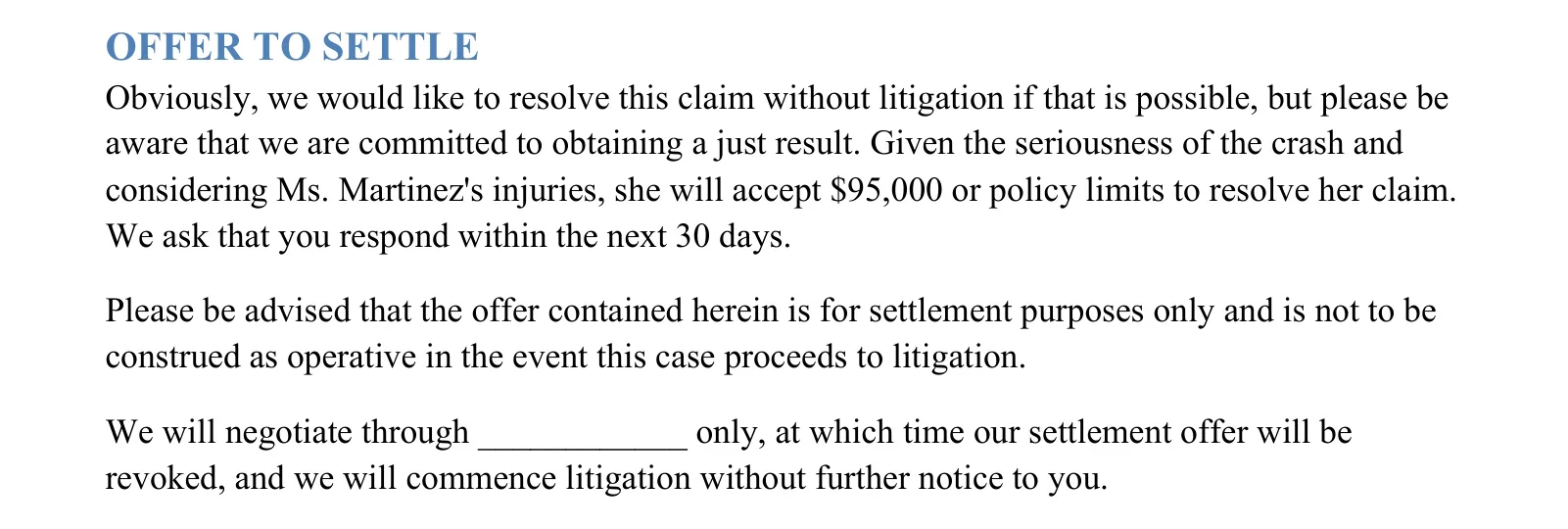
That 30 days is a request. It's still worth making, because it gives you a date to follow up on. Statutory time-limited demands are a different tool with their own rules. See our guides to California's CCP 999 time-limited demand and the policy limits settlement demand.
Can You Sue the Carrier for Missing a Deadline?
Usually not as the injured third party. California's Supreme Court found no private civil cause of action in the unfair practices statute. Washington held that third party claimants can't sue the insurer directly for bad faith. New York recognizes no private action under its statute. Regulators enforce these rules, and your paper trail still matters.
- California. Moradi-Shalal v. Fireman's Fund (1988) held that the statute was not "intended to create a private civil cause of action against an insurer."
- Washington. Tank v. State Farm (1986): "third party claimants may not sue an insurance company directly for alleged breach of duty of good faith."
- New York. Rocanova v. Equitable Life (1994) said New York law "does not currently recognize a private cause of action under Insurance Law § 2601." That statute also requires conduct frequent enough "to indicate a general business practice."
- New Jersey. We haven't checked New Jersey's case law on this point. Confirm it before you rely on a private remedy there.
The insured is in a different position. A carrier that mishandles a demand within limits can face a claim from its own policyholder. That's the pressure behind a limits demand. A first-party claimant has other options too, like Washington's IFCA.
What to Do When the Deadline Passes
Work the calendar, and put each step in writing.
- Calendar the clocks when you send. Note the date of the letter of representation and the date the full package went out.
- Follow up with the rule, not a complaint. Name the date and the section. Ask for the decision or the written notice the rule requires.
- Ask what's missing. If the adjuster needs something, the rules expect them to say so. Send it the same week.
- Consider the regulator. In Washington, an insurer must answer the commissioner's inquiry on a complaint within 10 business days. New Jersey gives insurers 15 working days to answer the Department.
- Watch the statute of limitations. None of these clocks extends it. If the date is close, file.
Weak: Please respond to our demand as soon as possible.
Better: You received our demand and supporting records on September 3. Under 10 CCR 2695.7(b), your written acceptance or denial was due within 40 calendar days. Please send it, or the written notice required by subsection (c)(1).
The second version gives the adjuster a date, a rule and a choice. It also reads well later if someone reviews the file. Whether to send it, and when, is your call.

How Long After a Demand Letter Does Settlement Take?
There's no reliable published average, and the rules above don't set one. In practice the answer turns on what the adjuster still needs. A complete package with records, bills and wage proof removes the usual reasons for delay. Disputed liability, open treatment, liens and policy limits questions all add time.
So we won't give you a number. A few things you control do shorten the wait:
- Send one complete package. Our records-to-settlement workflow covers the order of work, and the guide to the demand letter to the insurance company covers how adjusters read it.
- Prove the specials. See our guide to economic damages.
- Deal with liens early. See medical liens in personal injury cases.
- Know the threshold. In New York and New Jersey, the serious injury and verbal threshold questions come first.
How long the demand itself takes to write is a separate question. We covered it in how long a demand letter takes.
Where Lexyno Fits
Lexyno doesn't track carrier deadlines or decide when to follow up. That's your calendar and your judgment. Lexyno's AI demand letter software drafts the demand from the case's records, with source references you can check. A complete first package is the part of the timeline you control.
Medical Summary builds the treatment chronology and flags gaps over 30 days, so you can explain them before the adjuster asks. Plans are on the pricing page.
Put the Clock in the File
None of the four states has one time limit for insurance claim settlement, so the carrier doesn't have to settle on your schedule. It does have to acknowledge, answer, decide and explain on the state's schedule. Know the four clocks, calendar them, and follow up in writing.
Start from our PI demand letter template, see a sample car accident demand letter, or try Lexyno on one case from your own file, free.
Frequently asked questions
Not a single one. Washington, California, New York and New Jersey regulate the steps instead: acknowledging the claim, answering communications, investigating, deciding and paying an agreed settlement. Each step has its own deadline, counted in calendar, business or working days.
A communication that reasonably suggests a response is expected must be answered within 15 calendar days in California, 10 business days in Washington, 15 business days in New York and 10 working days in New Jersey. That is a reply, not necessarily an offer.
Usually not. A deadline in an ordinary demand is a request. Statutory time-limited demands are different. California’s CCP 999 sets its own rules and minimum response periods, and policy limits demands carry consequences for the insurer’s own policyholder.
The regulations define it as any evidence or documentation in the insurer’s possession that provides evidence of the claim and reasonably supports the magnitude or amount of the claimed loss. Receiving it starts the 40-calendar-day clock to accept or deny.
Generally not in California, Washington or New York. California’s Supreme Court found no private civil cause of action in the unfair practices statute, Washington bars direct bad faith suits by third party claimants, and New York recognizes no private action under Insurance Law 2601.
Send a short follow-up that names the date the insurer received the claim and the regulation that applies, and ask for the written explanation the rules require when more time is needed. Supply anything requested quickly, and keep the statute of limitations on your calendar.
Related posts

Requests for Admission in California PI Cases: A Guide
How requests for admission work in a California PI case: the 35 limit, the 30-day response, what happens when a deadline is missed, and cost of proof.

Pre-Litigation in a PI Case: Stages and Who Does What
What pre-litigation covers in a PI case: the seven stages, what the paralegal and the attorney each do, and the deadlines that keep running.
Economic Damages vs. Noneconomic Damages in PI Claims
What counts as economic damages in a PI claim, how the split from noneconomic damages works in WA, CA, NY and NJ, and how to calculate each line.
What's next?
Ready to see the difference in your next case?
Put these strategies to work. Try a mock demand generated by Lexyno today.
Request Evaluation Access