 Rich Martin
Economic Damages vs. Noneconomic Damages in PI Claims
Economic Damages vs. Noneconomic Damages in PI Claims
What counts as economic damages in a PI claim, how the split from noneconomic damages works in WA, CA, NY and NJ, and how to calculate each line.

You total the bills, add the wage loss, and send the demand. The carrier's evaluation comes back with the medical number cut and nothing for future care. The offer barely clears the specials.
Economic damages are the part of a claim you prove with paper. This guide covers what goes in that column and what goes in the noneconomic one. It also covers why the label changes what your client collects in Washington, California, New York and New Jersey. Then it walks through the calculation, line by line.
What Are Economic Damages in a Personal Injury Claim?
Economic damages are the losses you can prove with a document and a dollar figure. Medical bills, lost earnings, lost earning capacity, household help and out-of-pocket costs all belong here. They cover past losses and future ones. Most lawyers call the past portion specials. Every line needs a record behind it.
California's Civil Code 1431.2 defines them as "objectively verifiable monetary losses." Its list includes medical expenses, loss of earnings, burial costs, loss of use of property, and the cost of substitute domestic services. New Jersey's auto statute, N.J.S.A. 39:6A-2, is shorter. Economic loss is "uncompensated loss of income or property, or other uncompensated expenses, including, but not limited to, medical expenses."
| Item | What it covers | What proves it |
|---|---|---|
| Past medical expenses | Care your client already received | Itemized bills, the record for each date of service, payment ledgers |
| Future medical expenses | Care your client is reasonably certain to need | The treating provider's written recommendation and cost, or a life care plan |
| Past lost earnings | Income lost to date | Pay stubs, an employer letter, tax returns, work restrictions |
| Future lost earnings and earning capacity | Income the injury will cost later | Provider restrictions, work history, vocational and economic experts |
| Household services | Work at home your client can no longer do | Invoices for replacement help, statements from the household |
| Out-of-pocket costs | Prescriptions, equipment, travel to treatment, property loss | Receipts, mileage logs, repair estimates |
California's jury instructions use the same list. In the 2026 CACI, instructions 3903A through 3903E cover medical expenses, lost earnings, lost earning capacity and household services. Each title ends with "(Economic Damage)." If the bills and records aren't in yet, start with our records retrieval guide.
What Counts as Noneconomic Damages?
Noneconomic damages pay for losses that have no invoice: pain, suffering, inconvenience, emotional distress and loss of enjoyment of life. No formula sets the amount. The record still has to support it, through treatment notes, how long recovery took, and the change in your client's daily life. Several states define the category by statute.
California calls them "subjective, non-monetary losses." Its list runs from pain and suffering to loss of consortium and humiliation. New York's no-fault law defines non-economic loss as "pain and suffering and similar non-monetary detriment." New Jersey's definition is the shortest: "pain, suffering and inconvenience."
We cover how to support that number in our guides to pain and suffering settlement examples and emotional distress damages. Punitive damages sit outside both categories. Our Civil Code 3294 guide covers those.
Special, General, Pecuniary: Older Names for the Same Split
You'll see three sets of labels in statutes, verdict forms and carrier letters. In a PI file they mostly mean the same thing.
| Modern term | Older names | Where you'll still see them |
|---|---|---|
| Economic damages | Special damages (specials), pecuniary loss | Fed. R. Civ. P. 9(g): "If an item of special damage is claimed, it must be specifically stated." New York's wrongful death statute pays for "pecuniary injuries." |
| Noneconomic damages | General damages, nonpecuniary loss | New York's CPLR 4111(e) has juries itemize "special and general damages." California's Prop 213 statute refers to "other nonpecuniary damages." |
The match isn't exact everywhere. Special damages has more than one legal meaning, for example. For a PI demand, treat economic, special and pecuniary as one column. Treat noneconomic, general and nonpecuniary as the other.
The labels matter at the pleading stage too. In California, a PI complaint can't state the amount demanded. The defendant can then request a statement "setting forth the nature and amount of damages being sought," and you have 15 days to serve it under CCP 425.11.

Why Does the Label Change What Your Client Collects?
Because each state attaches different rules to each category. In California, a defendant owes noneconomic damages only in proportion to its fault. In New York and New Jersey, auto thresholds restrict noneconomic recovery but not uncompensated economic loss. Verdict forms split the two. So a dollar moved from one column to the other can change the recovery.
| State | What turns on the category | Source |
|---|---|---|
| California | Liability for noneconomic damages "shall be several only and shall not be joint." Liability for economic losses stays joint. Some uninsured and DUI plaintiffs can't recover noneconomic losses in an auto case. The verdict form states the two categories separately. | Civ. Code 1431.2 and 3333.4, CACI 3902 |
| New York | In a covered auto case there's no recovery for basic economic loss, which no-fault pays up to $50,000. There's none for noneconomic loss without a serious injury. Juries itemize each element, past and future. | Ins. Law 5104, CPLR 4111(e) |
| New Jersey | The limitation on lawsuit option restricts noneconomic loss only. PIP-paid amounts stay out of evidence, but the claim for uncompensated economic loss survives. Future lost income is measured after taxes. | N.J.S.A. 39:6A-12, Ruff v. Weintraub |
| Washington | The 1986 cap on noneconomic damages was struck down in 1989, and the statute was repealed in 2023. A future economic award of $100,000 or more can be paid over time if a party asks. | Sofie v. Fibreboard, RCW 4.56.250, RCW 4.56.260 |
The thresholds have their own guides: New York no fault and serious injury, and the NJ verbal threshold. Liens care about the split too. Our medical liens guide covers which part of a settlement a lien can reach.
The category also shapes limits strategy. When the documented economic loss alone approaches the policy, you're writing a different letter. See our guides to the policy limits settlement demand and California's CCP 999 time-limited demand.
How Do You Calculate Economic Damages?
Add them line by line, and tie each line to a document. Start with past medical expenses by provider. Add the future care a provider has said your client will need. Then add past lost earnings, future lost earnings or earning capacity, household services and out-of-pocket costs. Show the arithmetic so the adjuster can check it.
- Past medical expenses. List every provider, the dates of service and the amount. Match each bill to a visit in the medical chronology.
- Future medical expenses. Use the treating provider's recommendation: what care, how often, how long, and what it costs.
- Past lost earnings. Multiply the verified rate by the time missed. Back it with pay records and the work restriction for the same dates.
- Future lost earnings or earning capacity. Compare what your client could have earned with what they can earn now.
- Household services and out-of-pocket costs. Add receipts, mileage and replacement help.
- The total. Add the lines and state the sum once. Use the same figure everywhere in the letter.
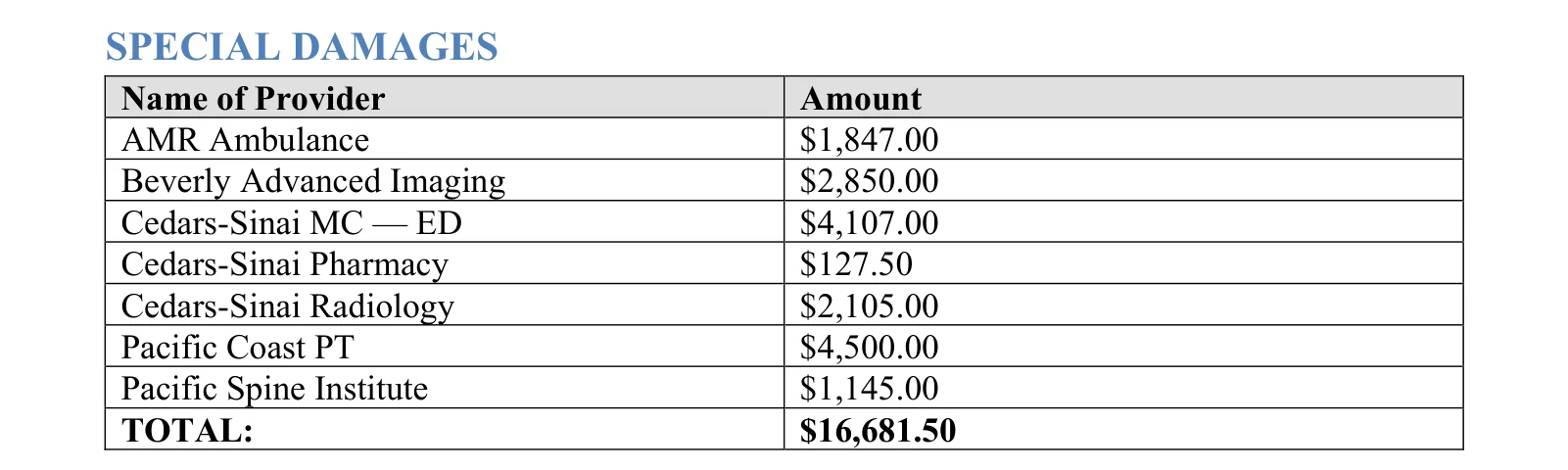
Here's the provider table from our demo demand letter. Seven providers, one total.
The wage loss section does its math in the open. Ten full days at $375.00 come to $3,750.00. Thirty half days add $5,625.00. Wage loss is $9,375.00.
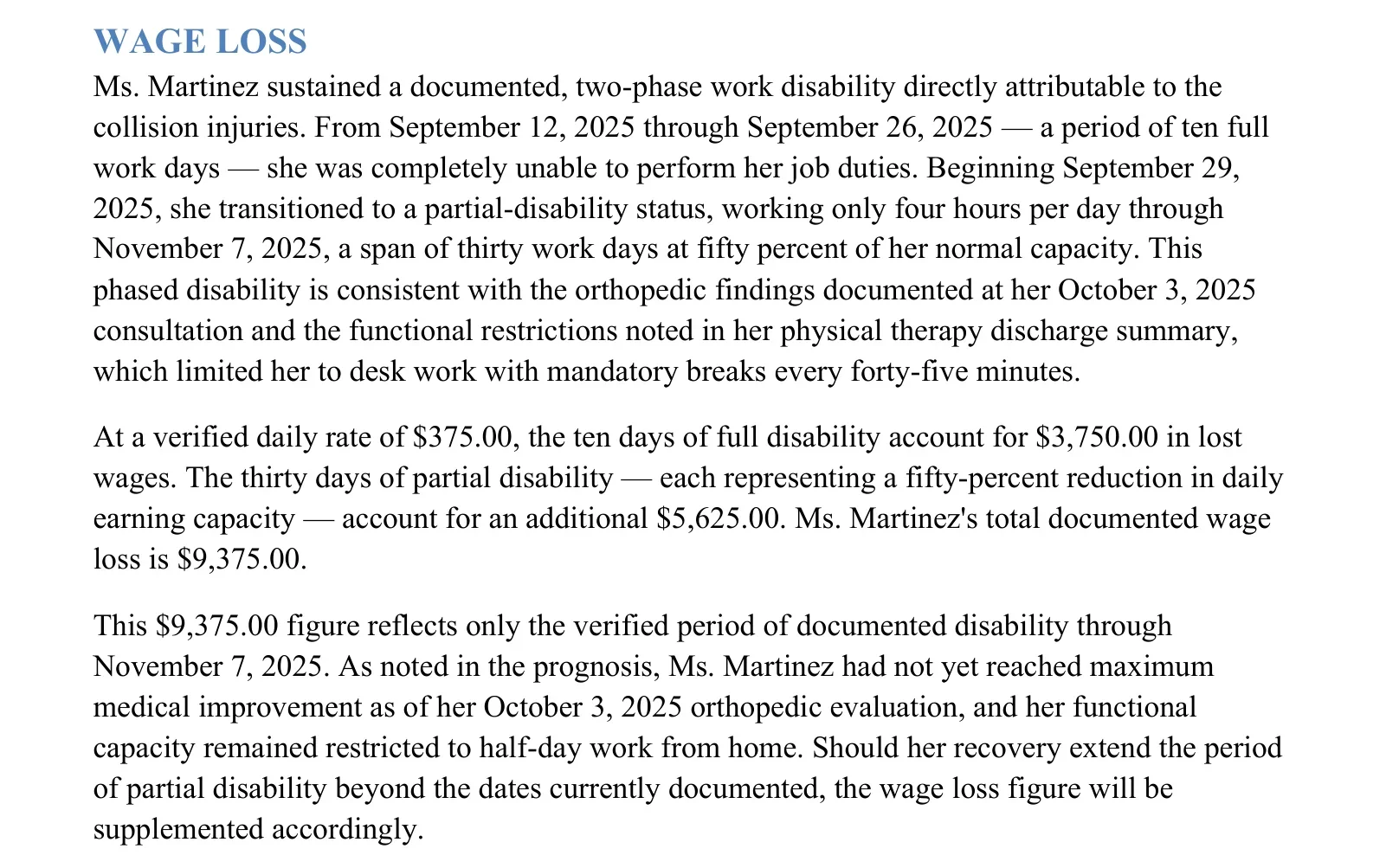
Add $16,681.50 and $9,375.00, and the documented economic loss to date is $26,056.50. Nobody argues with arithmetic. They argue with the inputs. Our post on why AI demand letters get numbers wrong explains how a total drifts between drafts.
Billed or Paid: Which Medical Number Counts?
It depends on the state. In California, a plaintiff recovers the lesser of the amount paid or incurred and the reasonable value of the services. So a bill that an insurer settled for less is usually worth the lower figure. Know your state's rule before you total the specials, because the carrier will apply it.
"[A] personal injury plaintiff may recover the lesser of (a) the amount paid or incurred for medical services, and (b) the reasonable value of the services." Howell v. Hamilton Meats (2011)
New York takes a different route. Under CPLR 4545, the court can reduce an award for medical care or lost earnings. The test is whether a collateral source "was or will, with reasonable certainty," cover the expense. Life insurance is excepted, and so are payments with a statutory right of reimbursement.
New Jersey keeps PIP-paid amounts out of evidence in the bodily injury case. The same statute preserves the claim for "uncompensated economic loss," including medical expenses beyond the PIP limits. Treatment on a lien raises its own fight over value. Our letter of protection guide covers it.
Future Medical Expenses and Lost Earning Capacity
Future losses are where most demands are thinnest, and the standard is strict. California allows damages for detriment "certain to result in the future." CACI 3903A asks for the care a plaintiff "is reasonably certain to need."

- Future care. Get it in writing from the treating provider. "May need" won't carry a number. If your client had a prior condition, see our eggshell plaintiff guide.
- Earning capacity. CACI 3903D compares what the plaintiff could have earned without the injury to what they can still earn. It says a work history isn't necessary.
- Present value. CACI 3904A defines present cash value as the amount that, "if reasonably invested today," will provide the future damages. In New York cases under CPLR Article 50-A or 50-B, the jury awards the full future amount "without reduction to present value."
- Taxes. New Jersey measures lost future income by "net income after taxes." Check your state before you use gross pay.
Where Carriers Push Back on the Economic Side
Carriers test the paper before they discuss anything else. These are the challenges you'll see most, and what answers each one.
| The challenge | What answers it |
|---|---|
| The treatment wasn't related to the crash | A chronology that ties each visit to the injury, with the provider's causation note |
| The charges are too high | Itemized bills, and the paid amounts where your state uses them |
| The bills don't match the records | One row per date of service, with a record behind every charge |
| The wage loss isn't verified | An employer letter, pay records and a work restriction for the same dates |
| The future care is speculative | A written recommendation with frequency, duration and cost |
Our guide to the demand letter to the insurance company covers the order adjusters read in. The medical record summary guide shows how to put the treatment story next to the bills.
One caution. These rules are state-specific, and they change. New York rewrote parts of its no-fault law in 2026. Check current law in your state before you rely on a table, including ours.
Where Lexyno Fits
Lexyno doesn't decide what a claim is worth, or which losses your state lets you recover. That's the attorney's call. Lexyno's AI demand letter software drafts the demand from the case's records. That includes the special damages table and the wage loss section, with source references you can check.
Medical Summary builds the treatment chronology and flags gaps over 30 days, so you can check the bills against the visits. POV reports read the same record from the insurer's side. Plans are on the pricing page.
Prove the Paper First
Economic damages are the floor of the claim. The noneconomic number is built on top, and the adjuster checks the floor first. Document every line, label it and add it correctly. Then argue the rest.
Start from our PI demand letter template, see a sample car accident demand letter, read the guide to each section of a demand letter, or try Lexyno on one case from your own file, free.
Frequently asked questions
Economic damages are losses with a dollar figure and a document behind them, such as medical bills and lost earnings. Noneconomic damages cover pain, suffering, inconvenience and emotional distress, which have no invoice. Several states define both categories by statute and attach different rules to each.
In a personal injury file, usually yes. Special damages, or specials, is the older name for itemized money losses, and general damages is the older name for pain and suffering. New York’s CPLR 4111(e) still has juries itemize special and general damages.
Pecuniary means monetary. Pecuniary damages are losses measured in money, the same idea as economic loss. Non-pecuniary damages are the intangible ones. New York’s wrongful death statute pays for pecuniary injuries, and California’s Prop 213 statute refers to nonpecuniary damages.
It depends on the state. In California, Howell v. Hamilton Meats limits recovery to the lesser of the amount paid or incurred and the reasonable value of the services. New York lets the court reduce an economic award for collateral source payments under CPLR 4545.
Washington’s 1986 cap was struck down in 1989 and repealed in 2023. California bars noneconomic losses for some uninsured and DUI plaintiffs. New York and New Jersey restrict them through auto thresholds, and New York added a $100,000 cap for some at-fault plaintiffs in 2026.
Federal law excludes damages, other than punitive damages, received on account of personal physical injuries or physical sickness. The statute carves out amounts tied to medical expense deductions taken in earlier years. Clients should ask a tax professional before they sign.
Related posts

Requests for Admission in California PI Cases: A Guide
How requests for admission work in a California PI case: the 35 limit, the 30-day response, what happens when a deadline is missed, and cost of proof.

Pre-Litigation in a PI Case: Stages and Who Does What
What pre-litigation covers in a PI case: the seven stages, what the paralegal and the attorney each do, and the deadlines that keep running.

Time Limit for Insurance Claim Settlement: 4 State Rules
No state sets one time limit for insurance claim settlement. WA, CA, NY and NJ set clocks to acknowledge, reply, decide and pay. Here they are.
What's next?
Ready to see the difference in your next case?
Put these strategies to work. Try a mock demand generated by Lexyno today.
Request Evaluation Access