 Rich Martin
Civil Code 3294: Punitive Damages in California PI Cases
Civil Code 3294: Punitive Damages in California PI Cases
A PI guide to Civil Code 3294: malice, oppression and fraud, drunk driving, employer liability, procedure, and how to handle punitive facts in a demand.

You open the crash report and the blood alcohol result is right there in the narrative. Or the trucking company's file shows it kept a driver on the road after a string of prior crashes. The case may have just changed shape. The question is whether you can prove it.
Civil Code 3294 is California's punitive damages statute. This guide covers what it requires, how malice works in auto cases and when an employer is on the hook. It also walks through the procedural rules that trip up PI files. Then it covers what most guides skip: what to do with punitive facts in a demand letter. The carrier won't pay them, and the ethics rules limit what you can say.
What Does Civil Code 3294 Say?
Civil Code 3294 lets a plaintiff recover punitive damages in a non-contract case. The plaintiff must show oppression, fraud or malice by clear and convincing evidence. These damages sit on top of actual damages, "for the sake of example and by way of punishing the defendant." A pure contract claim doesn't qualify.
The statute defines all three grounds in subdivision (c).
| Ground | What the statute requires | Where it shows up in PI |
|---|---|---|
| Malice | Conduct intended to injure, or despicable conduct carried on with a willful and conscious disregard of the rights or safety of others | Impaired driving, known safety hazards left in place |
| Oppression | Despicable conduct that subjects a person to cruel and unjust hardship in conscious disregard of their rights | Mistreatment of someone who can't protect themselves |
| Fraud | Intentional misrepresentation, deceit or concealment of a known material fact, intended to deprive a person of property or rights or to cause injury | Hiding a known defect or danger |
The word doing the most work is "despicable." The Legislature added it in the 1987 amendments. In College Hospital v. Superior Court (1994) 8 Cal.4th 704, 725, the California Supreme Court said it "seems to represent a new substantive limitation" and refers to circumstances that are base, vile or contemptible.
The burden matters too. Your negligence claim needs a preponderance of the evidence. The punitive claim needs clear and convincing evidence, so the same file has to do more.
What Separates Malice From Negligence?
Negligence is carelessness. Malice under section 3294 needs more: conduct meant to injure, or despicable conduct done with willful and conscious disregard for safety. In practice, the defendant has to know the probable danger and deliberately fail to avoid it. A serious injury alone doesn't get you there, however bad the result.
When you review a new file, sort the facts by what they show and what you'd need to find next. This table is a way to think about it, not a rule. Each case turns on its own evidence.
| Fact in the file | What it usually shows | What to look for next |
|---|---|---|
| Driver looking at a phone | Negligence | Anything showing the driver knew of a specific danger and went ahead |
| Speeding or an unsafe lane change | Negligence | Racing, fleeing or a pattern of conduct right before the crash |
| Impaired driver | Possible conscious disregard | Test results, what and when they drank, warnings, prior incidents |
| Hazard left unfixed | Possible conscious disregard | Prior complaints, internal messages, who decided to wait |
| Employer kept a bad driver | Possible employer liability | Driver file, prior crashes, who approved keeping them on |
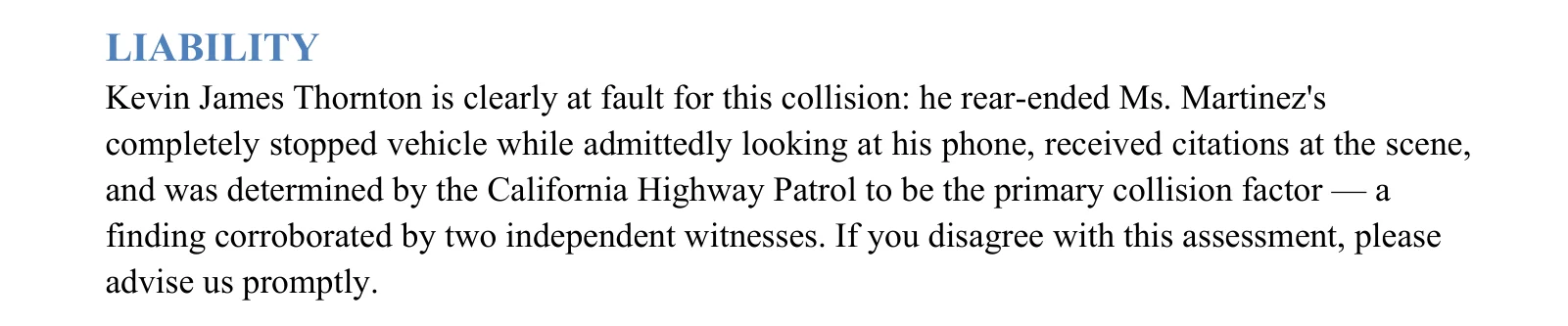
Here's a strong liability paragraph from our demo demand letter. The driver rear-ended a stopped car while looking at his phone, and got cited at the scene. Fault is clear, and that's all the paragraph needs to show. Clear fault and conscious disregard are different questions.
Can Drunk Driving Support Punitive Damages?
Yes, on the right facts. Taylor v. Superior Court (1979) 24 Cal.3d 890 held that driving while intoxicated may be malice under section 3294. The circumstances have to show conscious disregard of the probable dangerous consequences. Prior arrests and convictions can help prove it, but the court said they aren't essential.
One caution: Taylor came before the 1987 "despicable" language, so check how current cases apply it to facts like yours. Then build the record:
- Blood or breath results, and when the test was taken
- What the defendant drank, how much and over how long
- Any warning from a friend, server or passenger
- Prior DUI arrests, convictions or court-ordered classes
- The driving right before the crash, from witnesses and video
- The criminal case file and its outcome
A Prop 213 Wrinkle
The criminal outcome can matter for more than punitive damages. Civil Code 3333.4 bars non-economic damages for an injured owner whose car wasn't insured. But subdivision (c) lifts that bar when the owner was hit by a motorist who was driving under the influence and "was convicted of that offense." So if your client is uninsured, the conviction can decide whether there's a pain and suffering claim at all. Read it closely: the carve-out covers paragraph (2) owners, not paragraph (3) operators.
When Is an Employer Liable for Punitive Damages?
An employer isn't liable for punitive damages just because its employee is. Under section 3294(b), the employer must have known the employee was unfit and kept them on in conscious disregard, authorized or ratified the conduct, or been personally guilty. For a corporation, that must come from an officer, director or managing agent.
"Managing agent" is where most of these fights happen. In White v. Ultramar (1999) 21 Cal.4th 563, 566-567, the court limited it to those who "exercise substantial independent authority and judgment in their corporate decisionmaking so that their decisions ultimately determine corporate policy." It also said a managing agent must be "more than a mere supervisory employee." So a title isn't enough, and neither is a shift supervisor's sign-off.

In a commercial case, target your discovery at that question. Who set the policy? Who knew about the driver's history? Who could have pulled them off the road? CACI has separate instructions for this: CACI 3943 and 3945 cover an employer's liability for an employee's conduct and an entity defendant.
The Procedure Rules That Trip Up a Punitive Claim
Most of the traps are procedural, and several of them come early. Keep this table in the file.
| Stage | Rule | What to do |
|---|---|---|
| Complaint | CCP 425.10(b) and Civ. Code 3295(e): don't state an amount | Plead the facts behind malice, oppression or fraud, with no figure |
| Default | CCP 425.115: serve a statement preserving the right to seek punitive damages | Serve it before a default is taken, or you may lose the claim on default |
| Financial discovery | Civ. Code 3295(c): court order required, based on a substantial probability you'll prevail | Build the evidence first, then bring the motion |
| Trial | Civ. Code 3295(d): on a defendant's application, financial evidence waits for a verdict and a finding | Prepare for two phases (CACI 3941 and 3942) |
| Health care provider | CCP 425.13: court order needed before the claim goes in a pleading | Move within two years of the complaint or nine months before the first trial date, whichever is earlier |
| Death | CCP 377.34: survival action only, with the felony homicide exception in 3294(d) | Plead punitive damages in the right cause of action |
Two of these deserve a closer read. Section 3295(c) means you can't just serve financial discovery with your first set. And CCP 425.13 applies to claims arising from a health care provider's professional services. That motion needs affidavits showing a substantial probability you'll prevail. Calendar the deadline the day you file.

How Much Can Punitive Damages Be?
No fixed formula exists, and sections 3294 and 3295 set no dollar cap. CACI tells jurors to weigh how reprehensible the conduct was and how the amount relates to the plaintiff's harm. They also consider what it takes to punish and deter, given the defendant's finances. Due process and ability to pay set the outer limits.
Two cases set those limits in practice. First, Adams v. Murakami (1991) 54 Cal.3d 105, 109 says an award can't stand "unless the trial record contains meaningful evidence of the defendant's financial condition." The plaintiff carries that burden. A large verdict with no financial evidence won't survive.
Second, due process. State Farm v. Campbell says "few awards exceeding a single-digit ratio" will satisfy it. California applied that in Simon v. San Paolo (2005) 35 Cal.4th 1159. There, the jury gave $5,000 in compensatory damages and $1.7 million in punitive damages. The court held the maximum was $50,000.
Will the Carrier Pay Punitive Damages?
Generally, no. The California Supreme Court said in PPG Industries v. Transamerica that "our public policy prohibits indemnification for punitive damages." Peterson v. Superior Court says insurance policies don't cover them. So a punitive award usually falls on the defendant personally. That changes how you value the claim and frame a demand.
That has two practical effects. First, collectibility. In PPG, the insured couldn't even shift the award to a carrier that had negligently failed to settle. If the defendant is an individual with few assets, a punitive judgment may be worth little, however strong the facts. Check before you spend on it.
Second, your settlement number. The adjuster has authority over covered damages. Your offer to settle should rest on the compensatory damages you can document. Our guide to the policy limits demand covers what happens when those damages may exceed coverage. Insurance Code 533 is the related limit on covering an insured's wilful acts.
How to Handle Punitive Facts in a Demand Letter
Put the facts in the liability section and let them speak. An adjuster doesn't need adjectives to understand a blood alcohol result. You can say the facts may support a punitive claim, and that gives the carrier a reason to tell its insured about exposure the policy won't cover. Our guide to each section of a demand letter shows where this goes. If you're sending a time-limited demand, see the CCP 999 guide.
Now the trap. California Rule of Professional Conduct 3.10 says "A lawyer shall not threaten to present criminal, administrative, or disciplinary charges to obtain an advantage in a civil dispute." It applies whether or not a suit has been filed. In a DUI case, that's easy to run into.
Here's the difference, in illustrative language.
Tied to a threat. If this isn't resolved, we'll report your insured to the DMV and ask the District Attorney to file charges.
Facts and remedies. The CHP report records a chemical test result above the legal limit. Plaintiff reserves all available legal remedies, including punitive damages under Civil Code section 3294.
The second version states what the record shows and reserves remedies. The comments to the rule say a reference to "all available legal remedies" doesn't by itself violate it. Check the rule and its comments against your own wording before anything goes out.
The demand is a civil document. Keep the punishment argument in the claim, not in a threat.
Before you send it, run this list:
- Sourced facts: every punitive fact ties to a report, record or witness.
- No threats: nothing links settlement to criminal, DMV or licensing action.
- A clean number: the offer rests on damages you can document.
- Records in hand: you have the criminal file, not just the first report. Our records retrieval guide covers the medical side.
- Attorney sign-off: the decision to raise punitive damages at all is the attorney's.
If the case doesn't settle, a CCP 998 offer is the next tool to consider. Our guide to the demand letter to the insurance company covers the rest of the letter, and the car accident sample shows a finished one.
Where Lexyno Fits
Lexyno doesn't decide whether a case supports punitive damages. That's the attorney's judgment. Lexyno's AI demand letter software drafts the demand from the case's records, including the liability facts and damages, with source references you can check.
Medical Summary builds the chronology behind the compensatory claim. POV reports read the same record from the insurer's side, so you can see where the claim will be challenged. Plans are on the pricing page.
The Claim Is Only as Good as the File
Civil Code 3294 asks for more than a bad crash. It asks for proof, clear and convincing, of what the defendant knew and chose to do. Find those facts early, calendar the procedural deadlines, and check whether anyone can pay.
Then keep the demand clean. State what the record shows, and leave the threats out.
Start from our PI demand letter template, or try Lexyno on one case from your own file, free.
Frequently asked questions
It is California’s punitive damages statute. In a non-contract case, a plaintiff who proves oppression, fraud or malice by clear and convincing evidence can recover damages on top of actual damages, for the sake of example and to punish the defendant.
The California Supreme Court said in College Hospital that it refers to circumstances that are base, vile or contemptible. Since the 1987 amendments, oppression and the conscious disregard form of malice both require despicable conduct.
You can, depending on the facts. Taylor v. Superior Court held that driving while intoxicated may be malice when the circumstances show conscious disregard of the probable dangerous consequences. Prior arrests and convictions help but are not required. You still need clear and convincing evidence.
Generally not. The California Supreme Court has said public policy prohibits indemnification for punitive damages, and that insurance policies do not cover them. A punitive award usually falls on the defendant personally, so collectibility matters when you decide how much to invest in the claim.
Sections 3294 and 3295 do not set a dollar cap. The limits come from elsewhere: due process, which makes high ratios to compensatory damages suspect, and the defendant’s ability to pay, which the plaintiff must prove with evidence of financial condition.
Generally not in the wrongful death claim itself. They may be recoverable in a survival action under CCP 377.34, if the decedent would have been entitled to them. Section 3294(d) adds an exception for a death from a homicide for which the defendant was convicted of a felony.
Related posts

Pain and Suffering Settlement Examples: What a Demand Needs
Why pain and suffering settlement examples rarely transfer to your case, and the evidence and demand language that make noneconomic damages credible.
New York No Fault in 2026: Serious Injury After the Reforms
New York no fault and serious injury after the 2026 reforms: the eight categories left, the new fault rules, deadlines, and what it means for your demand.
NJ Verbal Threshold: A Guide for PI Attorneys
The NJ verbal threshold for PI attorneys: who is bound, the six categories, the physician certification and its 60-day deadline, and how to prove it.
What's next?
Ready to see the difference in your next case?
Put these strategies to work. Try a mock demand generated by Lexyno today.
Request Evaluation Access