 Rich Martin
Letter of Protection in Personal Injury: Uses and Risks
Letter of Protection in Personal Injury: Uses and Risks
A letter of protection gets a client treated now, but your signature carries duties. What to put in an LOP, how the bills count, what each state requires.

Your client has a herniated disc and no health coverage. The spine clinic will see them next week, if you sign a one-page form. You've signed dozens of these. Then the case settles low, the clinic's bill is bigger than expected, and the form on your desk suddenly matters.
That form is a letter of protection, or LOP. It gets clients treated. It also creates duties for the lawyer who signs it, and it changes how the bills are treated as damages. This guide covers what to put in an LOP, what each of our four served states says about it, how California counts the bills, and what the defense will do with it.

What Is a Letter of Protection?
A letter of protection is a written promise that a medical provider will be paid from the client's settlement or judgment. The provider treats now and waits for payment. It's usually a contract, not a statutory lien, so its terms decide who owes what, including what happens if the case is lost.
That's the main difference from a lien created by statute. California's Hospital Lien Act, for example, gives hospitals a lien on the patient's recovery with no signature from you. An LOP exists only because someone agreed to it.
| LOP | Statutory hospital lien (CA) | |
|---|---|---|
| Source | An agreement | Civil Code 3045.1 and following |
| Who can use it | Any provider willing to wait | Hospitals and affiliated health facilities |
| Who signs | Usually the attorney, the client or both | No one. Notice goes to the liable party |
| Amount | Whatever the agreement says | Reasonable and necessary charges |
| If the case is lost | Depends on the agreement | The lien attaches to the recovery. The underlying bill is a separate question |
When Does an LOP Make Sense?
An LOP makes sense when the client needs care and no one else will pay for it now. That usually means no health coverage, a provider who won't bill the plan, or treatment the plan has denied. Check the other payers first, because an LOP can be an expensive way to fund treatment, and it gives the defense an argument.
Run through these before you sign:
- Health insurance. Does the client have it, and will it cover this care? In California, choosing to treat outside the plan changes the damages analysis, as the section below shows.
- MedPay. Is there coverage on the client's own auto policy?
- No-fault. In New York and New Jersey, PIP pays first. Our New York no fault guide and NJ verbal threshold guide cover how those limits work.
- Case value. Do liability and policy limits support the bill you're about to create?

What Should an LOP Say?
An LOP should say who is promising payment, from what funds and at what rate. It should also cover a short recovery, a lost case and the client's consent. Providers often hand you their own form, so read it like any contract you're about to be held to.
- Who promises what. Is the firm promising to pay from the recovery, or promising to pay, period?
- Source of payment. Limit it to funds actually recovered for the client.
- Client consent. Get the client's signature, or their written consent, on the same document.
- The rate. Is it the provider's full billed rate? Is there a right to negotiate?
- A short recovery. What happens if the settlement can't cover everything?
- A lost case. Does the client owe the balance, and when?
- Records and bills. Require itemized bills and records on a set schedule.
- Sale of the account. Can the provider sell the receivable? You want to know who you'll be paying.
- Change of counsel. Does the promise follow you if the client leaves the firm?
The first term matters most. Here's the difference in illustrative language, for you to adapt and check against your state's rules.
Too broad. This firm will pay all charges for treatment of the above client.
Tied to the recovery. With the client's consent, this firm will pay the provider's charges from funds recovered for the client in this matter, to the extent funds are available after fees, costs and prior liens. This firm is not personally responsible for the charges.
Can an Attorney Promise Payment to a Provider?
Yes, within limits. The safe line runs between promising payment from recovered funds, with the client's consent, and promising to pay personally. Each state draws it in its own rules and opinions. Once you make the promise, expect to be held to it when the money comes in.
In California, Rule 1.8.5 generally bars a lawyer from paying or agreeing to pay a client's personal or business expenses. But it lets a lawyer pay third persons "from funds collected or to be collected for the client as a result of the representation, with the consent of the client." We didn't find a California opinion applying that rule to an LOP specifically, so the wording of your form is doing the work.
| State | Where to look | What it says |
|---|---|---|
| California | Rule 1.8.5, Rule 1.15, COPRAC 1988-101 | Payment from recovered funds needs client consent. If a written medical arrangement is disputed, the opinion points to interpleader as the safest course |
| Washington | WSBA Advisory Op. 185, RPC 1.15A | Names letters of protection. Don't promise a creditor payment without client consent. Once you do, that consent is irrevocable |
| New York | Rule 1.8(e), Rule 1.15, NYSBA Op. 717 | Pay the holder of a valid lien from proceeds. Providers without liens or assignments are simply creditors of the client |
| New Jersey | RPC 1.15, ACPE Op. 748 (2024) | You must honor promises to pay providers "reflected in a letter of protection" |
Two of these deserve a second look. New Jersey's Opinion 748 draws a useful distinction: if you never issued an LOP and no one notified you of a lien, an unpaid bill alone may not stop you from releasing funds. Sign one, and the provider's claim is yours to honor. Washington's point is the one clients miss. They can't change their mind after you've made the promise, so explain that before they consent.
What Happens to the LOP at Settlement?
The funds come in, and your duties start. Notify the provider, hold what's owed in trust and pay it from the recovery. If the client disputes the bill, don't pick a side on your own. Hold the disputed amount, and consider interpleader. Pay out the part no one disputes.
California's Rule 1.15(d)(1) requires notice within 14 days, absent good cause, of funds in which you know or should know another person has an interest. The comment to the rule adds a warning: "a lawyer may be civilly liable when the lawyer has notice of a lien and disburses funds in contravention of the lien."
Most files also involve a reduction. Providers often negotiate at the end, because some money now beats a dispute later. Get every reduction in writing before you disburse. Then put it in the settlement statement your client signs. Our guide to the workflow from medical records to settlement shows where that step sits.
What If the Case Is Lost?
It depends on the agreement. Many LOPs leave the client owing the balance, win or lose. We didn't find a California appellate decision settling the point either way, so the document controls. Read it, explain it, and do that before treatment starts. A surprise bill after a defense verdict is a hard call to make.
The record matters here too. In Pebley, the plaintiff testified he was liable for the costs regardless of the litigation, and his surgeons said they expected to be paid in full. If your client really does owe the money, get that into the record too.
How Do LOP Bills Count as Damages in California?
The bill is evidence, not the answer. Past medical damages are the lesser of the amount paid or incurred and the reasonable value of the services. A plaintiff who treats on a lien is treated as uninsured, so you need evidence of reasonable value, generally from an expert, as well as the bill.
The line of cases is worth knowing by name.
| Case | What it said | What it means for your file |
|---|---|---|
| Howell (2011) 52 Cal.4th 541 | An insured plaintiff recovers no more than what was paid or still owed | The starting point. Billed amounts aren't the measure |
| Bermudez (2015) 237 Cal.App.4th 1311 | Uninsured plaintiffs need evidence of both the amount incurred and reasonable value. "The amount incurred sets a cap" | The bill alone won't carry it |
| Pebley (2018) 22 Cal.App.5th 1266 | An insured plaintiff who treats outside the plan "shall be considered uninsured" | Lien treatment is allowed, but plan for the expert |
| Moore v. Mercer (2016) 4 Cal.App.5th 424 | Damages aren't capped at what a finance company paid for the lien | A sold account doesn't set the number, but the sale may come out |
| Qaadir (2021) 67 Cal.App.5th 790 | Attorney referrals to lien doctors are relevant to reasonable value | Referral patterns can reach the jury |
This has a direct effect on your demand. In the letter, an LOP bill looks like any other line on the specials table. The carrier reads it differently, and an adjuster may discount it because it's lien-based. Be ready to show why the charge is reasonable, not just that it was billed.
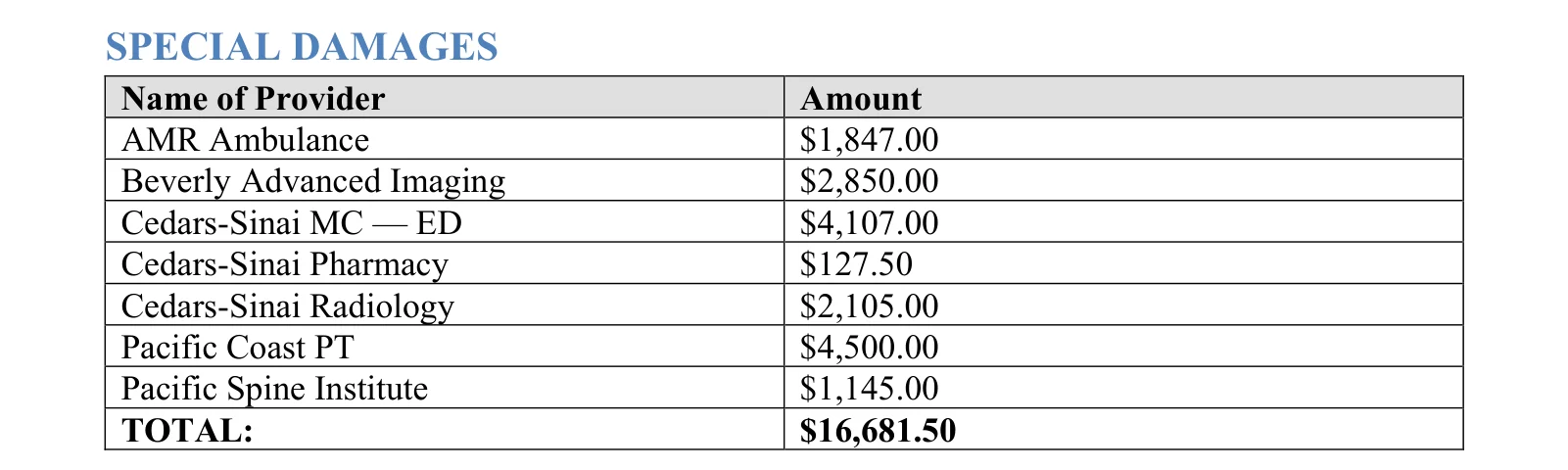
Other states have their own rules. Washington's Patterson v. Horton says a plaintiff may recover the reasonable value of medical services, not the total of all bills paid. New York's CPLR 4545 lets the court reduce an award for costs that were or will be replaced by a collateral source. Check your jurisdiction before you assume the bill is the number. Our sample demand letter shows how the specials table fits in a finished letter.
What Will the Defense Do With an LOP?
Expect the defense to argue that the doctor has a financial stake in the case. The argument is simple: a provider who gets paid only if the plaintiff wins has a reason to find more injury and bill more. In California, Qaadir said this kind of referral evidence "may show bias or financial incentives."
| Defense point | How to prepare |
|---|---|
| "The lawyer sent the client to this doctor" | Know how the referral happened. Don't build a pattern you wouldn't want to explain to a jury |
| "The doctor only gets paid if you win" | Document that the client owes the bill, if that's what the agreement says |
| "The charges are inflated" | Line up reasonable value evidence early |
| "The client had insurance and chose not to use it" | Record the reason in the file, such as a denied service or an access problem |
| "The treatment wasn't necessary" | Tie the care to objective findings in the records |

What Does California's SB 623 Change?
SB 623, signed in 2026, adds Civil Code 3333.9 and regulates lien-based treatment in one kind of case: claims against a rideshare network company, its subsidiary or an app-based driver, from accidents on or after January 1, 2027. Other crash cases aren't covered. Its definition of "medical lien" expressly includes a letter of protection.
If you handle rideshare claims, read the full text. Here's what stands out:
- A cap. Recovery for a lien-based provider's services can't exceed the 70th percentile of FAIR Health billed charges, or a comparable database, for the area.
- Discovery. Arrangements between a lien-based provider and an attorney relating to the treatment or the lien are discoverable.
- A sworn declaration. On request, the provider must state whether the attorney referred the plaintiff, and roughly how many patients that attorney referred in the past 24 months.
- Attorney limits. A contingency attorney can't refer a client to a provider in which they or their immediate family have a direct ownership interest.
Even outside rideshare cases, it shows where this area is going. Set up your LOP files as if the arrangement will be read aloud.
A Checklist for Every LOP File
- Confirm no other payer can cover the care, and note why in the file.
- Read the provider's form, and fix the source-of-payment language.
- Explain the deal to the client, including what happens if the case is lost.
- Get the client's written consent on the document.
- Calendar a review of the balance against case value.
- Collect itemized bills and records as treatment goes on. Our records retrieval guide covers the requests.
- Line up reasonable value evidence before the demand goes out.
- Keep treatment and bills tied together in a medical record summary.
- Get reductions in writing, and put them on the settlement statement.
- Disburse only after the provider's share is paid or the dispute is resolved.
If the balance starts to outrun the case value, raise it with the client early. Our guide to policy limits demands covers cases where the damages exceed coverage. In California, a time-limited demand needs to account for liens as well.
Where Lexyno Fits
Lexyno doesn't draft or review LOPs, and it doesn't decide what a charge is worth. That's the attorney's judgment. Lexyno's AI demand letter software drafts the demand from the case's records, including the special damages table, with source references you can check.
Medical Summary builds the treatment chronology and flags gaps over 30 days. POV reports read the same record from the insurer's side, so you can see where lien bills may be challenged. Plans are on the pricing page.
Sign It Like a Contract, Because It Is One
A letter of protection can be the reason an injured client gets care at all. It can also become a duty you owe, a bill your client owes and a theme for the defense. All three start with the words on that one page.
Read the form, get the client's consent, and build the reasonable value evidence before you need it.
Start the demand from our PI demand letter template, or try Lexyno on one case from your own file, free.
Frequently asked questions
It is a written promise that a medical provider will be paid from the client’s settlement or judgment. The provider treats now and waits for payment. It is usually a contract rather than a statutory lien, so its terms decide who owes what.
It depends on the agreement. Many are written so the client owes the balance win or lose. We did not find a California appellate decision settling the question either way, so read the document and explain it to the client before treatment starts.
Yes, in many cases, but check your state’s rules first. Promising payment from recovered funds with the client’s consent is different from a personal promise to pay. Once you sign, New Jersey says you must honor it, and Washington treats the client’s consent as irrevocable.
Not exactly. A statutory lien comes from a statute, such as California’s Hospital Lien Act, which covers hospitals and affiliated facilities. An LOP comes from an agreement. Both can restrict how you disburse settlement funds, and SB 623 treats an LOP as a medical lien in rideshare cases.
Expect it. In California, Qaadir v. Figueroa said attorney referrals to lien doctors are relevant to reasonable value because they may show bias or financial incentives. Moore v. Mercer said a lien sale agreement may be relevant and discoverable. Assume the defense will see the arrangement.
Not automatically. Past medical damages are the lesser of the amount paid or incurred and the reasonable value of the services. The bill alone is not enough evidence. A plaintiff treating on a lien needs evidence of reasonable value, generally from an expert.
Related posts

Civil Code 3294: Punitive Damages in California PI Cases
A PI guide to Civil Code 3294: malice, oppression and fraud, drunk driving, employer liability, procedure, and how to handle punitive facts in a demand.

Pain and Suffering Settlement Examples: What a Demand Needs
Why pain and suffering settlement examples rarely transfer to your case, and the evidence and demand language that make noneconomic damages credible.

New York No Fault in 2026: Serious Injury After the Reforms
New York no fault and serious injury after the 2026 reforms: the eight categories left, the new fault rules, deadlines, and what it means for your demand.
What's next?
Ready to see the difference in your next case?
Put these strategies to work. Try a mock demand generated by Lexyno today.
Request Evaluation Access