 Rich Martin
Medical Liens in Personal Injury Cases: A Settlement Guide
Medical Liens in Personal Injury Cases: A Settlement Guide
Who can claim your client’s settlement: hospital, Medicare, Medicaid and ERISA liens, the rules in WA, CA, NY and NJ, and how to reduce and clear each one.

The settlement check clears. Your client calls to ask when they'll get their money. Then you open the file and find a hospital lien notice, a letter from Medicare and a recovery vendor for the employer's health plan. Each one wants to be paid first.
Handling medical liens in personal injury cases is the last hard part of a file, and it's where a good settlement can turn into a bad phone call. This guide sorts liens by who holds them, covers the federal rules and the law in Washington, California, New York and New Jersey, and shows how to reduce and clear each one.

What Is a Medical Lien in a Personal Injury Case?
A medical lien is a claim on your client's settlement or judgment for medical care. It may come from a statute, a federal program, a plan document or a signed agreement. The source matters most, because it decides what the holder can collect, whether you can reduce it, and who's exposed if it isn't paid.
| Holder | Source of the claim | First move |
|---|---|---|
| Hospital | State lien statute | Check notice, timing and any cap |
| Treating provider | An agreement, or a state statute | Read the agreement |
| Medicare | Medicare Secondary Payer law | Report the case to the BCRC |
| Medicare Advantage plan | Federal regulation and the plan | Contact the plan directly |
| Medicaid | Federal and state law | Give notice to the state agency |
| Self-funded ERISA plan | The plan document | Request the plan documents |
| Insured health plan | The policy, limited by state law | Check your state's limits |
| Workers' comp carrier | State statute | Get consent before any release |
Federal plans have their own rules. FEHB contracts override state law on reimbursement under Coventry v. Nevils. If your client treated through the VA or TRICARE, check for a federal claim too. LOPs are a separate topic, covered in our letter of protection guide.
How Do You Find the Liens Early?
Ask at intake, and keep asking. Find out whether the client has Medicare, Medicaid, employer coverage or VA benefits, and which hospital treated them. Then check each medical bill for who actually paid. Most surprises with medical liens in personal injury cases come from a payer nobody asked about.
- Coverage on the date of injury and since. A client can turn 65 or qualify for disability during the case.
- Bills and explanations of benefits. They show who paid. Our records retrieval guide covers how to request them.
- Lien notices. Log each one with its date and amount.
- Deadlines. Some notice duties start early. In California, you must notify the state within 30 calendar days of filing a Medi-Cal beneficiary's action.
In no-fault states, the order of payment changes too. See our New York no fault guide and NJ verbal threshold guide for how those benefits work.
How Does a Medicare Lien Work?
Medicare pays conditionally, and federal law makes that payment repayable from any settlement. You report the case, dispute unrelated charges and report the settlement. Medicare then issues a final demand, and the beneficiary or other party must reimburse it within 60 days. Attorneys are exposed if that doesn't happen, so don't treat this as paperwork.
CMS lays out the steps in its recovery process guidance:
- Report the case to the Benefits Coordination & Recovery Center (BCRC).
- Get the Rights and Responsibilities letter, and submit proof of representation.
- Review the Conditional Payment Letter. CMS says it comes within 65 days of the RAR letter.
- Dispute unrelated charges. Allow 45 calendar days for review.
- Report the settlement, with fees and costs.
- Pay the demand within the 60 days, or request a waiver or appeal as the letter explains.
Two details catch firms out. Interest runs from the date of the demand letter, and it's assessed if the debt isn't resolved in the 60-day period. And the first figure isn't final, because payments can be added until the case closes.

Attorney Exposure
Under 42 CFR 411.24(g), CMS has a right of action against "any entity," and the list includes an attorney who received a primary payment. The Ninth Circuit, which covers California and Washington, said in Haro v. Sebelius that an attorney who receives settlement proceeds, "even as an intermediary," has received payment from a primary plan. So paying your fee and sending the rest to the client isn't a safe way out.
The Procurement Cost Reduction
Medicare shares in the cost of getting the recovery. 42 CFR 411.37 sets the formula. Here it is with made-up numbers:
| Step | Example |
|---|---|
| Settlement | $100,000 |
| Fees and costs (procurement costs) | $40,000 |
| Ratio of procurement costs to settlement | 40% |
| Medicare's conditional payments | $10,000 |
| Medicare's share of procurement costs | $4,000 |
| Amount Medicare recovers | $6,000 |
Small Settlements and Medicare Advantage
Some small cases have shortcuts. CMS's 2026 threshold notice says it won't seek recovery on physical trauma-based liability settlements of $750 or less. CMS also lists demand calculation options for settlements up to $10,000 and $25,000, each with its own conditions. Check the current figures before you rely on them.
Medicare Advantage is separate. The BCRC doesn't handle those claims, so you deal with the plan. Under 42 CFR 422.108(f), the plan "will exercise the same rights to recover" that the Secretary exercises. In the Third Circuit, which covers New Jersey, In re Avandia gave a plan a private cause of action.
How Much Can Medicaid Take From a Settlement?
Medicaid can reach only the part of a settlement that represents medical care. Under Ahlborn, a state can't take the rest. Gallardo added that this covers past and future medical care. Each state then sets its own procedure and reductions.
A state also can't simply declare the medical share. Wos v. E.M.A. struck down North Carolina's fixed one-third presumption. So keep a record of how the settlement relates to the medical damages.
| State | Where to look | What stands out |
|---|---|---|
| California | W&I Code 14124.70 and following | Notice within 30 calendar days of filing. No settlement is final without notice to the director. A 25 percent reduction applies for fees when the beneficiary sues alone |
| Washington | RCW 41.05A.070 | The lien bears its proportionate share of attorneys' fees and costs |
| New York | Social Services Law 104-b | Limited to the assistance paid, and subordinate to the attorney's lien |
| New Jersey | N.J.S.A. 30:4D-7.1 | Written notice to the Director. Reimbursement comes with a pro rata deduction for counsel fees and costs |
Does State Law Limit an ERISA Lien?
It depends on how the plan is funded. Under FMC v. Holliday, self-funded ERISA plans are exempt from state regulation, so state anti-subrogation law generally won't help. Insured plans remain subject to state insurance law. Find out which you have before you argue any state rule.
You'll need the documents. Under 29 U.S.C. 1024(b)(4), the plan must furnish the summary plan description, latest annual report and governing instruments on a participant's written request. If it doesn't within 30 days, a court may impose a daily penalty, currently up to $110.
Two Supreme Court cases then shape the negotiation. US Airways v. McCutchen held that equitable rules can't "override the clear terms of a plan," but the common-fund doctrine fills in when the plan is silent on fees. Montanile held a plan can't reach the participant's general assets once a settlement is wholly spent on nontraceable items. That isn't a strategy for you to advise, because funds you hold with notice of the claim are a different problem.
For insured plans, state law can do a lot of work:
| State | Rule | Effect |
|---|---|---|
| California | Civil Code 3040 | Caps covered plan liens. With an attorney, the cap is one-third of the moneys due the enrollee, with a pro rata fee reduction. It doesn't reach a plan lien preempted by federal law |
| Washington | Thiringer, Mahler | The insurer recovers only after the insured is fully compensated, and shares in the cost of recovery |
| New York | GOL 5-335 | A settlement is conclusively presumed not to include these costs, with exceptions such as Medicare and Medicaid. Wurtz held it saved from ERISA preemption as an insurance law |
| New Jersey | Perreira v. Rediger | A health insurer can't recoup from the settlement under the collateral source statute. ERISA preempts that rule for some plans, so check yours |
What Are the Hospital Lien Rules in Each State?
Each served state has its own statute, and they differ on who can file, how much they can take and what notice they must give. A hospital lien is only as good as its compliance with the statute, so check the notice and the math before you pay. Don't assume the amount on the notice is the amount owed.
| State | Who it covers | Limit | Notice or filing |
|---|---|---|---|
| California (Civ. Code 3045.1-.6) | Hospitals and affiliated facilities | Reasonable and necessary charges, out of 50 percent of the moneys due after prior liens | Written notice before payment. One year to sue a payor |
| Washington (RCW 60.44) | Ambulance services, hospitals, nurses, practitioners, physicians, surgeons | All liens together, 25 percent of the settlement or award | File with the county auditor. Suit within one year of filing |
| New York (Lien Law 189) | Charitable, SUNY and municipal hospitals | Reasonable charges at cost rates. No percentage cap. Subordinate to the attorney's lien | Notice under the statute. Excludes settlements of $300 or less |
| New Jersey (N.J.S.A. 2A:44-35 and following) | Hospitals, nursing homes, physicians, dentists | Physician and dentist liens capped at 25 percent | File with the county clerk, no later than 90 days after first treatment. Confirm the current text |
California adds a useful check. In Parnell v. Adventist Health, the Supreme Court said an HLA lien "requires the existence of an underlying debt owed by the patient to the hospital." If the hospital accepted a health plan's payment in full, ask what debt is left.

Should You Know the Liens Before You Send a Demand?
Yes. Your offer has to make sense after the liens come out. In California, a time-limited demand under CCP 999.1 needs a clear offer to settle all claims within policy limits, "including the satisfaction of all liens." You can't offer that if you don't know what they are.
That's true for any demand. A policy limits offer can leave the client with little if the liens are large, so run the numbers first. Our guides to CCP 999 demands and policy limits demands cover the rest of that decision.
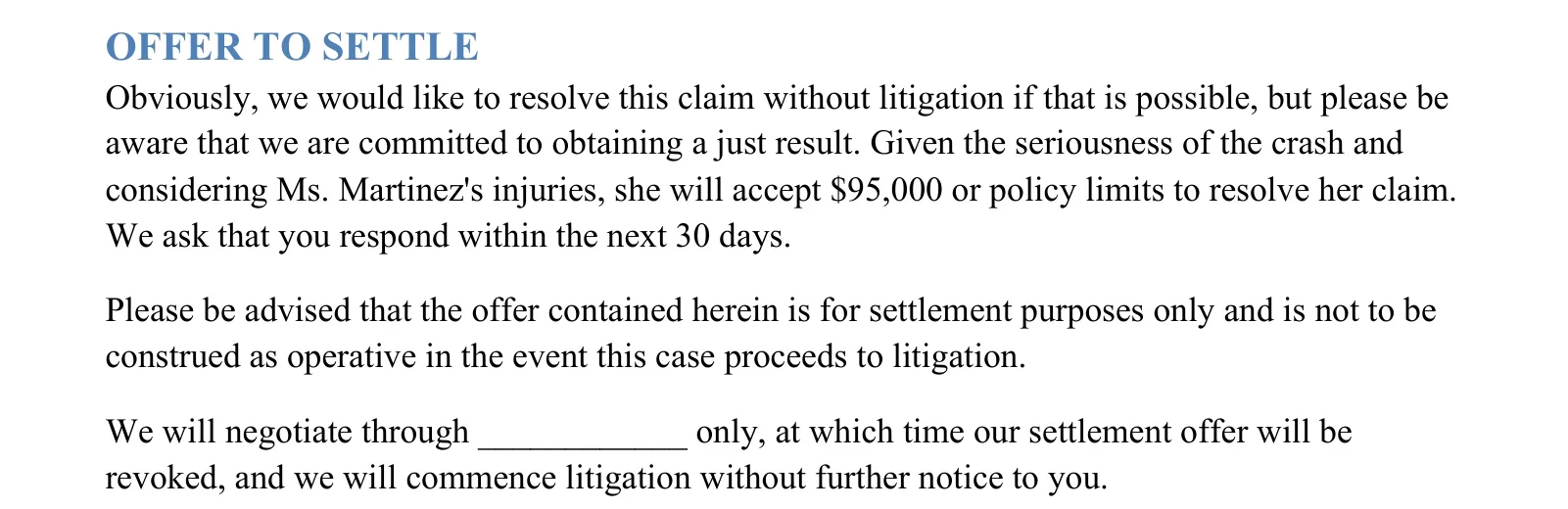
The carrier will have questions of its own, including your client's Medicare status. It has its own federal reporting duties, and that's usually why it asks. Build the answer into your demand letter sections so it doesn't hold up payment.
How Do You Reduce a Medical Lien?
Start with the math, not the ask. Audit the claim for charges unrelated to the injury, then apply the statutory caps and fee reductions the holder must accept. Only after that ask for a voluntary reduction. Most holders respond better to a specific, documented request than to a general plea.
- Unrelated charges. Compare every line to the injury. Our medical record summary guide shows how to build the record you'll compare against.
- Fee and cost reductions. Medicare's procurement formula, Medi-Cal's 25 percent, common fund language in a plan.
- Statutory caps. California's 50 percent and Civil Code 3040, Washington's 25 percent.
- Legal limits. Ahlborn, made-whole rules in Washington, GOL 5-335 in New York.
- Hardship. Medicare has a waiver process. Other holders may compromise.
- Policy limits. Show the holder that the available coverage was the real ceiling.
Get every reduction in writing, from someone with authority to give it.
A Checklist Before You Disburse
- List every holder, with source, amount and contact.
- Confirm the final figure in writing from each one.
- Check that your release doesn't promise more than you can deliver on liens.
- Hold the disputed amounts in trust, and pay out what's undisputed.
- Show each lien and reduction on the settlement statement your client signs.
- Pay the holders, and keep the proof of payment and any lien release.
Your ethics rules back this up. New Jersey's ACPE Opinion 748 says a lawyer must honor valid and undisputed statutory liens, including those under ERISA, Medicare, Medicaid and workers' compensation laws. For workers' comp, watch the consent rule: in California, Labor Code 3859 makes a release invalid without both parties' written consent. Our guide to the records to settlement workflow shows where liens fit in the whole file.
Where Lexyno Fits
Lexyno doesn't track, negotiate or resolve liens, and it doesn't tell you what's owed. That work stays with your firm. Lexyno's AI demand letter software drafts the demand from the case's records, including the special damages table, with source references you can check.
Medical Summary builds the treatment chronology, which helps when you compare a lien's charges to the injury. POV reports read the same record from the insurer's side. Plans are on the pricing page.
The Settlement Isn't Done Until the Liens Are
Medical liens in personal injury cases come from different places, follow different rules and carry different risks. Sort them by source, start early, and put every figure in writing.
Your client will remember the check they took home, not the gross number.
Start the demand from our PI demand letter template, see our car accident sample, or try Lexyno on one case from your own file, free.
Frequently asked questions
It is a claim on the client’s settlement or judgment for medical care. It can come from a statute, as with hospitals, Medicare and Medicaid, from a plan document, as with ERISA plans, or from an agreement, as with a letter of protection.
Federal regulations say a beneficiary or other party who receives a primary payment must reimburse Medicare within 60 days. Interest runs from the date of the demand letter and is assessed if the debt is not resolved within the 60-day period in the letter.
Yes. CMS has a right of action to recover from any entity that received a primary payment, and the regulation names attorneys. In Haro v. Sebelius, the Ninth Circuit said an attorney who receives settlement proceeds, even as an intermediary, has received payment from a primary plan.
No. Under Ahlborn, the state can reach only the part of a settlement that represents medical care. Gallardo added that this includes past and future medical care. Each state sets its own procedure and reductions, so check yours.
Often, but the leverage depends on the plan. A self-funded plan is generally free of state anti-subrogation law, and McCutchen says clear plan terms control. If the plan is insured, state law may limit it. Get the plan documents before you negotiate.
You should at least know them. In California, a time-limited demand under CCP 999.1 must offer to settle all claims within limits, including the satisfaction of all liens. Knowing the liens also tells you what the client will actually take home.
Related posts

Letter of Protection in Personal Injury: Uses and Risks
A letter of protection gets a client treated now, but your signature carries duties. What to put in an LOP, how the bills count, what each state requires.

Civil Code 3294: Punitive Damages in California PI Cases
A PI guide to Civil Code 3294: malice, oppression and fraud, drunk driving, employer liability, procedure, and how to handle punitive facts in a demand.

Pain and Suffering Settlement Examples: What a Demand Needs
Why pain and suffering settlement examples rarely transfer to your case, and the evidence and demand language that make noneconomic damages credible.
What's next?
Ready to see the difference in your next case?
Put these strategies to work. Try a mock demand generated by Lexyno today.
Request Evaluation Access